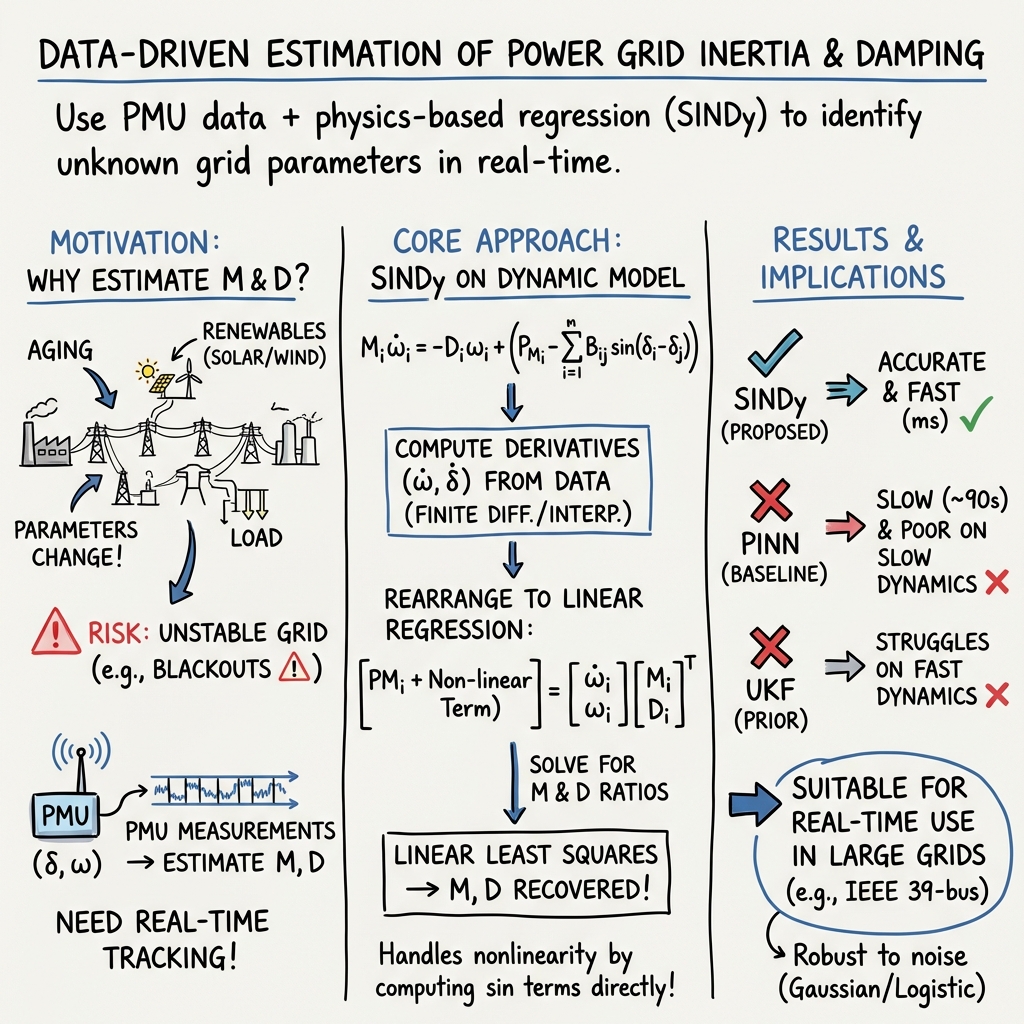
- The paper presents a novel SINDy algorithm for efficient and robust grid parameter estimation, accurately characterizing inertia and damping in non-linear systems.
- Numerical simulations on IEEE bus systems reveal that SINDy achieves superior computational efficiency and accuracy compared to UKF and PINN under varied dynamic conditions.
- The study underscores practical implications for real-time grid monitoring and decentralized control, paving the way for future advancements in power system resilience.
A Comparison of Data-Driven Techniques for Power Grid Parameter Estimation
Introduction
The accurate estimation of power grid model parameters, such as inertia and damping coefficients, is critical for ensuring the reliability and safety of power grid operations. These parameters can vary due to system aging, operational changes, and the integration of renewable energy sources. Traditional methods like Kalman filters often struggle in the presence of non-linearity and fast dynamics. This paper introduces and evaluates a novel algorithm for parameter estimation based on the Sparse Identification of Nonlinear Dynamics (SINDy) approach, comparing its efficacy against existing methods like the Unscented Kalman Filter (UKF) and Physics-Informed Neural Networks (PINN).
Methodology
Sparse Identification of Nonlinear Dynamics (SINDy)
The proposed SINDy algorithm utilizes linear regression to deduce the parameters that best characterize observed power grid dynamics. It utilizes the system model's known differential equations to derive a regression problem for parameter estimation. The SINDy approach is advantageous due to its ability to handle high non-linearity with computational efficiency, allowing for real-time application. By constructing a candidate library of linear and non-linear functions of observed states, the system parameters can be estimated via a sparse regression framework, yielding efficient and accurate parameter estimates.
Benchmark Techniques
Two prominent benchmark techniques are compared against SINDy:
- Unscented Kalman Filter (UKF): Known for joint state and parameter estimation, this approach faces challenges with non-linear systems and low-inertia scenarios, resulting in significant estimation errors under fast dynamic conditions.
- Physics-Informed Neural Networks (PINN): This method leverages deep learning to incorporate physical laws into the NN training process. While it effectively addresses non-linearities, its computational demand and slower dynamic handling in high-inertia systems present practical limitations, particularly for real-time applications.
Numerical Results
Extensive simulations using IEEE bus systems reveal that the SINDy algorithm consistently performs well across various system parameter settings. The method outperforms PINN and UKF by delivering more accurate estimates and faster computation times. For example, while both SINDy and PINN effectively estimated parameters for systems with fast dynamics, SINDy showed a distinct advantage in computational efficiency and performance against slow system dynamics, where PINN estimation errors increased significantly due to NN training challenges.
Practical Implications and Future Work
The SINDy algorithm's real-time capability and adaptability to non-linear models represent a pragmatic advancement for operational power systems, particularly given its decentralized implementation potential. Future work will focus on optimizing PMU placement for enhanced system observability and extending the approach to more complex generator models. The integration of SINDy in dynamic grid control applications promises improved grid stability by enabling rapid parameter recalibration in response to operational changes.
Conclusion
In conclusion, the research underscores SINDy's potential as a credible alternative for efficient and robust power grid parameter estimation. Its compatibility with non-linear systems and suitability for real-time applications mark it as a valuable tool in the evolving landscape of power system operations. This study lays the groundwork for future developments, facilitating enhanced resilience and adaptability in power grid management.