Birkhoff Normal Form and Twist Coefficients of Periodic Orbits of Billiards
Published 27 Aug 2021 in math.DS | (2108.12098v3)
Abstract: In this paper we study the Birkhoff Normal Form around elliptic periodic points for a variety of dynamical billiards. We give an explicit construction of the Birkhoff transformation and obtain explicit formulas for the first two twist coefficients in terms of the geometric parameters of the billiard table. As an application, we obtain characterizations of the nonlinear stability and local analytic integrability of the billiards around the elliptic periodic points.
The paper presents explicit formulas for the first two twist coefficients, linking boundary curvature and its derivatives to the nonlinear stability of periodic billiard orbits.
It employs Birkhoff normal form to linearize dynamics near elliptic orbits and distinguishes between symmetric and asymmetric billiards for detailed stability analysis.
The study provides practical insights into predicting bifurcations and resonances, offering a robust framework for assessing local integrability in billiard systems.
Birkhoff Normal Form and Twist Coefficients of Periodic Orbits of Billiards
Introduction and Context
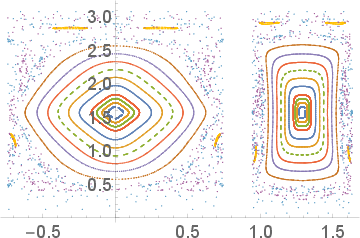
This paper presents a comprehensive treatment of Birkhoff normal forms and twist (Birkhoff) coefficients for periodic orbits in planar billiard systems, with an emphasis on rigorous and explicit computation of the first two twist coefficients in terms of boundary geometry. The dynamics near elliptic periodic orbits are linearizable to leading order, but their nonlinear features, notably the nature of nonlinear stability and local integrability, depend on twist coefficients. The analysis is carried out both for symmetric billiards (identical focusing components at each bounce) and for the general asymmetric case. Key results are illustrated on classical examples including lemon- and ellipse-related billiards.
Birkhoff Normal Form and Twist Coefficient Formalism
Given a symplectic (area-preserving, orientation-preserving) planar map f with an elliptic fixed point or periodic orbit, a formal Birkhoff normalization yields local coordinates in which f is conjugate to a nonlinear rotation: hN−1∘f∘hN(x)=RΘ(r2)x+O(r2N+2)
where RΘ(r2) is a rotation by an angle function Θ(r2)=θ+τ1r2+τ2r4+…. The coefficients τj (first and second twist coefficients, etc.) encode the variation of the rotation number with the action and are central to nonlinear stability analysis. Nonresonance conditions on eigenvalues are imposed to avoid small denominators or lack of formal invertibility in the normalization.
The explicit formulas derived in this paper for τ1 and τ2 provide a direct link between dynamical properties and geometric derivatives (specifically, local curvature and its higher derivatives evaluated at the impact points) of the boundary.
Explicit Computation for Symmetric Billiards
The approach starts from the Taylor expansion of the billiard map in a local coordinate system. For symmetric billiards (identical radii of curvature at corresponding points), the linear part at a 2-periodic orbit gives the classification of stability as a function of the ratio L/R (trajectory length over curvature radius):
Hyperbolic: L/R>2
Parabolic: L/R=2
Elliptic: $0 < L/R < 2$
The twist coefficients are shown to be homogeneous under domain scaling, with deg(τj)=−j.
The main explicit results for the first and second twist coefficients (under nonresonance) are:
Figure 2: The asymmetric lemon billiards Q(r,B+,R), illustrating the construction and the family of orbits analyzed for twist coefficients and stability.
These expressions explicitly show the dependence on curvature and higher derivatives, with the sign and vanishing of the twist coefficients dictating nonlinear stability (KAM-type stability).
Applications and Stability Results
The authors provide an extensive suite of applications, demonstrating the machinery on several canonical billiards:
Elliptic billiard: Along the minor axis, the first twist coefficient τ1=2b is never zero, confirming classical integrability.
Lemon billiard: When L/R=1, resonant obstructions arise (i.e., c03=0 blocks normalization), and the system fails to be locally analytically integrable.
Asymmetric tables: For billiards with different curvature at each bounce point, generalizations of the formula for τ1 and τ2 are provided, with a detailed polynomial structure involving higher derivatives and geometric invariants. The zero loci and pole structure (where normalization fails) are explicitly analyzed and characterized.
These concrete computations allow determination of nonlinear stability for each parameter set via the sign and non-vanishing of twist coefficients, implementing the Moser twist mapping theorem. The bifurcation analysis via vanishing twist coefficients is also formalized, including special, explicitly solvable cases.
Generalization: Asymmetric Billiards and the Structure of Higher Twist Coefficients
The generalization to asymmetric billiards is significant due to the complexity of the resulting expressions. The authors derive the Taylor expansion with respect to arc-length and angle coordinates, solve the nonlinear homological equations for normalization, and explicitly express the second twist coefficient τ2 through sizable polynomials in L, R0, R1 and their higher derivatives up to fourth order, identifying the homogeneous polynomial structure and providing an explicit decomposition (presented as an ansatz).
Special care is taken for resonant cases (where eigenvalues satisfy λn=1), as these yield poles in the expressions or block the existence of normalization altogether—a phenomenon explicitly analyzed for the lemon and lens billiards.
Implications and Theoretical Advances
The explicit normal form calculation goes well beyond traditional perturbative analysis in billiards and Hamiltonian systems. It allows:
An algebraic description of nonlinear stability for generic billiard tables.
Explicit identification of parameter regimes where local analytic integrability is impossible.
Strong predictions for bifurcations as geometric parameters are varied.
Analysis of how twist coefficients transform under scaling or domain perturbation.
On the theoretical front, the work rigorously connects geometry (via boundary curvature and its derivatives) to local dynamical invariants, delineating when nonlinear stability (or break-up of KAM tori) occurs and under what precise geometric restrictions resonances or vanishing twist coefficients intervene. The explicit characterization of the "poles" obstructing Birkhoff normalization sharpens our understanding of analytic obstructions.
Relation to Classical and Modern Literature
The paper extends insights from Birkhoff, Moser, Meyer, Moeckel, and the billiards literature (Kamphorst, Pinto-de-Carvalho, Dias Carneiro, et al.), providing not only improved formulas where previously only qualitative or lower-order statements were available, but also optimal accuracy in comparisons (e.g., comparison with Ko{\l}odziej's formula for rotation numbers up to 4th-order).
Potential and Directions for Future Work
This framework is immediately applicable for spectral investigations (relating quantum and classical billiards), for fine-grained control of stability islands in generic billiards, and for symmetry-breaking bifurcations. The explicit nature of higher-order twist formulae invites numerical and algebraic experimentation in diverse billiard geometries, including those relevant to optics, material science, and mathematical physics.
Specific directions include:
Extending explicit normal form calculations to non-Euclidean and higher-dimensional billiards.
Numerical studies of the breakup of invariant curves using higher twist coefficients.
Study of global obstructions (matching twist coefficients to arithmetics such as the Brjuno or Diophantine condition).
Rigorous computer-aided proof frameworks using the explicit recursions for higher-order derivatives.
Conclusion
This work provides a systematic, explicit, and highly technical approach for understanding the nonlinear stability and local integrability of periodic orbits in billiard systems, connecting the deep algebraic structure of Birkhoff normal form with concrete geometric data. It advances the capacity for both theoretical and applied investigation of dynamical billiards by furnishing precise, closed-form formulae for the first two twist coefficients and mapping the landscape of resonances and nonlinear phenomena, establishing both a toolkit and a reference point for further study.