- The paper develops a dual-component model using a Poisson process and a generalized Pareto distribution to capture disaster frequency and severity.
- It employs maximum likelihood estimation with data from EM-DAT, the World Bank, and IPCC SSPs to link CO₂ emissions and regional GDP per capita to disaster outcomes.
- Projections under sustainability and business-as-usual scenarios underscore the critical role of climate policy and economic growth in mitigating future death tolls.
Introduction
The paper "Climate-Related Disasters and the Death Toll" develops a quantitative framework to model and project the frequency and severity of climate-related disasters using econometric methods. It explores how changes in climate conditions and socioeconomic factors affect the occurrence and impact of disasters globally.
Model Specification
The core of the paper’s contribution is a dual-component model consisting of:
- Poisson Process for Disaster Frequency: It models the frequency of climate-related disasters as a Poisson process, where the rate parameter is influenced by aggregate CO₂ emissions. Higher emissions are hypothesized to increase disaster frequency.
- Generalized Pareto Distribution for Disaster Severity: The severity, defined as the number of deaths per disaster, follows a generalized Pareto distribution (GPD). The parameters of the GPD are linked to regional GDP per capita, suggesting an inverse relation between economic development and disaster severity.
These components are integrated to forecast death tolls under different climate scenarios.
Data and Methodology
The study employs data from the Emergency Events Database (EM-DAT) and incorporates socioeconomic and climate data from the World Bank and IPCC's Shared Socioeconomic Pathways (SSPs). The paper emphasizes the use of econometric techniques to isolate the effects of covariates on the frequency and severity of disasters. The Poisson and GPD models are fitted with parameters estimated using maximum likelihood approaches.
Projections and Scenarios
The paper explores two distinct scenarios:
- Scenario SSP1 (Sustainability): Involves low emissions, high economic growth, and effective climate policy measures. Projections under SSP1 suggest a potential reduction in both frequency and severity of disasters over time due to substantial economic growth and climate change mitigation.
- Scenario SSP3 (Business as Usual): Relies on continued high emissions and minimal socioeconomic progress. The projections indicate a significant increase in both the frequency of disasters and potential death toll, especially in regions with low GDP growth.
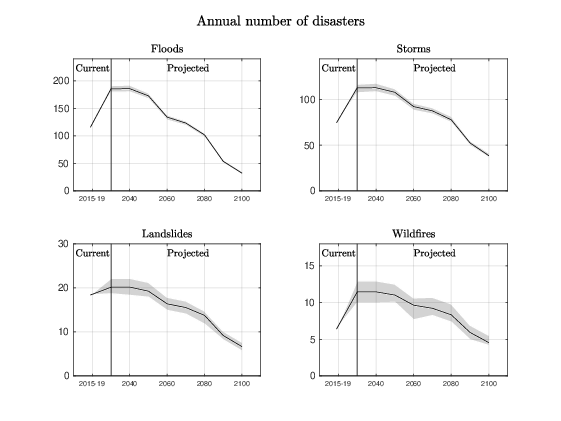
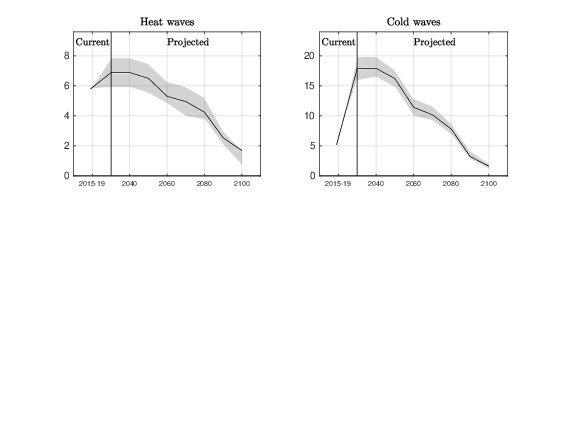
Figure 1: Number of disasters per year -- World -- Scenario SSP1.
Numerical Results
- In SSP1, the frequency of floods is expected to peak around 2040 and then decrease due to effective climate policies reducing CO₂ emissions. The severity (deaths per disaster) should significantly decrease due to enhanced GDP per capita and improved disaster risk management.
- Conversely, under SSP3, a substantial increase in the number of disasters is observed, with significant death tolls, particularly in underdeveloped regions, emphasizing the detrimental potential of inaction.
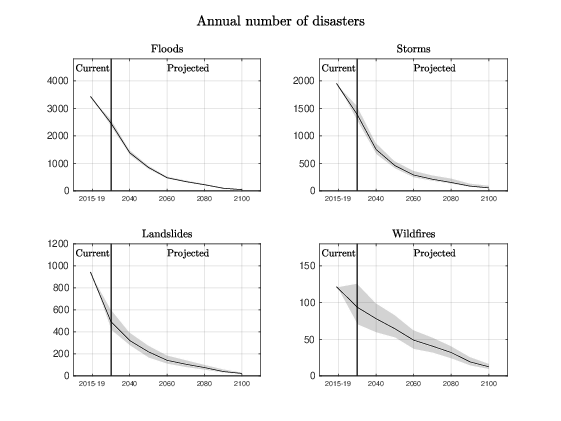
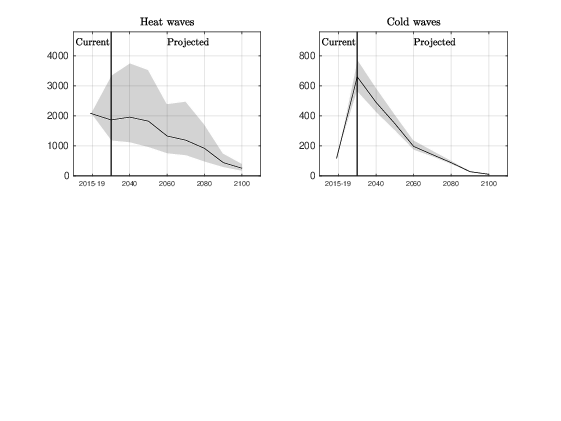
Figure 2: Annual number of deaths -- World -- Scenario SSP1.
Dependence and Correlation
The study also explores analyzing dependencies among disaster types to understand compound disaster events better. The correlation studies for disaster numbers and severities show significant dependencies between certain types (e.g., floods and storms), which can exacerbate impacts.
Implications
The findings underscore the impact of policy decisions on the future landscape of disaster risk. Proactive climate action and investment in economic development can substantially mitigate the impacts of climate-related disasters. Meticulous disaster risk management aligned with economic growth is crucial in minimizing future death tolls.
Conclusion
The paper provides a robust statistical framework to project and understand the implications of climate change on natural disaster occurrences and their severities. The contrasts drawn between scenarios reveal the critical importance of sustainable practices and economic resilience in combating the challenges posed by climate-related disasters. The study ultimately serves as a vital tool for policymakers to devise strategies preventing excessive future human tolls.
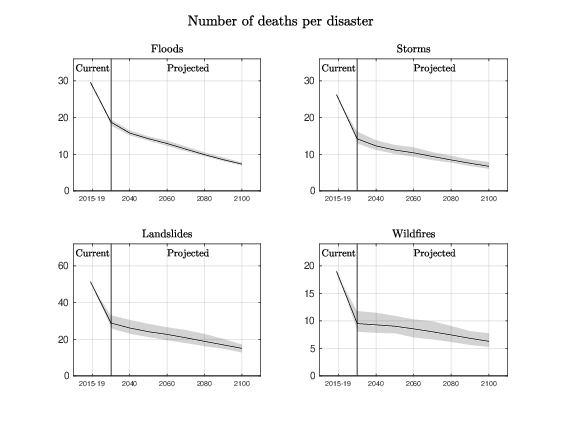
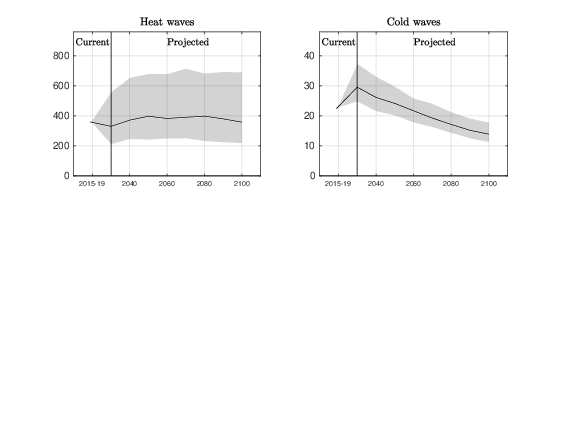
Figure 3: Number of deaths per disaster -- World -- Scenario SSP3.