- The paper introduces an analytic model that predicts superbubble evolution via clustered supernovae, delineating four outcome regimes based on gas fraction and dynamical time.
- It employs momentum injection methods and phase-space boundaries validated by observations of local NGC galaxies and high-redshift SMGs.
- The study quantifies feedback momentum deposition and turbulence driving scales, clarifying conditions necessary for galactic wind initiation.
Analytic Model of Clustered Supernova Feedback: Predictive Framework for Galactic Wind Dynamics
Model Construction and Superbubble Outcomes
The paper formulates an analytic model for the evolution of superbubbles generated via spatially and temporally clustered core-collapse SNe within galactic disks. The model leverages clustered star formation in marginally stable GMCs with efficiencies derived from local gas surface densities. Superbubble growth is modeled through momentum injection, tracking expansion until either stalling/fragmenting within the ISM or breaking out to drive galactic winds and fountains. Outcomes are partitioned via two fundamental local parameters: the gas fraction (f~g) and inverse dynamical time (Ω). Four outcome regimes are delineated:
- Powered Break-out (PBO): Bubble reaches disk scale height prior to cessation of SNe.
- Coasting Break-out (CBO): Unpowered bubble reaches scale height post-SNe.
- Powered Stall (PS): Stalling occurs before SNe cease.
- Coasting Fragmentation (CF): Fragmentation post-SNe, with radius below scale height.
The phase-space boundaries (Figure 1) are derived from parametric constraints on f~g and Ω and reproduce the evolution outcomes of superbubbles in stratified turbulent disks observed in simulations, including realistic ISM turbulence and feedback timescales.
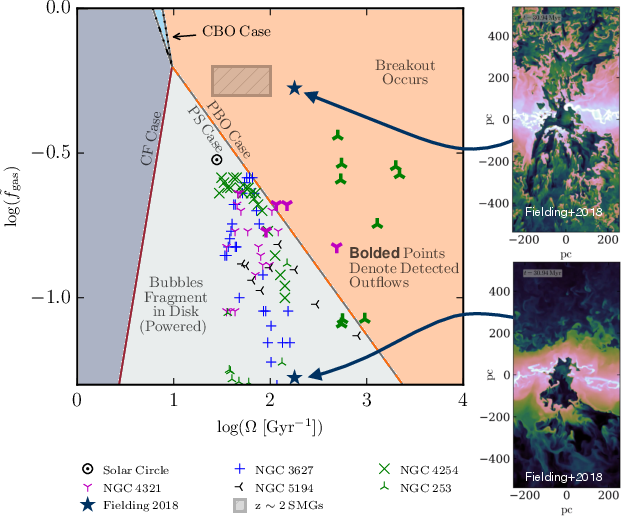
Figure 1: Gas fraction--dynamical time phase space for superbubble outcomes, with observational and simulation data validating model case boundaries.
Empirical Validation: Local and High-Redshift Galaxies
Comparison to observations is systematically executed using spatially resolved data for molecular and atomic gas, stellar surface density, and rotation curves from local NGC galaxies and the Solar Circle. The analytic case boundaries are in agreement with empirical detection (or non-detection) of outflows, notably in NGC 253 and 4321. The model further incorporates high-z SMGs using rotation curve and gas fraction data, demonstrating that nearly all z∼2 galaxies are in the PBO regime. This predicts universality of SNe-driven outflows at cosmic noon, aligning with observed wind ubiquity.
Unexpectedly, the stalling and fragmentation boundary for local star-forming galaxies aligns closely with gas disk scale height, implying turbulence driving mechanisms at this scale. Superbubble fragmentation and momentum deposition are quantitatively reproduced in simulations, directly confirming the analytic predictions.
Turbulence Driving Scales and Feedback Momentum Deposition
A critical result is the prediction of the fragmentation radius (Rb/H) and effective feedback strength (P/m⋆) deposited locally (Figure 2). For local universe disks, fragmentation occurs very near scale height (Rb/H≳0.7), reinforcing a scenario in which SN feedback is the dominant ISM turbulence driver at large scales. The model estimates momentum deposition efficiency, revealing that only ∼10% of feedback momentum from central starbursts is retained in the ISM for cases like NGC 253; by contrast, z∼2 galaxies capture 20-50%, indicating a strong redshift dependence in feedback-regulated ISM evolution.
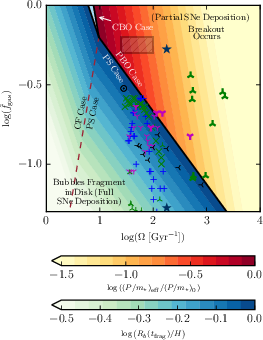
Figure 2: Fragmentation radius as fraction of disk scale height and momentum deposition efficiency as functions of gas fraction and dynamical time.
HI Bubble Observations and Remnant Interpretation
The model is further tested via observed HI bubble radii and expansion velocities across local star-forming galaxies (Figure 3). The analytic predictions organize bubbles in vb/σ--Rb/H space, separating those destined to fragment from those likely to break out. The majority of intact HI bubbles in local galaxies are shown to fragment within the ISM, except for those in central regions characterized by short dynamical times (tdyn<20 Myr), consistent with nuclear origin of break-out events.
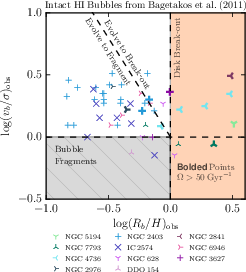
Figure 3: Observed properties of intact HI bubbles, demonstrating modeled fragmentation/break-out division within disk environments.
An alternative scenario assuming constant star cluster formation efficiency per Toomre mass is evaluated and empirically refuted (Figure 4). The model with constant efficiency fails to reproduce central outflows in high surface density regions, strongly contradicting observations of starburst-driven winds in both high-redshift SMGs and local circumnuclear disks. This result supports cluster formation scaling with gas surface density as necessary for physically realistic feedback models.
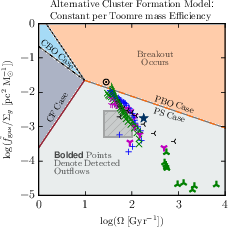
Figure 4: Case boundaries for constant cluster formation efficiency; observations favor the analytic model over the Toomre-mass scenario.
Conclusion
The analytic framework effectively encapsulates clustered SNe feedback mechanisms, predicting superbubble property evolution and outcome regimes as functions of gas fraction and dynamical time. It is validated against observations and simulations, accurately describing turbulence driving scales, momentum deposition, and conditions for galactic wind genesis—in both local and high-redshift galaxies. The model's exclusion of constant cluster formation efficiency is justified by empirical contradiction. The theoretical advance has direct implications for sub-grid feedback prescriptions in galaxy simulations and for interpreting resolved turbulent ISM structures. Future spatially resolved, multi-phase studies are anticipated to further constrain the parameterization of feedback and superbubble scaling relations under varying galactic conditions.