Published 28 Nov 2021 in cs.SI and cs.CY | (2111.14020v2)
Abstract: The proliferation of social media platforms, recommender systems, and their joint societal impacts have prompted significant interest in opinion formation and evolution within social networks. We study how local edge dynamics can drive opinion polarization. In particular, we introduce a variant of the classic Friedkin-Johnsen opinion dynamics, augmented with a simple time-evolving network model. Edges are iteratively added or deleted according to simple rules, modeling decisions based on individual preferences and network recommendations. Via simulations on synthetic and real-world graphs, we find that the combined presence of two dynamics gives rise to high polarization: 1) confirmation bias -- i.e., the preference for nodes to connect to other nodes with similar expressed opinions and 2) friend-of-friend link recommendations, which encourage new connections between closely connected nodes. We show that our model is tractable to theoretical analysis, which helps explain how these local dynamics erode connectivity across opinion groups, affecting polarization and a related measure of disagreement across edges. Finally, we validate our model against real-world data, showing that our edge dynamics drive the structure of arbitrary graphs, including random graphs, to more closely resemble real social networks.
The paper demonstrates that local edge dynamics, merging confirmation bias with friend-of-friend recommendations, are key drivers of opinion polarization.
It extends the Friedkin-Johnsen model by incorporating time-evolving networks and provides closed-form expressions for polarization changes using effective resistances.
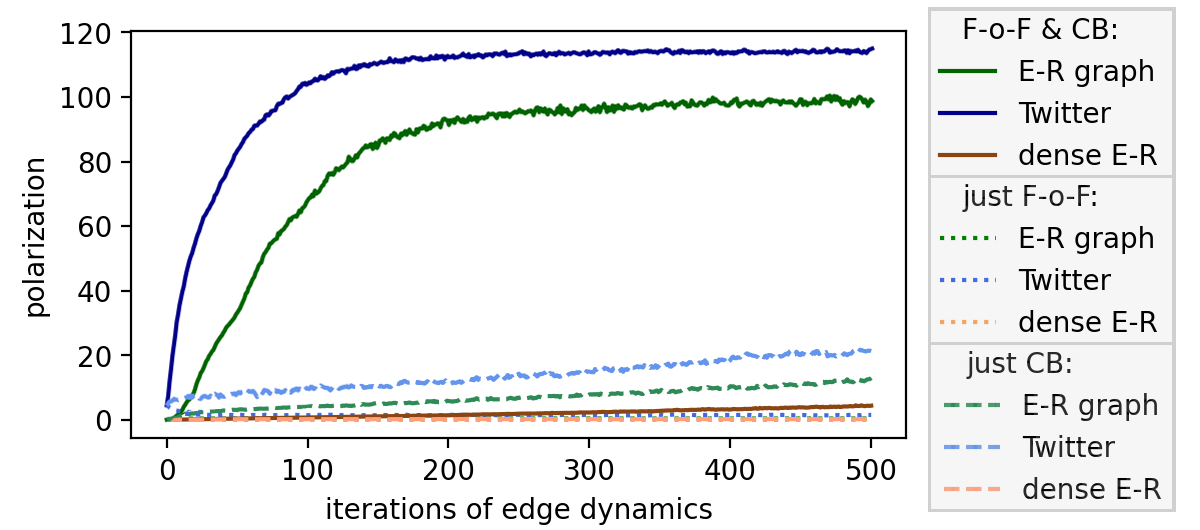
Empirical simulations on synthetic and real-world networks reveal that both bias-driven edge removal and FoF recommendations are necessary for rapid polarization, with network density modulating the effect.
Local Edge Dynamics and the Emergence of Opinion Polarization
Introduction and Motivation
This work addresses the coevolution of social network structure and opinion polarization, focusing on the interplay between local edge dynamics—specifically, confirmation bias and friend-of-friend (FoF) recommendations—and the evolution of opinions. The study extends the Friedkin-Johnsen (FJ) model by introducing time-evolving network topologies, where edges are iteratively added or removed based on local rules reflecting both individual preferences (confirmation bias) and algorithmic recommendations (FoF). The central question is how these local edge dynamics, which are ubiquitous in online social platforms, drive the emergence and persistence of polarization.
Model Formulation
The model consists of n agents connected by an undirected graph G with Laplacian L. Each agent i has a fixed innate opinion s(i)∈[−1,1] and an expressed opinion z(i), which evolves according to the FJ update:
z(i):=1+∑jwijs(i)+∑jwijz(j)
where wij is the (unweighted) adjacency matrix entry. The equilibrium is z=(I+L)−1s.
Edge dynamics are as follows:
At each time step, a fraction p of non-fixed edges are removed, with removal probability proportional to ∣z(i)−z(j)∣ (confirmation bias).
An equal number of edges are added, either uniformly at random (control) or preferentially between friend-of-friends (FoF recommendation).
A small fraction of edges are fixed at initialization, modeling exogenous ties (e.g., family, coworkers) that are not subject to deletion.
The primary observables are:
Polarization: variance of z, P(L,s)=zTz/n.
Disagreement: sum of squared differences across edges, D(L,s)=∑(i,j)∈E(z(i)−z(j))2.
Theoretical Analysis
Edge Operations and Polarization Dynamics
The authors derive closed-form expressions for the change in polarization plus disagreement (PD) under single edge addition/removal using the Sherman-Morrison formula. For an edge (u,v) with expressed opinion difference δ=z(u)−z(v) and effective resistance ruv:
Addition: PD(L+E)=PD(L)−δ2/(1+ruv)
Removal: PD(L−E)=PD(L)+δ2/(1−ruv)
This quantifies the monotonic effect of removing disagreeable edges and adding agreeable ones, showing that such swaps increase PD and, under typical conditions, polarization.
Stochastic Block Model (SBM) Approximation
The network is coarsely approximated as a two-block SBM, with in-group and out-group connection probabilities p and q. The polarization and disagreement in the SBM can be computed in closed form:
P(Lˉ,sˉ)=(qn+1)2n,D(Lˉ,sˉ)=(qn+1)2qn2
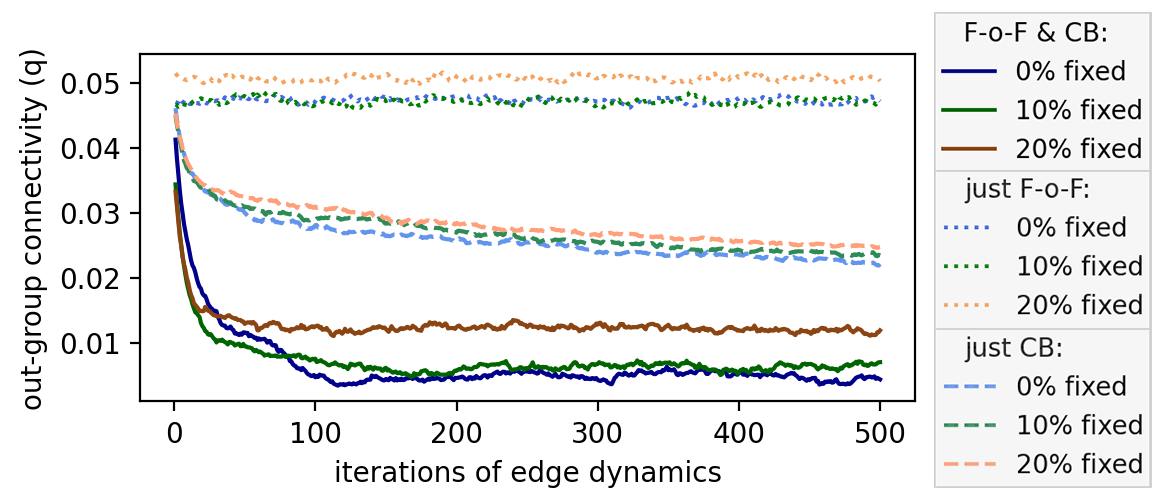
This reduction demonstrates that the evolution of polarization is governed primarily by the decay of out-group connectivity q.
Empirical Results
Drivers of Polarization
Simulations on both synthetic (Erdős-Rényi, Barabási-Albert) and real-world (Twitter, Facebook, Reddit) networks reveal that both confirmation bias and FoF recommendations are necessary for rapid and substantial polarization. Removing either dynamic (i.e., using random edge addition or removal) suppresses polarization, even in the presence of the other.
Figure 1: Opinion polarization over time for an Erdős-Rényi graph, a real-world Twitter network, and a dense ER graph. Only the combination of confirmation bias and FoF recommendations yields significant polarization.
Role of Network Density
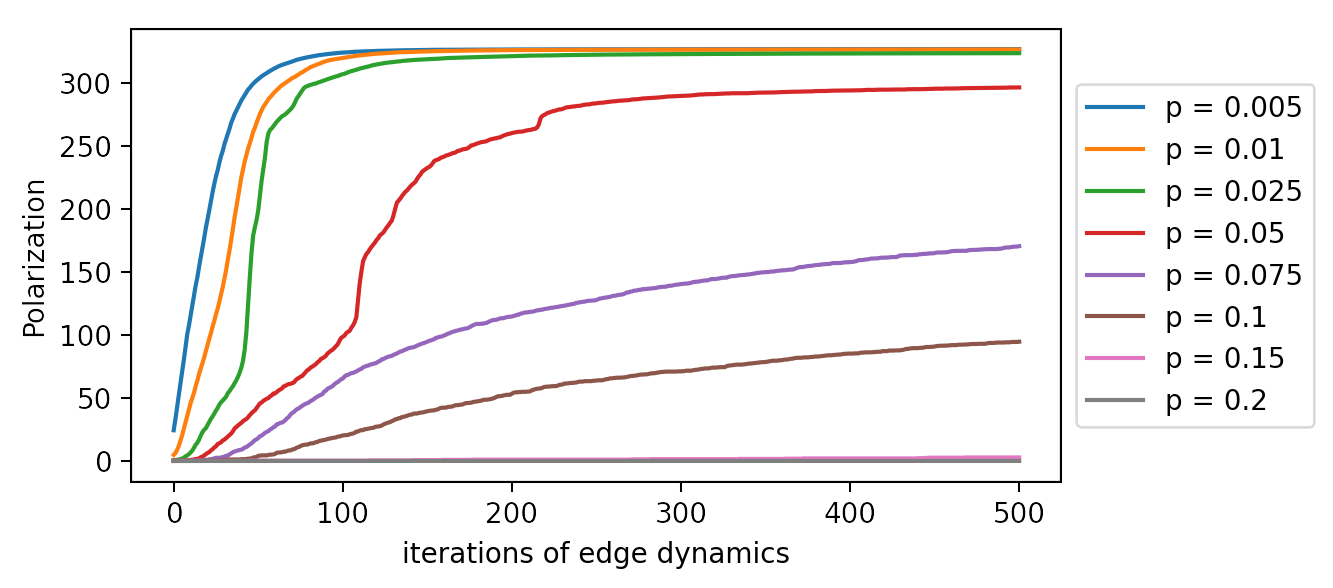
The polarizing effect of FoF recommendations diminishes in dense graphs, as the FoF set becomes nearly the entire network, making recommendations effectively random. Polarization is maximized in sparse to moderately dense regimes.
Figure 2: Polarization for ER random graphs with 1000 nodes and varied connection probabilities. Polarization decreases as density exceeds 1/n.
Evolutionary Stages
The system exhibits three distinct phases:
Initial State: Expressed opinions are near the mean; low polarization and disagreement.
Maximal Polarization: In the absence of fixed edges, the network fragments into homogeneous components; polarization saturates at the innate opinion variance, disagreement vanishes.
Figure 3: Out-group connectivity q over time for ER graphs with varying fixed edge percentages. q drops sharply under confirmation bias and FoF, driving polarization.
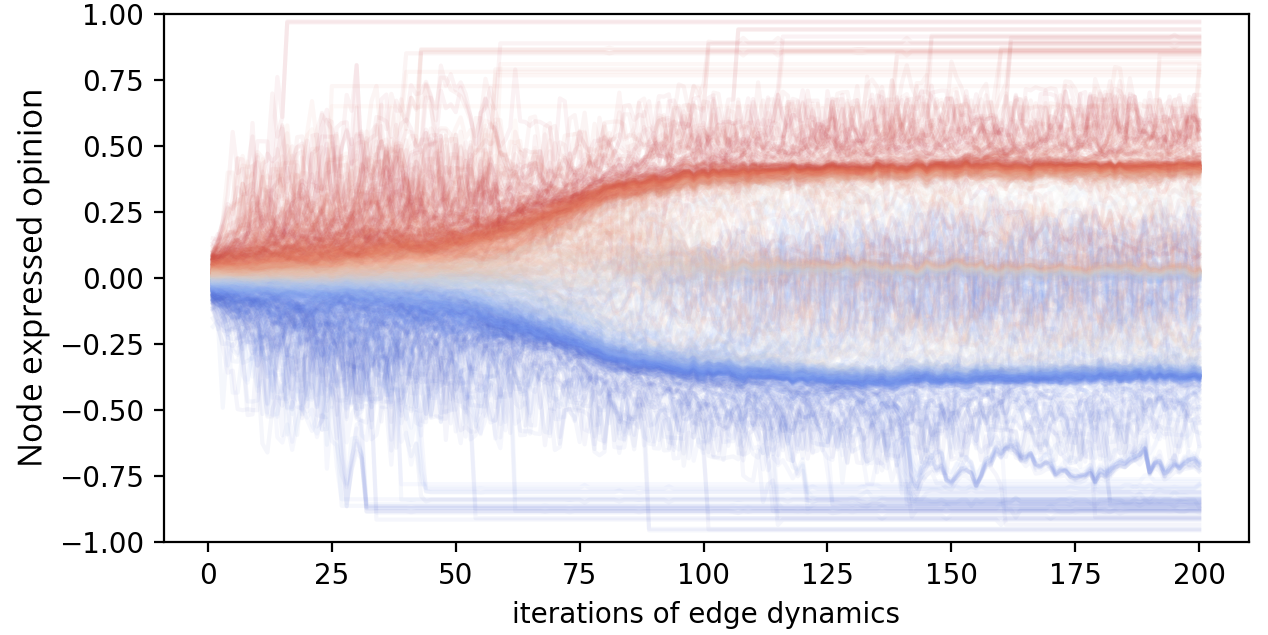
Figure 4: Evolution of opinions on a Barabási-Albert graph with 5% fixed edges. Opinions bifurcate and stabilize in two clusters, reflecting the bimodal polarization phase.
Real-World Validation
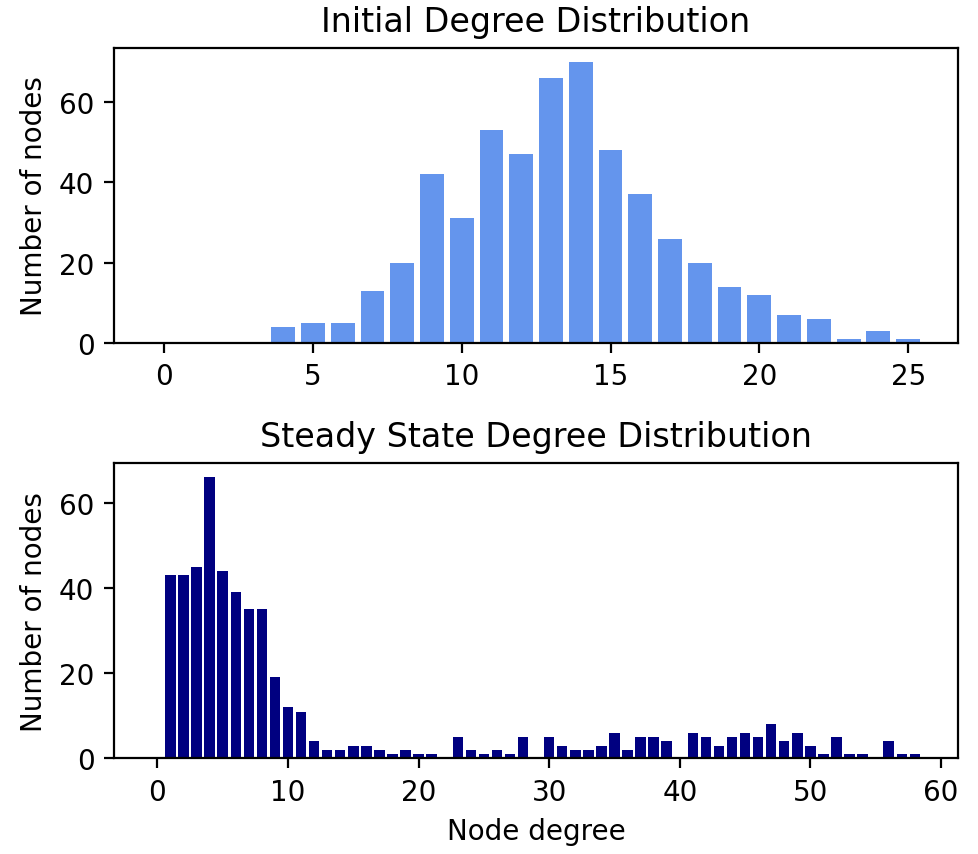
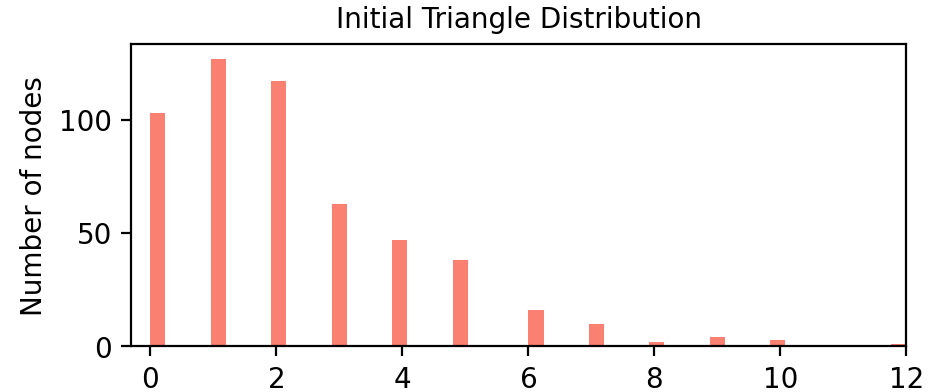
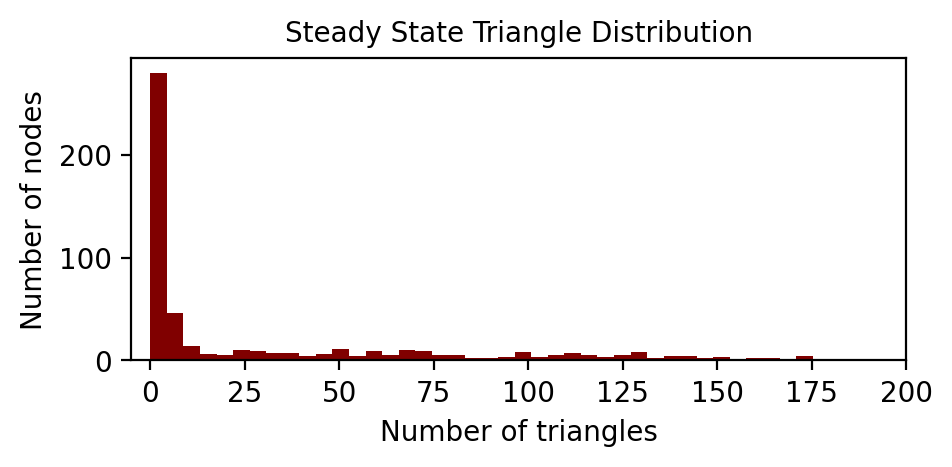
The model's edge dynamics transform synthetic graphs to exhibit degree and triangle distributions closely matching empirical social networks. For instance, an initial ER graph's degree distribution evolves from binomial to power-law-like, and triangle counts shift to match those observed in Twitter data.
Figure 5: Initial and steady state degree histograms for an ER graph. The steady state is closer to a power law, matching real social networks.
Figure 6: Initial and steady state triangle distributions for an ER network. The steady state aligns with the Twitter network's triangle distribution.
Implications and Future Directions
The results demonstrate that the interplay of confirmation bias and local recommendation algorithms is sufficient to drive strong polarization, even in initially unstructured networks. The necessity of both mechanisms is nontrivial: confirmation bias alone is insufficient, and FoF recommendations alone do not polarize unless coupled with bias-driven edge removal. The SBM reduction provides a tractable analytical framework, suggesting that interventions targeting out-group connectivity can modulate polarization.
The findings have direct implications for the design of social platforms and recommender systems. Algorithmic interventions that maintain or increase out-group connectivity may mitigate polarization. Conversely, naive application of engagement-maximizing recommendations can amplify division.
Open questions include:
Analytical characterization of the critical density threshold where FoF recommendations lose efficacy.
Extension to multidimensional or continuous opinion spaces.
Incorporation of temporal or exogenous shocks.
Empirical validation with longitudinal social network and opinion data.
Conclusion
This study provides a rigorous framework for understanding how local edge dynamics, reflecting both human and algorithmic behaviors, drive the emergence of polarization in social networks. The combination of confirmation bias and friend-of-friend recommendations is both necessary and sufficient for the rapid formation of polarized clusters, as validated by both theoretical analysis and empirical simulation. The model's ability to generate realistic network structures further supports its relevance for studying real-world opinion dynamics and for informing the design of interventions to counteract polarization.