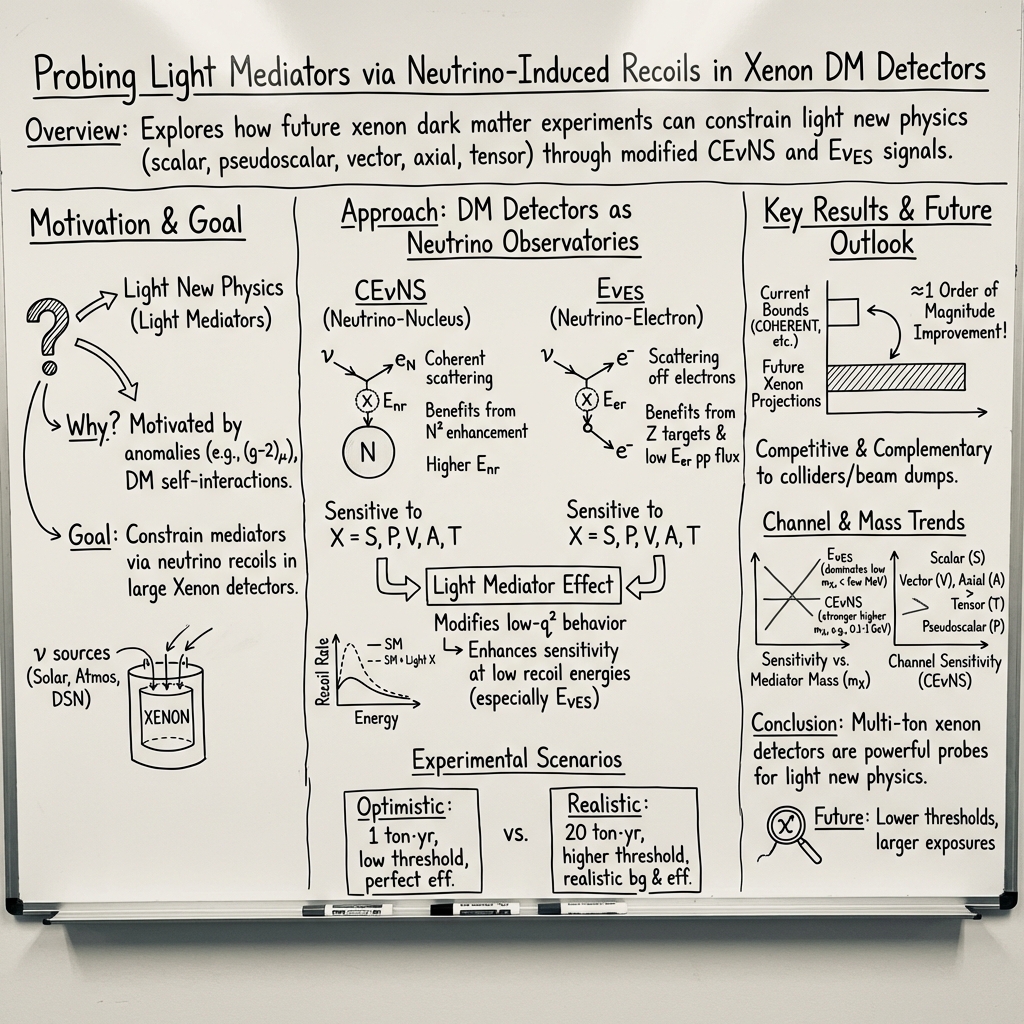
- The paper demonstrates that next-gen dark matter detectors probe light new physics through CEvNS and EνES, setting tighter constraints on light mediators.
- The methodology employs rigorous statistical analysis under both realistic and optimistic scenarios to assess detector efficiency and energy resolution.
- The study’s implications drive advancements in detector technology and refined theoretical models to enhance our understanding of BSM physics.
Exploring Dark Matter Detectors for Light New Physics
Introduction
The study explores the potential of next-generation dark matter detectors to constrain light mediators via coherent elastic neutrino-nucleus scattering (CEνNS) and elastic neutrino-electron scattering (EνES). Unlike traditional high-energy BSM physics framework, this paper focuses on probing light new physics through Lorentz-invariant interactions, namely scalar (S), pseudoscalar (P), vector (V), axial vector (A), and tensor (T). The work is particularly relevant in light of recent experimental efforts to explore CEνNS, which have showcased its viability as a probe for novel physics signaling beyond the Standard Model (BSM).
Coherent Elastic Neutrino-Nucleus Scattering (CEνNS) and its BSM Extensions
CEνNS represents a pivotal interaction at low and intermediate neutrino energies, offering a potent platform for BSM physics exploration. The standard CEνNS process is neatly described through an effective Fermi interaction Lagrangian. However, the allure of light mediators prompts us to explore the extended framework that includes potential scalar, vector, or tensor interactions featuring light U(1) gauge bosons. The interest in these mediators arises partly from their role in attempting to resolve prevailing anomalies, such as the muon g−2 discrepancy.
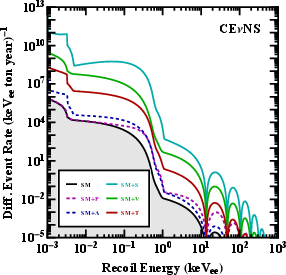
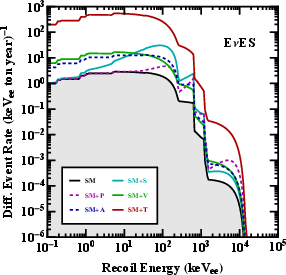
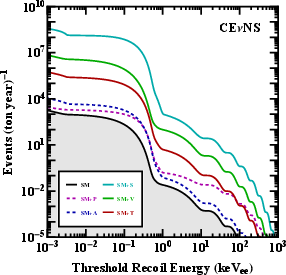
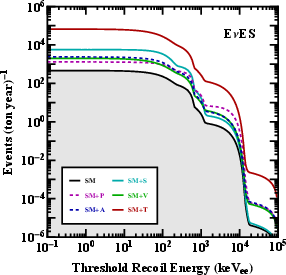
Figure 1: Differential (a) and integrated (b) event spectra expected at a xenon target for CEνNS and EνES as a function of the recoil energy measured in $\mathrm{keV_{ee}$.
The inquiry into EνES stems from its profound applicability in verifying BSM physics, through its sensitivity to novel interactions at sub-GeV energies. For scalar and vector mediators, theoretical frameworks have been diligently extended to incorporate effects from light mediators. Such analysis is nuanced, requiring incorporation of atomic binding effects critical to EνES signature interpretations. At the experimental front, EνES stands to provide complementary constraints on light mediators, particularly in regimes where CEνNS achieves limited sensitivity.
Numerical Sensitivity Analysis and Projected Constraints
A rigorous statistical framework is employed to evaluate the sensitivity of forthcoming dark matter detectors, operating at multi-ton scales and featuring sub-keV thresholds, towards constraining new physics through CEνNS and EνES. Methodologically, specialized scenarios—optimistic and realistic—are scrutinized, comparing ideal conditions versus those reflecting the detector's pragmatic facets, such as detection efficiency and energy resolution. This analysis decisively enriches the understanding of conceivable implications on various novel interactions, delineating prospective bounds for S,P,V,A,T interactions, which are juxtaposed with extant constraints from collider and beam dump experiments.
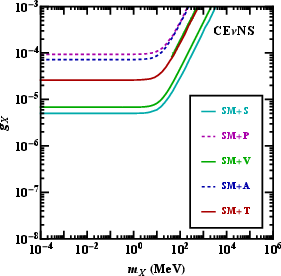
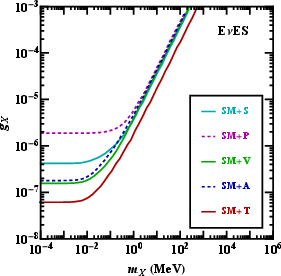
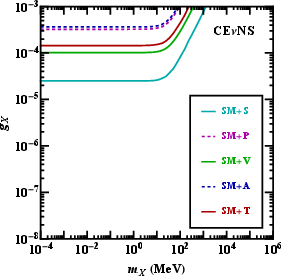
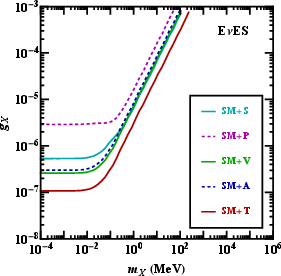
Figure 2: Projected sensitivities for the various X={S,P,V,A,T} interactions for CEνNS and EνES.
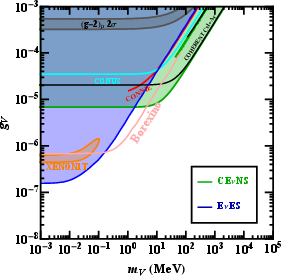
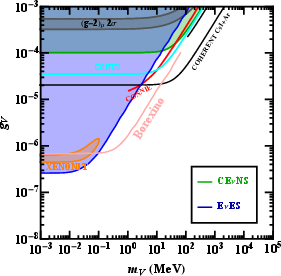
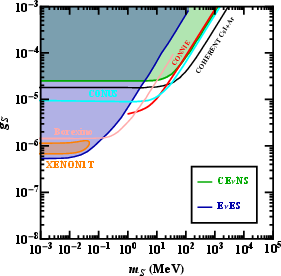
Figure 3: Projected sensitivity at 90\% C.L. in the parameter space for universal vector mediator models.
Implications and Future Prospects
The implications of this research are bifold: experimental and theoretical. Experimentally, the findings underscore the transformative potential of upcoming dark matter detectors as credible venues for probing sub-GeV BSM physics. Theoretically, the work stimulates interest in refining nuclear and atomic physics models to heighten the accuracy of scattering predictions, imperative for delineating light mediator interactions. Future efforts will undoubtedly channel towards harnessing these avant-garde insights in not only fine-tuning detector technology but also coherently expanding the accessible parameter space for light new physics in the landscape of neutrino research.
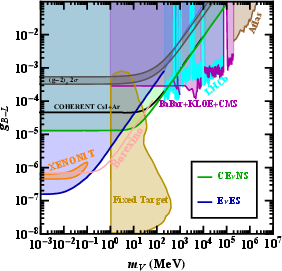
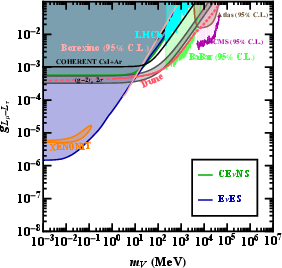
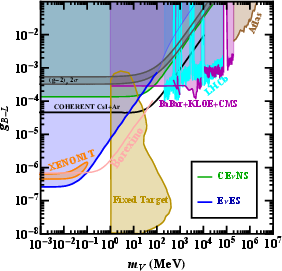
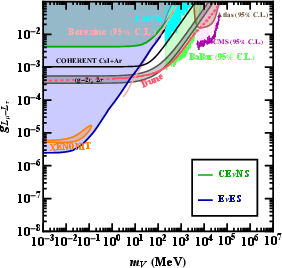
Figure 4: Projected exclusion curves at 90\% C.L. obtained in the present work with comparisons to existing experimental constraints.
Conclusions
The paper illustrates that forthcoming dark matter detectors possess the propensity to eschew existing constraints posed by dedicated CEνNS and EνES experiments. By achieving sub-keV operation thresholds, these detectors will robustly probe the landscape of light mediators, refining our understanding thereof and framing qualitative shifts in BSM physics paradigms. These promising results prompt a continued focus on the synergistic development of high-precision detection technologies and theoretical models to conclusively address current gaps in BSM explorations. Such comprehensive approaches are ultimately vital in forging new pathways in neutrino physics and dark matter research.