- The paper introduces an adaptive mechanism combining homophilic rewiring with bounded-confidence updates to understand complex opinion dynamics.
- Simulations on ER networks demonstrate that a larger confidence bound is needed for complete consensus and reveal the emergence of pseudo-consensus states.
- Homophilic rewiring accelerates convergence under small tolerance thresholds while moderate agents play a key role in bridging polarization.
An Adaptive Bounded-Confidence Model of Opinion Dynamics on Networks
Introduction
"An Adaptive Bounded-Confidence Model of Opinion Dynamics on Networks" extends the classical Deffuant-Weisbuch (DW) model by integrating a dynamic network adaptation process influenced by homophily. This paper explores how allowing nodes to change neighbors based on opinion tolerance affects opinion dynamics and consensus formation. The model introduces a homophilic rewiring mechanism where discordant edges are broken and rewired to nodes with more similar opinions.
The Adaptive DW Model
The model builds on the DW framework where agents update their opinions based on the bounded confidence principle but adds a layer of adaptability to the social network's structure. Two main processes occur at each discrete time step:
- Rewiring Process: A predetermined number of discordant edges (where agents' opinions are sufficiently different) are removed. The selected node of a pair then probabilistically rewires to another node based on opinion similarity, defined by a homophily metric.
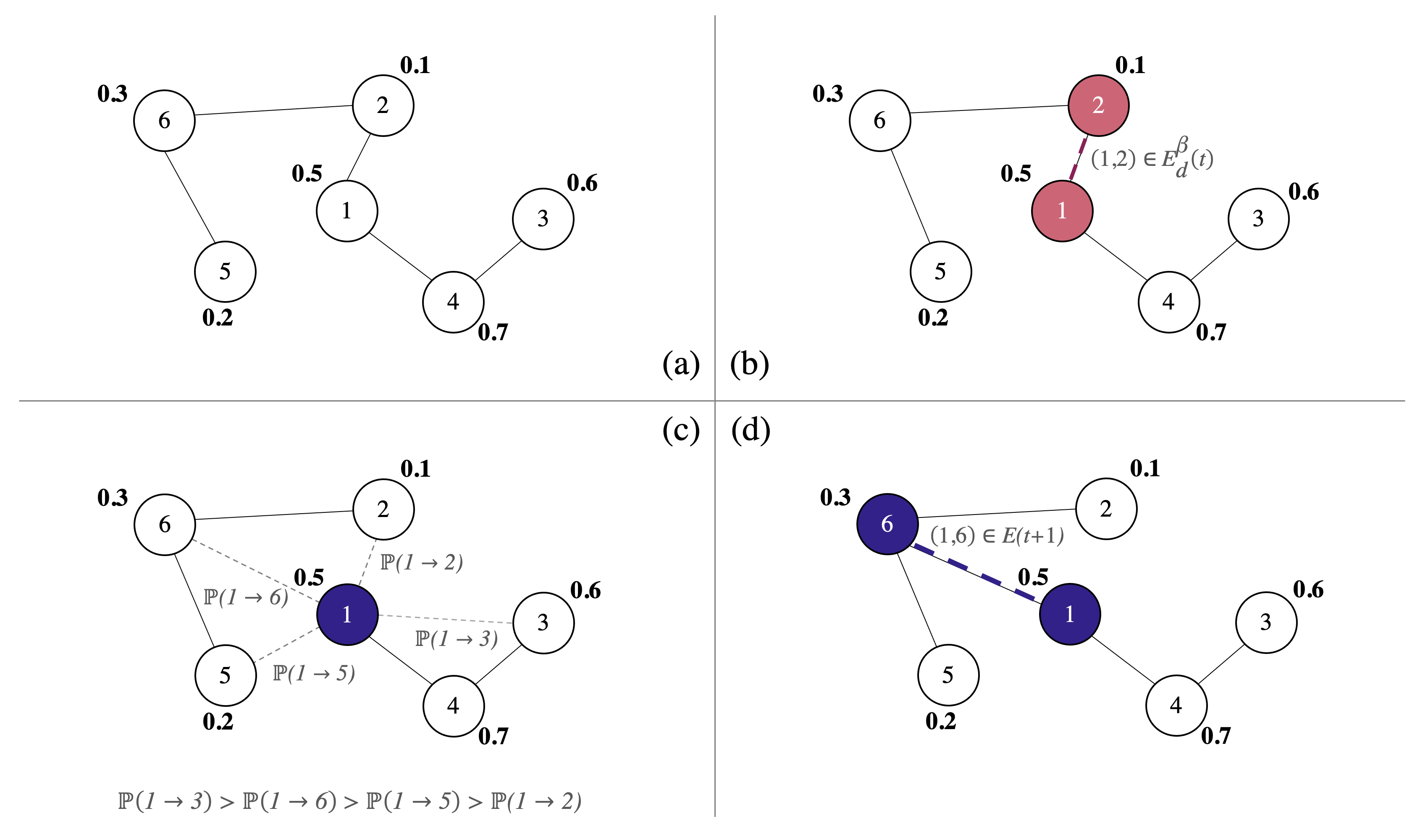
Figure 1: A schematic illustration of the rewiring mechanism in our adaptive DW model.
- Opinion Update Process: A number of agent pairs interact, and if their opinion difference is within the confidence bound, they compromise based on the DW opinion-update rule.
The model introduces the opinion tolerance threshold β, which governs the breaking of discordant edges, and a confidence bound C, affecting opinion updates. These two parameters control the scales and interactions between rewiring and opinion formation processes.
Numerical Simulations and Findings
Simulations were conducted on Erdős–Rényi (ER) networks to study the model's dynamic behaviors. Key findings include:
- Increased Threshold for Consensus: Compared to the baseline DW model (where β=1, meaning no rewiring), the adaptive model requires a larger confidence bound C to achieve consensus. This is due to network fragmentation driven by fast rewiring under small β.
- Pseudo-Consensus Formation: In regions where β and C are intermediate, a pseudo-consensus state develops, characterized by one major opinion cluster with minor subclusters noting minute differences in opinions. This indicates a balance in dynamics between rewiring and opinion evolution.
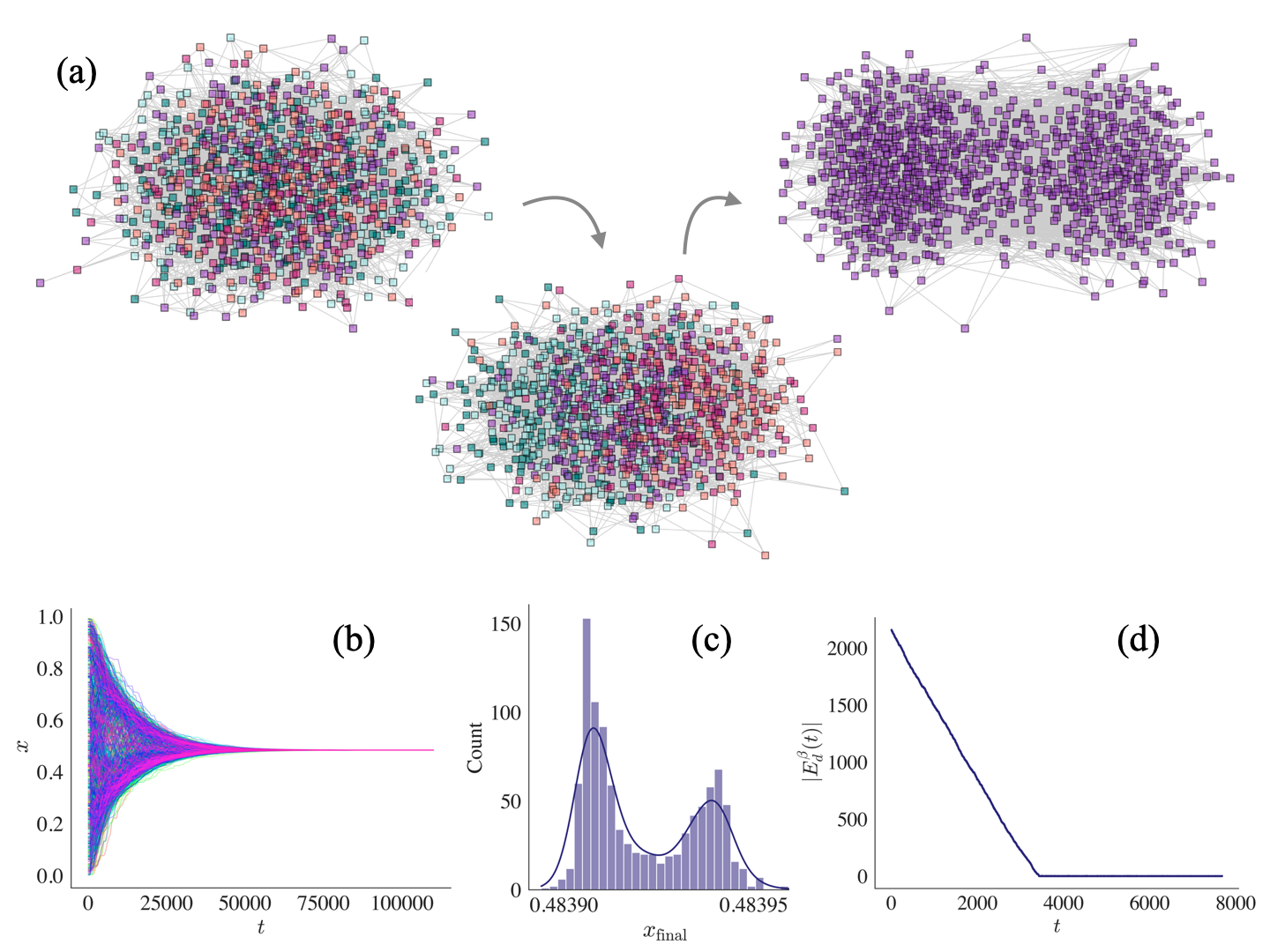
Figure 2: Overview of one simulation of our adaptive DW model, depicting network structural changes and opinion dynamics.
- Role of Moderate Agents: Initially moderate agents, typically centrally located in the opinion spectrum, play a bridging role in mitigating extensive polarization, encouraging consensus or pseudo-consensus outcomes.
- Diverse Assortativity and Polarization: Opinion assortativity, calculated via a network-based metric, trends higher with smaller β values, hinting at stronger community formation, and varies notably as C increases.
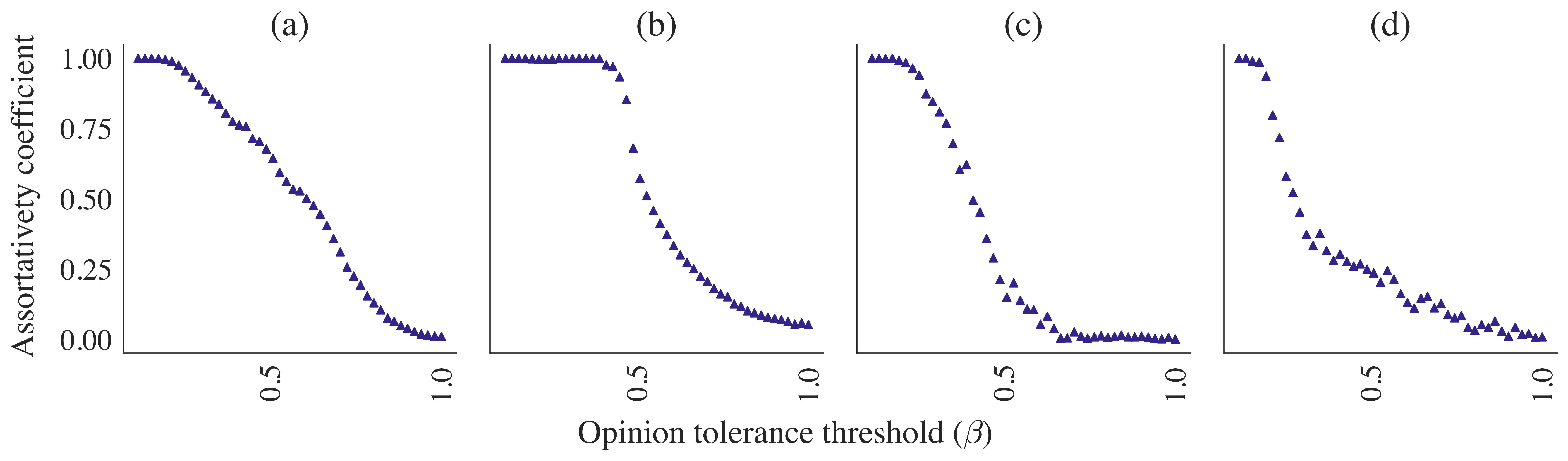
Figure 3: Assortativity of agent opinions as defined by the opinion tolerance threshold β for various confidence bounds.
- Convergence Times: Homophilic rewiring decreases convergence times when both β and C are small, contrasting with the longer convergence times observed near phase transition thresholds or large β values.
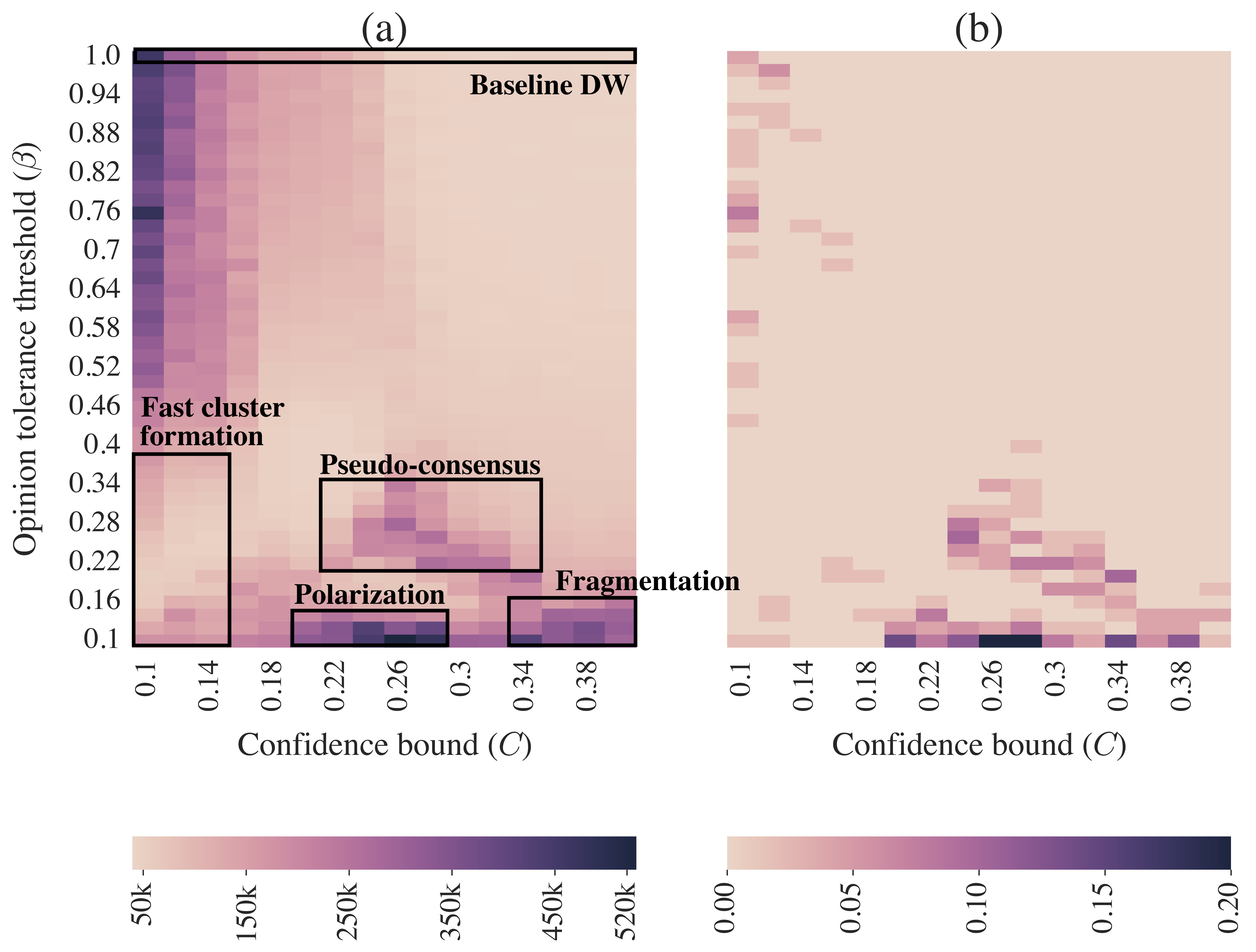
Figure 4: Average convergence times and bailout occurrences as functions of β and C.
Discussion
The adaptive DW model highlights the critical role of network adaptability and homophilic preference in opinion dynamics, presenting a nuanced view of how social networks might evolve and stabilize opinions in practice. These findings underline potential applications in understanding social media dynamics where echo chambers and homophily-driven connections impact opinion formation.
Conclusions
This study contributes to understanding bounded-confidence models by integrating dynamic network coevolution, revealing that network adaptations based on homophily can hinder or facilitate consensus. Observing pseudo-consensus states reinforces the relevance of considering both network and opinion dynamics together. Future research could further dissect the complex interactions and expand on the model to include heterogeneity in individual confidence bounds or tolerance thresholds, potentially reflecting more realistic social dynamics. The continued exploration of deconstructing these dynamics is invaluable for augmenting our approach to digital and societal interaction models.