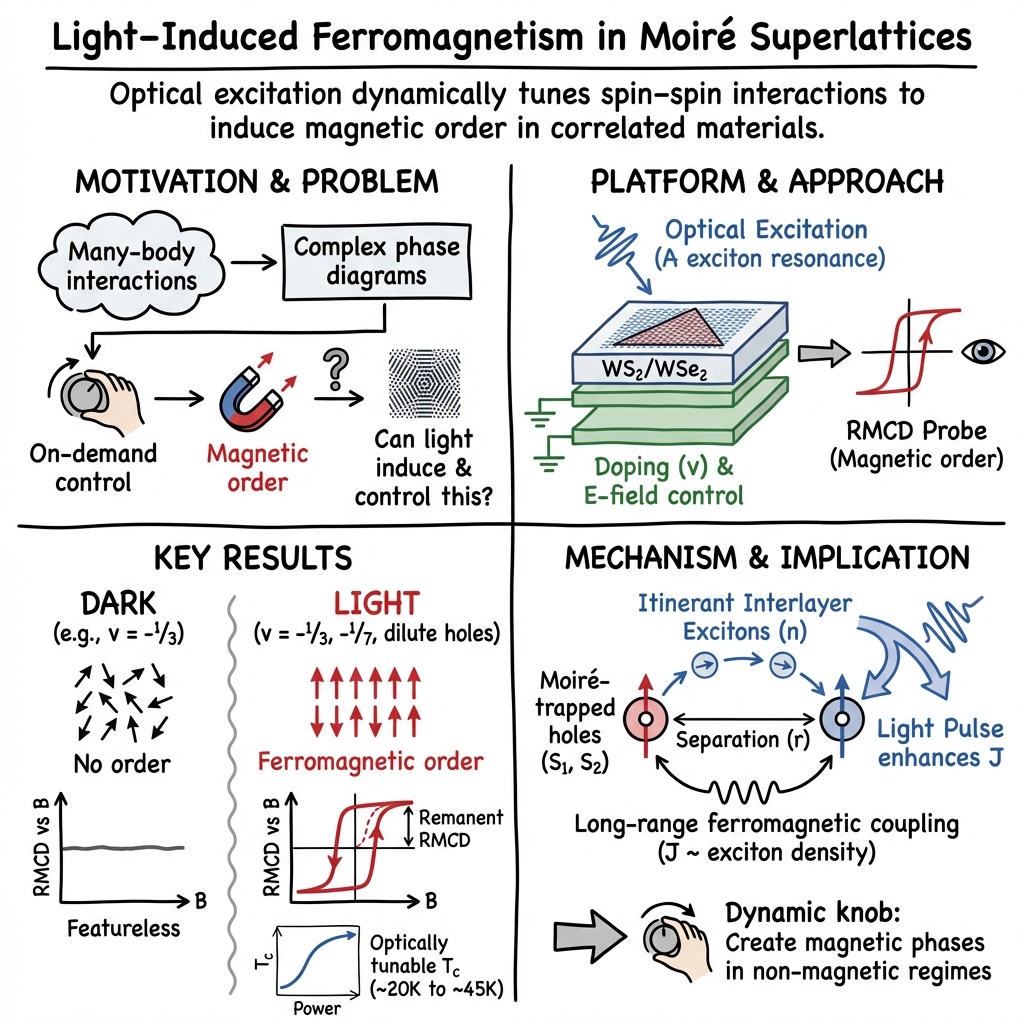
- The paper introduces optical excitation as a novel method to induce ferromagnetism in WS₂/WSe₂ moiré superlattices, as evidenced by pronounced hysteresis in RMCD measurements.
- The study employs dual-gated, dry-transferred samples with reflective magnetic circular dichroism, enabling precise control over carrier concentration and vertical electric fields.
- The findings offer a new approach for dynamically tuning many-body interactions in quantum materials, with implications for spintronics and quantum computing.
Light-Induced Ferromagnetism in Moiré Superlattices
Introduction
The paper "Light-Induced Ferromagnetism in Moiré Superlattices" (2203.07161) presents a comprehensive study on the optical manipulation of spin-spin interactions within moiré superlattices, specifically focusing on WS2/WSe2 heterobilayers. The research capitalizes on the tunability of moiré superlattices formed by two-dimensional TMDs, which offer a controllable platform for exploring strongly correlated electronic phenomena. The study elucidates an innovative method where optical excitation serves as a mechanism to induce ferromagnetic order, effectively adding a new dynamical parameter to manipulate the many-body Hamiltonian in quantum materials.
Methodology and Experimental Setup
The authors prepared dual-gated WS2/WSe2 samples to independently control the carrier concentration and the vertical electric field. The samples were fabricated using a dry-transfer method and were probed using piezoresponse force microscopy to ensure precise moiré pattern characterization. Reflective magnetic circular dichroism (RMCD) measurements were conducted to investigate the magnetic properties of the superlattices under varying doping levels and optical excitation conditions. This technique enabled the detection of hysteresis loops, a signature of ferromagnetic order, in the RMCD signal at specific moiré miniband fillings.
Key Findings
The research unveils that optical excitation in moiré superlattices can drastically enhance the exchange interaction between moiré trapped carriers, resulting in the emergence of ferromagnetism at elevated temperatures. Near a filling factor of v=−1/3, corresponding to one hole per three moiré unit cells, increasing the excitation power at the exciton resonance leads to a pronounced hysteresis loop in the RMCD signal. This loop is indicative of ferromagnetic order and persists down to charge neutrality, demonstrating that ferromagnetic order can be optically induced in the dilute hole regime.
A particularly intriguing aspect of the findings is the exciton-mediated interaction mechanism, which allows for long-range exchange coupling between moiré trapped holes. This mechanism provides an additional tuning knob for the moiré many-body Hamiltonian, potentially facilitating the exploration of a wide range of correlated electronic states on demand.
Implications and Future Directions
This paper significantly contributes to our understanding of the interplay between light and spin interactions in moiré superlattices. The introduction of a method for optically inducing and controlling ferromagnetic order could drive advances in quantum computing and spintronics, where control over magnetic properties is crucial. Additionally, the ability to dynamically tune the electronic phase diagrams of moiré quantum matter could herald the development of novel devices capable of operating in previously inaccessible parametric regimes.
Future research could further explore the impact of optical orientation of exciton spins on magnetic state formation, and investigate transient phenomena such as optically controlled topological phase transitions. Moreover, expanding this approach to include other superlattice geometries and material systems could widen the scope of potential applications in quantum technologies.
Conclusion
The study provides a critical advancement in the field of moiré quantum materials by demonstrating that optical excitation can be used to induce and manipulate ferromagnetic order in WS2/WSe2 moiré superlattices. This discovery opens new avenues for exploring optically-driven many-body phenomena in correlated electron systems and may have profound implications for the design of tunable quantum devices.