- The paper introduces a novel framework that recasts multi-token trade routing in CFMMs as a convex optimization problem when excluding fixed costs.
- The study demonstrates that incorporating fixed transaction costs transforms the problem into a mixed-integer convex challenge, addressed via tailored heuristics.
- Numerical experiments validate the approach, highlighting its potential to enhance arbitrage detection and trading efficiency in decentralized finance.
Optimal Routing for Constant Function Market Makers
Introduction
This research paper addresses the complex problem of optimally executing trades involving multiple crypto-assets across a network of constant function market makers (CFMMs), which are commonly utilized in decentralized exchanges (DEXs). As the paper elucidates, this routing problem can be simplified to a computationally solvable convex optimization problem when fixed trading costs are excluded. When these costs are included, the problem transitions into a mixed-integer convex optimization problem, requiring more advanced solution techniques.
Optimal Routing Problem
The core focus of the paper is on formulating the optimal routing of multiple token trades using CFMMs, which are characterized by their use of trading functions that dictate the validity of trades based on the token amounts held in reserves. The trading functions such as the constant product rule popular in Uniswap ensure that each trade fulfills the CFMM's criteria without the need for intermediaries. As traders seek to maximize utility, they are often faced with the challenge of navigating multiple CFMMs to minimize costs. The research demonstrates that this problem can effectively be recast as a convex optimization problem, facilitating efficient solutions even in complex scenarios involving several DEXs.
Convex Optimization for Routing
In exploring the optimal routing problem, the paper distinguishes between scenarios with and without fixed transaction costs. The optimization process without fixed costs - a convex optimization scenario - is computationally feasible and scalable across various scenarios. This can be extended to identify arbitrage opportunities within networks of CFMMs. In the presence of transaction costs, the routing problem becomes far more computationally intensive, classified as a mixed-integer convex problem. However, the paper proposes heuristics and approximation methods based on convex optimization that can significantly reduce computational demands.
Numerical Results
The efficacy of the proposed method is highlighted through numerical examples that illustrate trade optimization between CFMMs. In particular, the research presents a scenario where the amount of one token is traded to maximize the receipt of another, showcasing the method's ability to pinpoint arbitrage opportunities where no net token input yields a positive balance of the target token. The numerical outcomes reinforce the viability and robustness of the proposed optimization strategy in real-world applications.
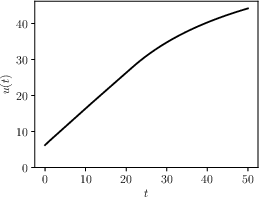
Figure 1: Plot of u(t), the maximum amount of token 3 obtained when tendering the amount t of token 1.
Incorporation of Transaction Costs
Addressing fixed transaction costs adds an additional layer of complexity, turning the original problem into an MICP. The paper discusses methodologies for handling these costs by incorporating Boolean decision variables to denote trades with associated costs, and recommends employing global optimization techniques for exact solutions or heuristic approaches for approximate solutions. The strategies presented effectively balance between computational efficiency and optimality in the presence of such costs.
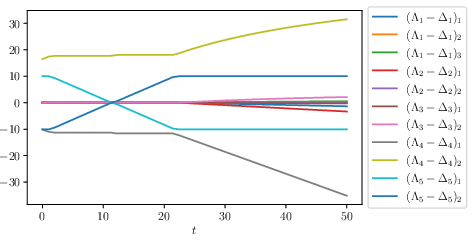
Figure 2: Optimal trades versus t, the amount of token 1 tendered.
Discussion and Implications
The implications of this research extend across both theoretical and practical domains. Theoretically, the paper contributes a rigorous framework for routing optimization in decentralized settings, grounded in convex optimization principles. Practically, the methodologies proposed offer pathways to optimize trading strategies in decentralized finance (DeFi), enhancing the efficiency and profitability of trading operations across multiple CFMMs. The research encourages further exploration and refinement of heuristic solutions in scenarios with high computational complexity due to transaction costs.
Conclusion
In conclusion, the paper provides comprehensive insights and solutions to the optimal routing problem in CFMM networks, distinguishing itself through effectively blending convex optimization principles with the practical requirements of decentralized trading environments. The results and methods detailed present clear contributions to the domain, particularly in enhancing the understanding and execution of trades across complex networks of CFMMs, thereby facilitating advancements in decentralized finance applications.