- The paper introduces MeritRank, a reputation system that balances Sybil tolerance with merit-based tokenomics in decentralized platforms.
- It employs innovative decay mechanisms, including transitivity and connectivity decay, to limit the influence of Sybil attacks while maintaining feedback utility.
- Experimental results using MakerDAO data demonstrate the system's ability to effectively resist Sybil attacks and optimize reputation allocation.
MeritRank: Sybil Tolerant Reputation for Merit-Based Tokenomics
Introduction
The paper "MeritRank: Sybil Tolerant Reputation for Merit-based Tokenomics" (2207.09950) addresses the critical challenge of developing robust reputation mechanisms for decentralized blockchain systems. The authors propose MeritRank, a reputation system designed to operate within the complex environments of Decentralized Autonomous Organizations (DAOs), offering Sybil tolerance while maintaining the integrity and utility of reputation-based incentives. This work aims to address the decentralization reputation trilemma, which posits that a system cannot be simultaneously generalizable, trustless, and Sybil resistant. MeritRank seeks to balance these trade-offs, particularly focusing on mitigating the effects of Sybil attacks.
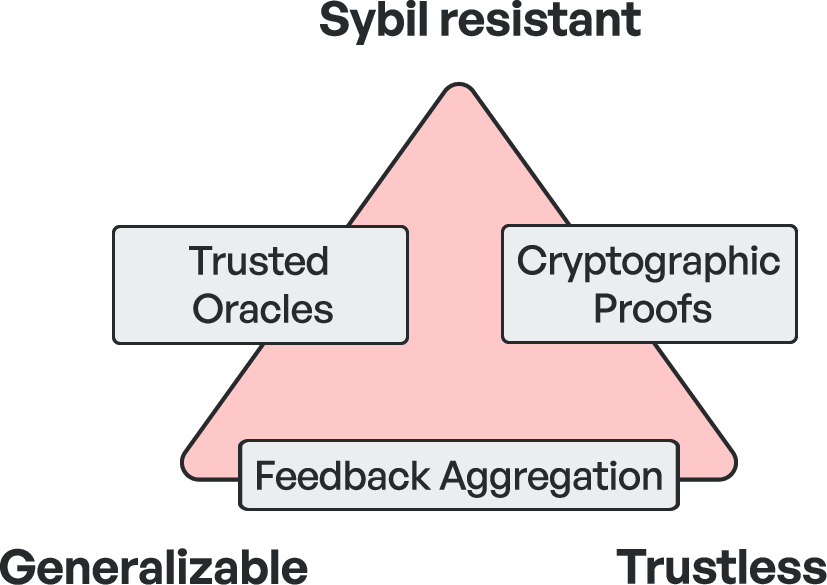
Figure 1: Reputation mechanism trade-off triangle. A reputation mechanism can be only one of the two: Generalizable, Sybil resistant, Trustless.
Background
Blockchain applications rely heavily on tokenomics, employing token-based incentives to maintain network activities and governance. However, these systems often confront issues related to incentive misalignment, governance vulnerabilities, and centralization risks. Reputation mechanisms offer an alternative, seeking to reward merit and contributions rather than monetary holdings. Nonetheless, applying reputation systems in decentralized environments presents unique challenges, particularly concerning scalability, privacy, and resilience against Sybil attacks.
Reputation mechanisms have historically struggled to reconcile scalability, contextual accuracy, trustless nature, and Sybil resistance. Trusted oracles, cryptographic proofs, and feedback aggregation represent approaches with varied strengths and limitations. Feedback aggregation, despite its susceptibility to manipulation, offers potential for balancing these properties without undermining decentralization principles.
Sybil Tolerant Feedback Aggregation
The paper introduces MeritRank as a feedback aggregation mechanism that bounds the gains from Sybil attacks rather than preventing them altogether. This approach involves defining trade-offs through a decentralized reputation trilemma and optimizing feedback aggregation mechanisms to achieve Sybil tolerance. MeritRank utilizes decay parameters—transitivity decay and connectivity decay—to tune the levels of reputation utility and Sybil tolerance.
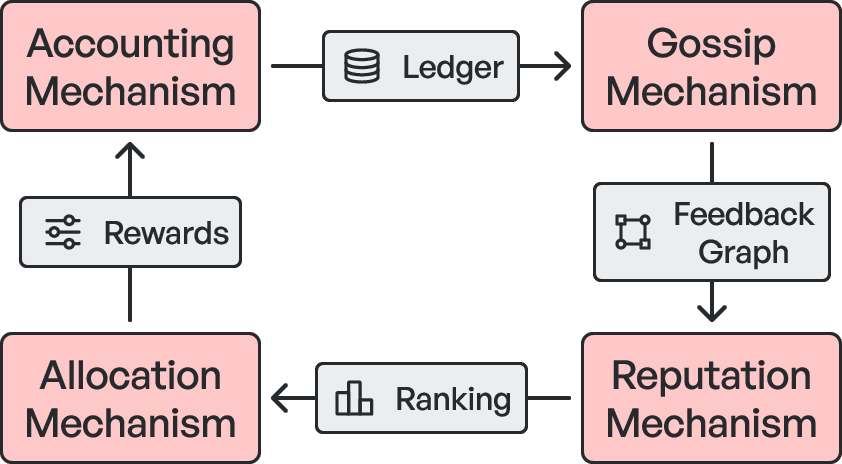
Figure 2: Merit-Based Tokenomics system model.
MeritRank operates on a model that evaluates contributions through directed graphs, called feedback graphs, where interactions among participants accrue reputation over time. The model leverages gossip protocols and dynamic models to maintain updated reputation scores, ensuring high-quality decentralization characteristics while combating strategic manipulation via Sybil attacks.
MeritRank System Model
MeritRank relies on multiple elements to structure its tokenomics model effectively. Participants interact, providing feedback, which forms the basis of a directed graph representing their evaluations. Reputation scores are computed through feedback aggregation, facilitating reward allocations proportionally to the reputation accumulated.
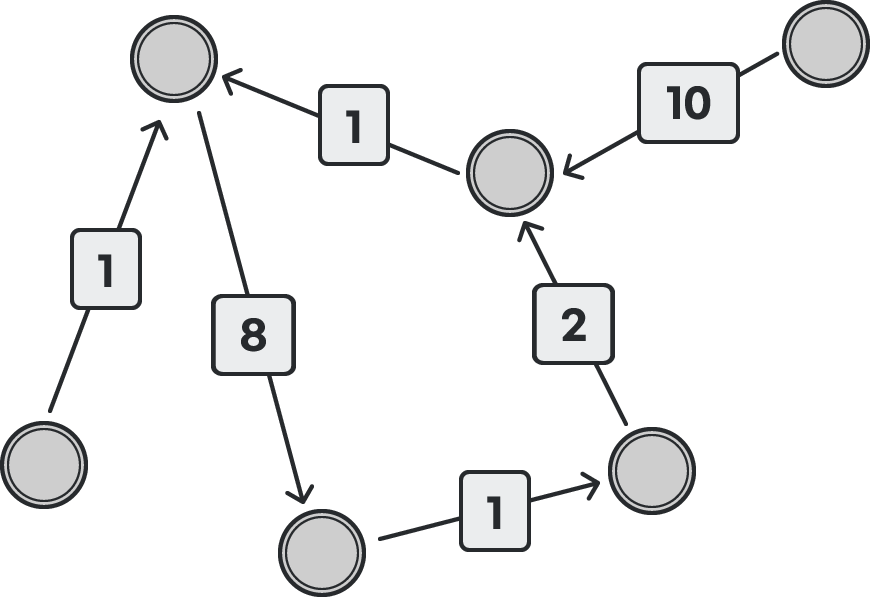
Figure 3: Example of feedback graph G. Edge represent the sum of evaluations made by the participant about another participant.
This decentralized approach eliminates dependence on centralized entities, leveraging peer-to-peer interactions and recognition of contributions. Sybil attacks are modeled strategically to measure the potential impact on reward allocation, allowing MeritRank to implement adjustments via decay mechanisms to mitigate these risks effectively.
Bounding the Attacks
MeritRank introduces modifications to existing reputation mechanisms to reduce vulnerability to Sybil attacks. These include parallel report bounds, serial report bounds, and bounded transitivity. The paper adapts these principles by employing relative feedback measurements, transitivity α decay, connectivity β decay, and epoch γ decay to maintain Sybil tolerance while preserving utility.
Decay mechanisms effectively limit the influence of Sybil nodes by penalizing isolated network components and restricting feedback significance over time. As demonstrated through simulations using MakerDAO data, these modifications greatly enhance resistance against Sybil attacks without compromising the informativeness or accuracy of the reputation system.
Experimental Results
Experiments conducted using MakerDAO data reveal that MeritRank's decay mechanisms successfully reduce the efficacy of Sybil attacks across varied scenarios. The results highlight the effectiveness of transitivity decay, connectivity decay, and combined decay applications in maintaining competitive sybil tolerance levels.
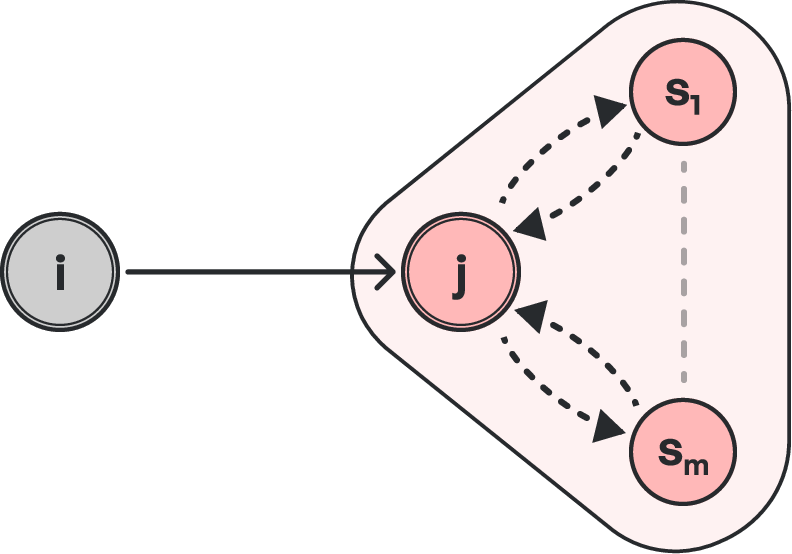
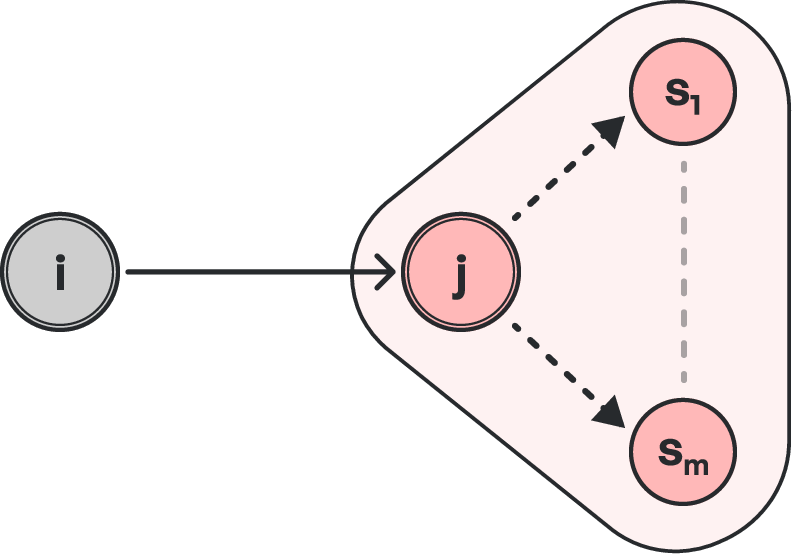
Figure 4: Cycle attack.
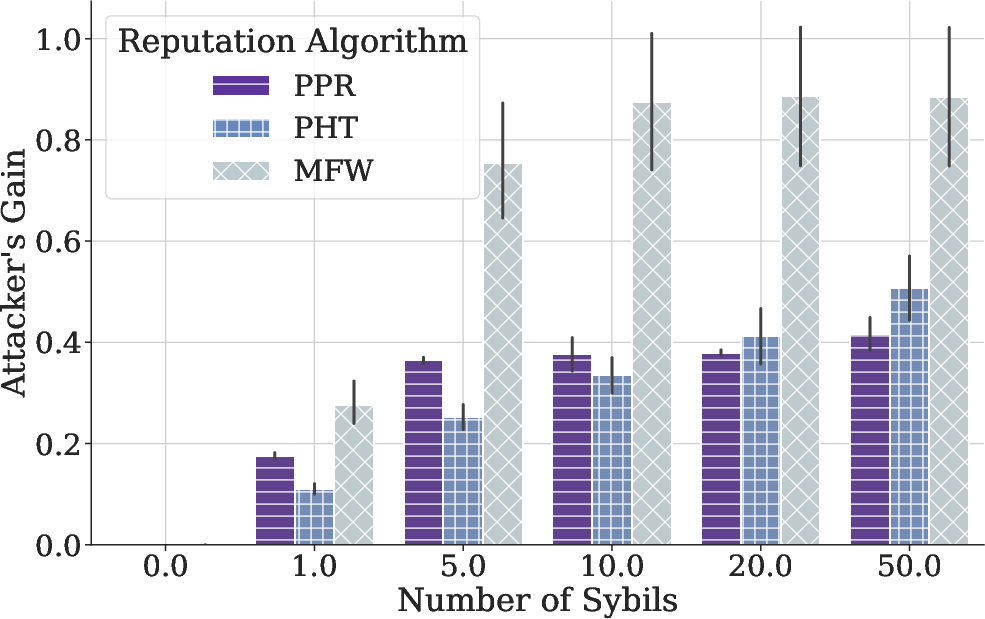
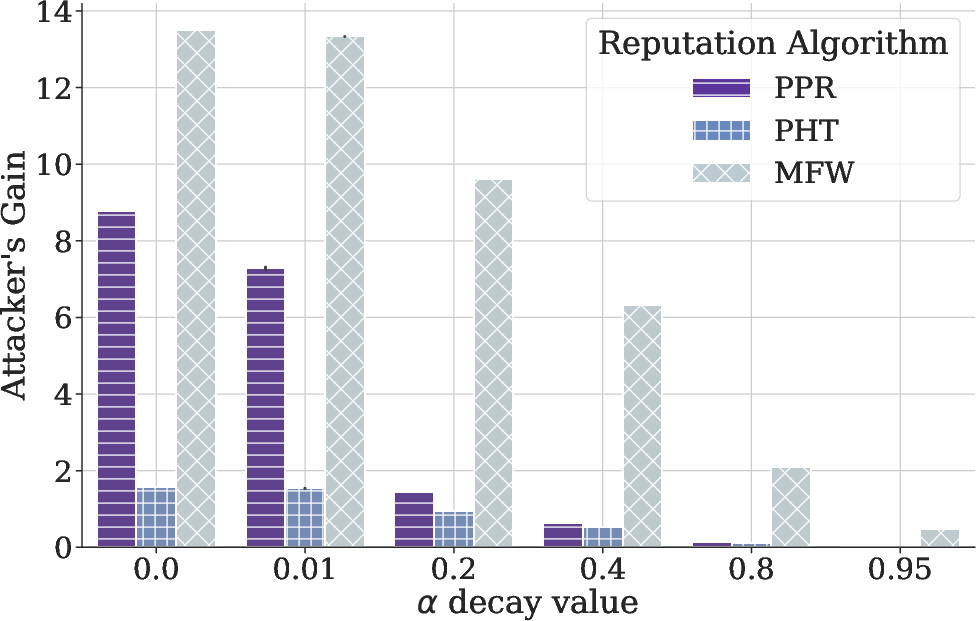
Figure 5: Gain for given reputation algorithms with alpha = 0.4.
While the alternative epoch decay γ approach introduced unexpected vulnerabilities, demonstrating potential drawbacks, MeritRank's flexible decay configurations allow researchers and practitioners to fine-tune their systems according to specific application needs and desired sybil thresholds.
Conclusion
MeritRank presents a novel solution to the decentralized reputation trilemma by optimizing feedback aggregation mechanisms with robust decay settings. This paper underscores the necessity for balancing desirable properties within reputation systems, maintaining decentralization, and ensuring resilience against manipulative behaviors. Through detailed experimentation, MeritRank proves adaptable to varying contexts, establishing itself as a viable approach for future blockchain networks seeking sustainable, merit-based tokenomics.
As blockchain applications continue to evolve, the practical implications of MeritRank's design offer promising advancements in reputation systems, enhancing the precision and security of decentralized interactions without sacrificing core principles. The developments presented set the stage for future explorations in optimizing decentralization technologies, contributing valuable insights into the emergence of complex digital socio-economies.