- The paper demonstrates a novel hybrid quantum-classical algorithm that frames sentence generation as an optimization problem using quantum circuits.
- It integrates the DisCoCat model with simulated annealing to translate linguistic structures into parameterized quantum circuits on IBM hardware.
- The research provides a proof-of-concept for quantum NLG, addressing current hardware noise limitations while paving the way for future advances.
Quantum Natural Language Generation on Near-Term Devices
Introduction to Quantum NLG
The paper "Quantum Natural Language Generation on Near-Term Devices" explores the application of quantum computing to natural language generation (NLG). It investigates the intersection of procedural generation and NLP using a hybrid quantum-classical algorithm. This algorithm leverages the known DisCoCat model, which parallels quantum computation in its representational framework. Using the simulated annealing method, the paper presents sentence generation on both simulated and actual quantum devices. Through this, the feasibility of utilizing existing quantum hardware for NLP tasks is demonstrated, although large-scale benefits remain a topic for future exploration.
Quantum Computing and DisCoCat Model
Quantum computing, superseding traditional bit systems with quantum bits (qubits), allows computations that were previously deemed infeasible. In this context, the paper elaborates on the basic principles of quantum computation, emphasizing features like superposition and quantum gates, which facilitate these enhanced capabilities. These principles underpin the design of quantum circuits requisite for executing algorithms akin to those involved in NLG.
The DisCoCat model, integral to this approach, extends traditional linguistic models to encapsulate compositional and grammatical relationships as quantum entities. This dual utility — reflecting syntactic structure through categorical semantics — enables effective sentence representation as quantum circuits.
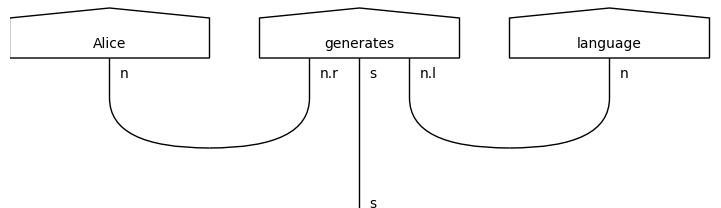
Figure 1: DisCoCat diagram for the sentence `Alice generates language.'
Sentence Generation Algorithm
The proposed sentence generation algorithm marries classical simulated annealing with quantum evaluations. By framing sentence generation as an optimization problem, the algorithm iterates through potential sentences using quantum circuits to determine topic relevance. These circuits, parameterized for execution on IBM’s quantum hardware, aim to maximize the objective function, aligning the generated sentence with a predetermined topic.
Simulation and Implementation
The algorithm's capability was tested using a classical simulator for preliminary validation prior to deployment on IBM's quantum computers. This dual-stage experimentation highlights quantum devices' potential while underscoring current challenges, such as hardware limitations and noise-induced errors typical of near-term quantum devices.
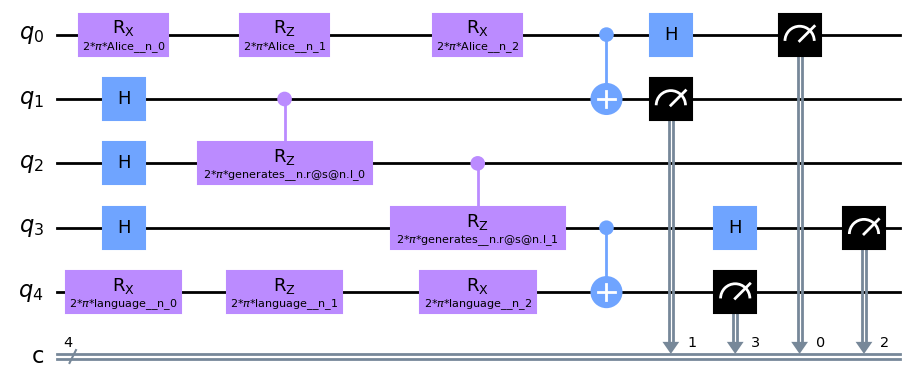
Figure 2: Parameterised quantum circuit for the sentence ``Alice generates language''.
Applications and Future Directions
Beyond sentence generation, the paper suggests potential extensions to music generation, reflecting the flexibility of the DisCoCat framework when applied to other compositional tasks. Though promising, the algorithm primarily serves as a proof-of-concept given the constraints of present quantum technology. Further exploration is essential to integrate more advanced quantum algorithms in tackling large-scale NLG tasks effectively.
Continued advancements in quantum hardware, alongside innovations like the DisCoCirc model for document-scale processing, may pave the way for substantive improvements over existing classical methods. These trajectories hinge on innovative algorithmic designs that can leverage quantum computing's full capabilities for real-world NLG applications.
Conclusion
This work presents foundational steps towards utilizing quantum computing for NLG tasks, embedding linguistic structures within quantum systems. While current capabilities are limited by hardware maturity, the ongoing evolution in quantum technology holds substantial prospects for developing quantum-enhanced NLP models. Such endeavors stand to revolutionize how natural language and other compositional data structures are generated and processed, fundamentally shifting computational paradigms.