- The paper reveals that animal groups exhibit self-organizing behavior near critical points, enhancing their information processing abilities.
- It employs statistical physics methods, using models like the Vicsek model to quantify susceptibility and correlation lengths in non-equilibrium conditions.
- The research highlights trade-offs in collective decision-making, where operating near criticality balances responsiveness with stability.
Phase Transitions and Criticality in the Collective Behavior of Animals
Introduction
The paper "Phase Transitions and Criticality in the Collective Behavior of Animals -- Self-organization and Biological Function" explores the conceptual frameworks borrowed from statistical physics to understand collective behaviors in animal groups such as fish schools, bird flocks, or insect swarms. These behaviors are emblematic of self-organization, where the interactions between individual entities lead to emergent group-level dynamics. The primary focus of the paper is to assess the applicability and implications of phase transitions, particularly near-critical points, in optimizing the information processing capabilities of these collectives.
Phase Transitions in Collective Behavior
Animal collectives demonstrate phase transition-like phenomena, analogous to those observed in physical systems such as magnets and fluids. In biological systems, these transitions occur in non-equilibrium conditions and involve a relatively small number of interacting entities. Key challenges in applying statistical physics concepts to biology include the inherent far-from-equilibrium nature of biological systems and the relatively small size of animal groups compared to classical thermodynamic systems.
One of the most studied transitions in animal groups is the flocking transition, described by models like the Vicsek model, which shows a shift from disordered to ordered movement as a function of interaction strength among the individuals. The ordered state is characterized by orientational coherence across the group, often visualized in bird flocks or fish schools.
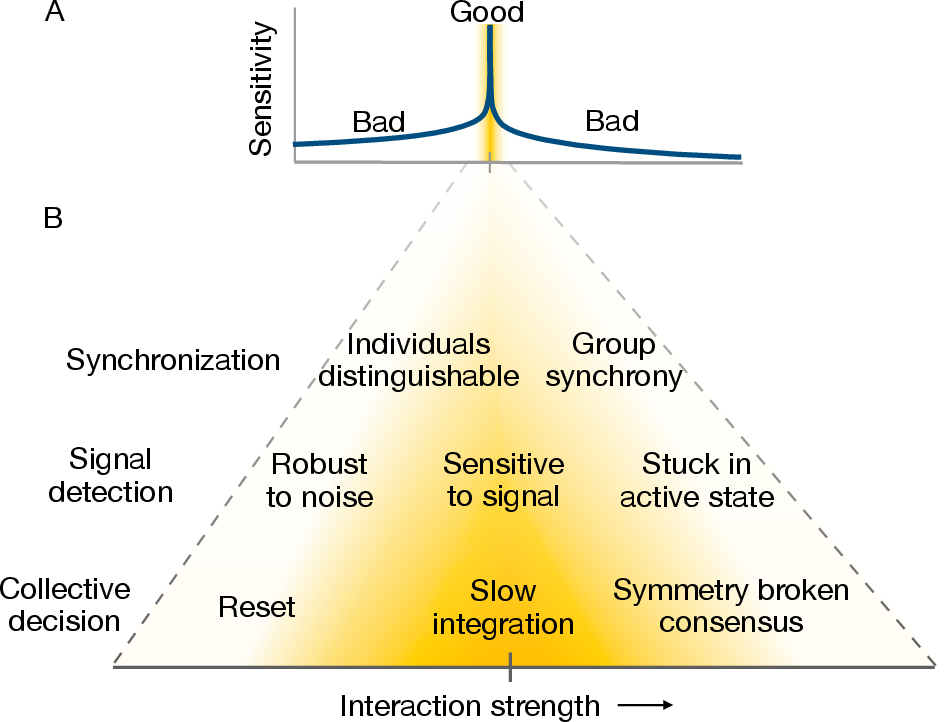
Figure 1: Biological function near a continuous phase transition. (A) A simplistic view recognizes that collective sensitivity is enhanced only near the critical point --- hence the idea that being tuned near criticality can be functionally advantageous. (B) Sufficiently near the transition, collective effects related to the transition are graded. Functional consequences, which can be advantageous or harmful depending on context, can be traded off against one another.
Quantifying Criticality in Animal Collectives
Identifying the proximity to criticality in animal groups is essential for exploring the benefits of collective sensitivity enhancement at these points. Techniques adapted from statistical physics, such as measuring susceptibility and correlation lengths, provide tools to quantify criticality. These measures help determine the system's sensitivity to individual changes and the potential for large-scale influence from small perturbations.
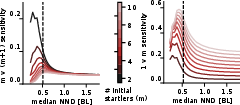
Figure 2: Maximal susceptibility at criticality in a behavioral contagion model as studied by Poel et al. (2211.03879).
Functional Implications of Criticality
Operating near a critical point confers several computational advantages on animal groups, particularly in terms of maximizing information processing, sensitivity to environmental changes, and enhancing collective decision-making capability. The trade-offs between robustness and sensitivity, as well as speed and accuracy in decision-making, are influenced by the system's proximity to criticality. These trade-offs are crucial in dynamic environments where adaptability dictates the survival and efficiency of the group.
Mechanisms of Self-Organization toward Criticality
A primary challenge is understanding how animal collectives might self-organize to approach critical points using localized individual interactions. Possible mechanisms include local adaptation strategies where individuals adjust their behavior based on temporally averaged local dynamics or through density modulations that affect interaction strengths within the group.
Evolutionary adaptation also plays a role over long timescales, where criticality might emerge as an evolutionarily stable strategy if it consistently provides a fitness advantage in variable environments.
Conclusion
The study of phase transitions and criticality in animal collective behavior offers a promising intersection between statistical physics and biology. While the potential benefits of operating near critical points are substantial, the paper also emphasizes the need for further empirical and theoretical work to uncover the mechanisms that allow animal groups to capitalize on these dynamics. Understanding these processes could provide profound insights into the self-organizing principles governing complex biological systems. The research calls for a deeper interdisciplinary approach that integrates empirical observations with theoretical advancements to unravel the complexities of collective phenomena in living systems.