Papers
Topics
Authors
Recent
Search
2000 character limit reached

Matrix factorization with neural networks

Published 5 Dec 2022 in cond-mat.dis-nn and cs.LG | (2212.02105v1)

Abstract: Matrix factorization is an important mathematical problem encountered in the context of dictionary learning, recommendation systems and machine learning. We introduce a new `decimation' scheme that maps it to neural network models of associative memory and provide a detailed theoretical analysis of its performance, showing that decimation is able to factorize extensive-rank matrices and to denoise them efficiently. We introduce a decimation algorithm based on ground-state search of the neural network, which shows performances that match the theoretical prediction.

Definition Search Book Streamline Icon: https://streamlinehq.com
References (20)
  1. B. A. Olshausen and D. J. Field, Nature 381, 607 (1996).
  2. B. A. Olshausen and D. J. Field, Vision Research 37, 3311 (1997).
  3. Y. Bengio, A. Courville, and P. Vincent, IEEE Transactions on Pattern Analysis and Machine Intelligence 35, 1798 (2013).
  4. D. H. Ackley, G. E. Hinton, and T. J. Sejnowski, Cognitive Science 9, 147 (1985).
  5. J. Mairal, M. Elad, and G. Sapiro, IEEE Transactions on Image Processing 17, 53 (2008).
  6. M. Elad and M. Aharon, Trans. Img. Proc. 15, 3736–3745 (2006).
  7. I. M. Johnstone, The Annals of Statistics 29, 295 (2001).
  8. F. Krzakala, J. Xu, and L. Zdeborová, in 2016 IEEE Information Theory Workshop (ITW) (2016) pp. 71–75.
  9. J. Barbier and N. Macris, Journal of Physics A: Mathematical and Theoretical 52, 294002 (2019).
  10. A. E. Alaoui, F. Krzakala, and M. Jordan, The Annals of Statistics 48, 863 (2020).
  11. J. Baik, G. Ben-Arous, and S. Péché, The Annals of Probability 33, 1643 (2005).
  12. F. Benaych-Georges and R. R. Nadakuditi, Advances in Mathematics 227, 494 (2011).
  13. Y. Kabashima, Journal of Physics A: Mathematical and General 36, 11111 (2003).
  14. D. L. Donoho, A. Maleki, and A. Montanari, Proceedings of the National Academy of Sciences 106, 18914 (2009).
  15. J. Barbier and N. Macris, Phys. Rev. E 106, 024136 (2022).
  16. J. J. Hopfield, D. I. Feinstein, and R. G. Palmer, Nature 304, 158 (1983).
  17. J. J. Hopfield, Proceedings of the National Academy of Sciences 79, 2554 (1982), https://www.pnas.org/doi/pdf/10.1073/pnas.79.8.2554 .
  18. D. J. Amit, H. Gutfreund, and H. Sompolinsky, Phys. Rev. A 32, 1007 (1985a).
  19. D. J. Amit, H. Gutfreund, and H. Sompolinsky, Phys. Rev. Lett. 55, 1530 (1985b).
  20. M. Mézard, G. Parisi, and M. Virasoro, Spin Glass Theory and Beyond (WORLD SCIENTIFIC, 1986) https://www.worldscientific.com/doi/pdf/10.1142/0271 .
Citations (12)

Summary

  • The paper introduces a neural network-based decimation algorithm that iteratively extracts patterns to factorize large, noisy matrices.
  • The method leverages associative memory and Monte Carlo techniques, outperforming traditional rotation invariant estimators in denoising tasks.
  • Theoretical analysis confirms its efficiency in reconstructing matrices under high noise levels, suggesting potential for future polynomial-time optimizations.

Matrix Factorization with Neural Networks

This paper introduces a novel approach to matrix factorization by leveraging neural network models of associative memory, presenting a decimation scheme that is theoretically analyzed to effectively factorize extensive-rank matrices and perform matrix denoising efficiently.

Introduction to Matrix Factorization

Matrix factorization is a fundamental problem in various domains such as dictionary learning, recommendation systems, and deep learning. It involves decomposing a matrix Y\mathbf{Y}, which is a noisy observation of the product of two matrices AB\mathbf{A}\mathbf{B}, into these two factors given prior information about their distributions. The primary goals are to determine when reconstruction is feasible and whether efficient algorithms exist for this purpose.

The Decimation Approach

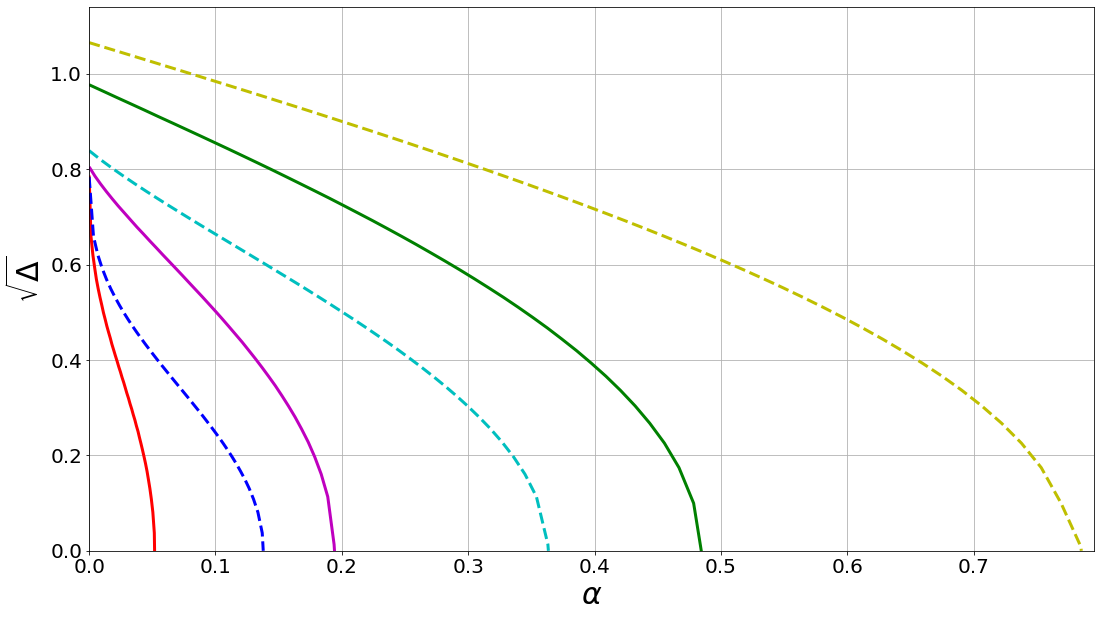
The paper presents a decimation scheme, which is mapped to neural network models for associative memory. This approach focuses on reconstructing a symmetric rank-PP matrix by iteratively estimating and subtracting individual patterns or vectors. Figure 1

Figure 1

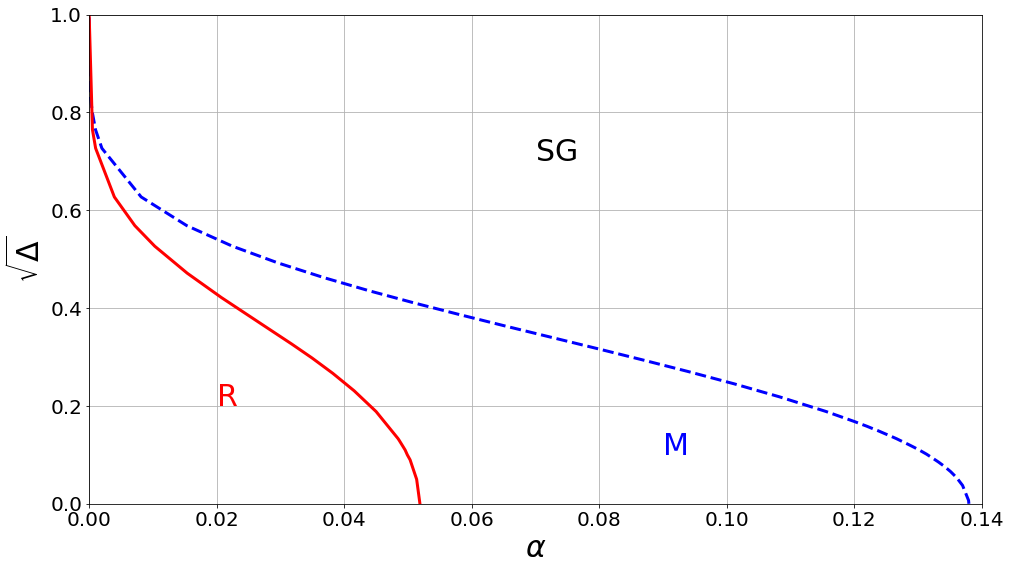
Figure 1: Phase diagrams for the indicated values of inverse temperature β\beta and sparsity ρ\rho. (a): the ``R'' phase is the retrieval phase.

The decimation procedure extracts one pattern at a time from Y\mathbf{Y}, by estimating the pattern and subtracting it from the observed matrix, iteratively. The resulting decimated matrix YR\mathbf{Y}_R is then used to find subsequent patterns through a Boltzmann distribution framework.

Theoretical Analysis and Performance

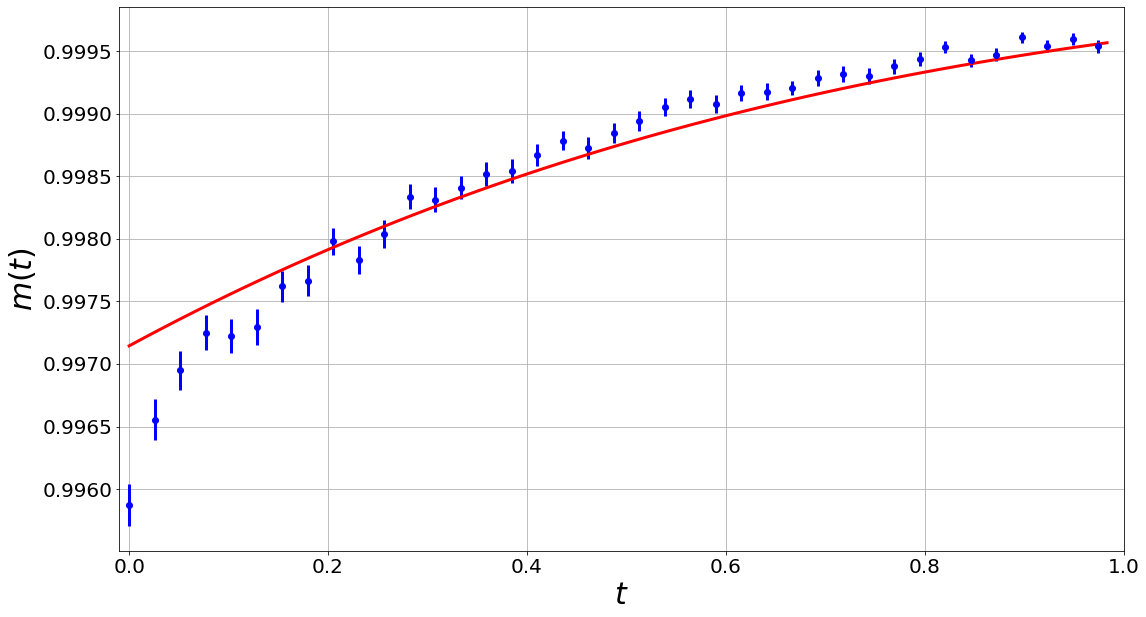
The paper provides a theoretical analysis showing that the decimation approach is efficient in reconstructing matrices with extensive rank. In the retrieval phase, neural network energy formulations like in Hopfield models facilitate pattern extraction. Figure 2

Figure 2: The accuracy of pattern retrieval is plotted vs the decimation parameter t=R/Pt = R/P.

When applied, the algorithm matches theoretical performance predictions, exhibiting that reconstruction is viable across substantial portions of phase space, a significant finding in scenarios with Gaussian noise and large N×NN \times N matrices.

Denoising Large Matrices

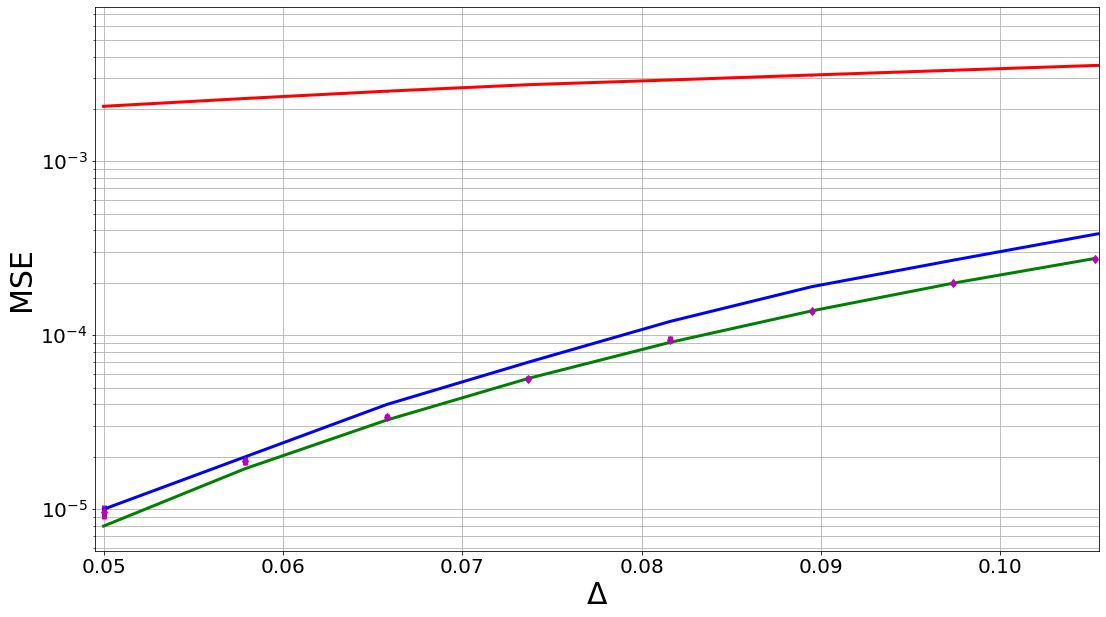
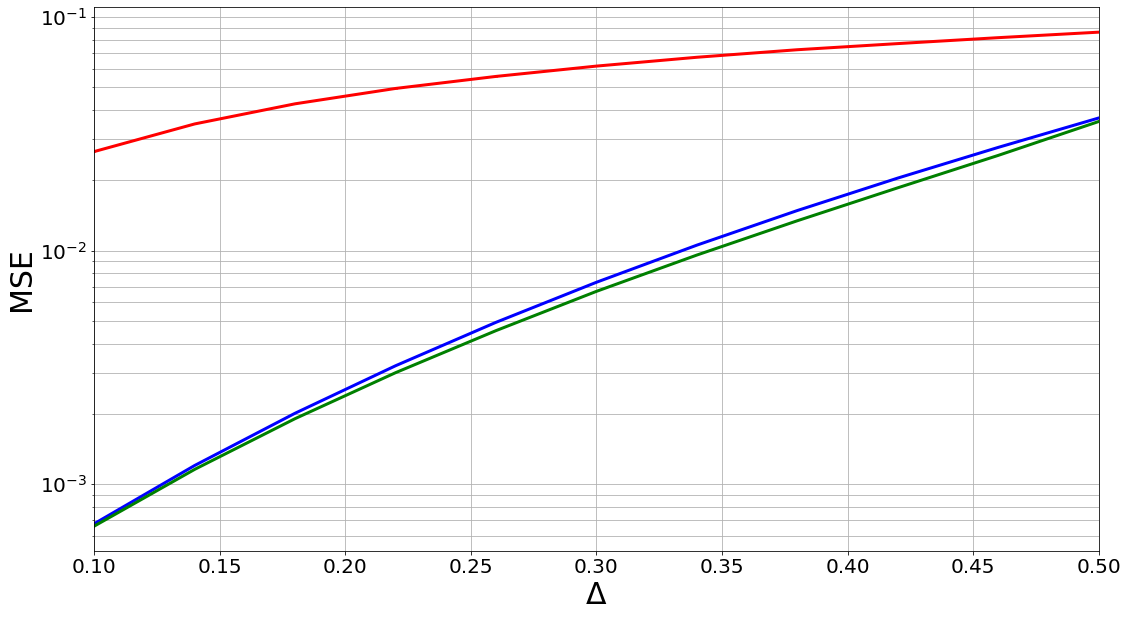
In addition to factorization, the decimation method effectively denoises matrices. It outperforming Rotation Invariant Estimators (RIEs) by leveraging pattern structure present in the underlying matrix. Figure 3

Figure 3

Figure 3: Matrix denoising: comparison between rotation invariant (red) and denoising based on decimation (blue and green).

Denoising is evaluated using mean square error metrics, demonstrating superior performance compared to traditional RIE denoisers.

Practical Considerations and Future Directions

The implementation of the decimation approach using a ground state search algorithm with a Monte Carlo method and simulated annealing proves the concept's validity for finite systems. However, the method's current oracle-based retrieval needs optimization to achieve practical performance scaling without exponential time complexity. Figure 4

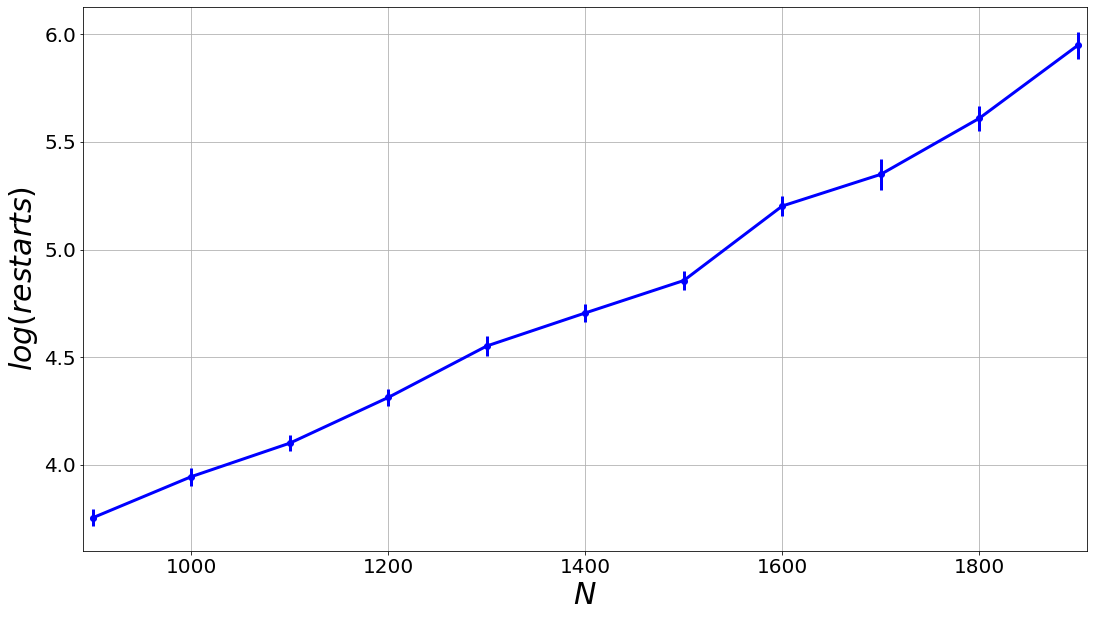
Figure 4: Logarithm of the number of restarts in the decimation procedure versus the number of signal components.

Further research is suggested to develop polynomial-time oracles for pattern retrieval, which could have significant implications for neural network training methodologies and broader applications in AI and machine learning.

Conclusion

The decimation algorithm offers a practical, theoretically sound method for matrix factorization and denoising in the challenging regime of extensive rank matrices. By mapping these problems to associative memory models, the research sets a foundation for future developments in neural network transformations and large-scale matrix analyses. Further algorithmic enhancements hold promise for broader applicability, especially in large, noisy data environments.

Paper to Video (Beta)

No one has generated a video about this paper yet.

Whiteboard

No one has generated a whiteboard explanation for this paper yet.

Open Problems

We haven't generated a list of open problems mentioned in this paper yet.

Collections

Sign up for free to add this paper to one or more collections.