Long time validity of the linearized Boltzmann equation for hard spheres: a proof without billiard theory
Published 8 Dec 2022 in math.AP and math-ph | (2212.04392v1)
Abstract: We study space-time fluctuations of a hard sphere system at thermal equilibrium, and prove that the covariance converges to the solution of a linearized Boltzmann equation in the low density limit, globally in time. This result has been obtained previously in [7], by using uniform bounds on the number of recollisions of dispersing systems of hard spheres (as provided for instance in [9]). We present a self-contained proof with substantial differences, which does not use this geometric result. This can be regarded as the first step of a program aiming to derive the fluctuation theory of the rarefied gas, for interaction potentials different from hard spheres.
The paper proves that the empirical covariance field of hard spheres converges globally to the solution of the linearized Boltzmann equation.
It introduces a novel probabilistic-combinatorial framework that bypasses traditional billiard theory to control recollision events.
The method provides explicit error bounds and offers potential extensions to more general interaction potentials beyond hard spheres.
Long-Time Validity of the Linearized Boltzmann Equation for Hard Spheres Without Billiard Theory
Introduction and Context
The paper "Long time validity of the linearized Boltzmann equation for hard spheres: a proof without billiard theory" (2212.04392) addresses the derivation of space-time fluctuation dynamics for a system of hard spheres at equilibrium in the low-density (Boltzmann-Grad) regime. Specifically, it establishes that the empirical covariance field converges globally in time to the solution of a linearized Boltzmann equation. Unlike previous approaches relying on geometric billiard theory to quantify recollisions, this work introduces a probabilistic-combinatorial argument built around dynamical cumulant expansions and innovative conditioning procedures that enable control of pathological collision histories.
This result is significant for two main reasons. First, it provides an alternative route to global-in-time propagation of fluctuation fields for hard spheres, facilitating extension to more general interaction potentials for which billiard-type geometric estimates may fail. Second, the removal of explicit assumptions on recollision numbers eliminates major obstacles for the fluctuation theory of rarefied gases in the Boltzmann-Grad scaling.
Model and Problem Formulation
Consider N hard spheres in the d-dimensional torus Λ, with standard binary elastic collisions, and initialize the positions and velocities by the grand canonical Gibbs measure tuned to the Boltzmann-Grad scaling (Nεd−1=1, where ε is the sphere radius or interaction range). The empirical time-evolved distribution field at time t,
πtε(g)=με1i=1∑Ng(zi(t)),
where g is a test function and με is a scaling factor, satisfies a law of large numbers converging to the Maxwellian-weighted spatial average.
The main object of interest is the fluctuation field ζtε(g), the properly rescaled centered empirical field, whose covariance one seeks to control:
ζtε(g)=με1/2(πtε(g)−Eε[π0ε(g)]).
The aim is to show that, as ε→0, the space-time covariance
Eε[ζtε(h)ζ0ε(g)]
converges (globally in time) to the solution of the fluctuation (linearized) Boltzmann equation:
⟨h,et(−v⋅∇x+L)g⟩L2(M(v)dz),
where L is the linearized Boltzmann collision operator.
Key numerical result: The error bound for the covariance deviance is nontrivial and explicitly controlled (see equation (Borne principale) in the text):
where the parameters θ and α are carefully selected to ensure convergence as ε→0.
Main Techniques: Cluster Expansion, Conditionings, and Pseudotrajectories
A central challenge—ubiquitous in rigorous derivations from particle to kinetic theory—is the presence of recollisions (dynamical memory effects), breaking the independence structure assumed in Boltzmann's molecular chaos hypothesis. Earlier work surmounted this using geometric billiard techniques to uniformly bound the number of recollisions per trajectory.
This work departs from billiard theory by leveraging:
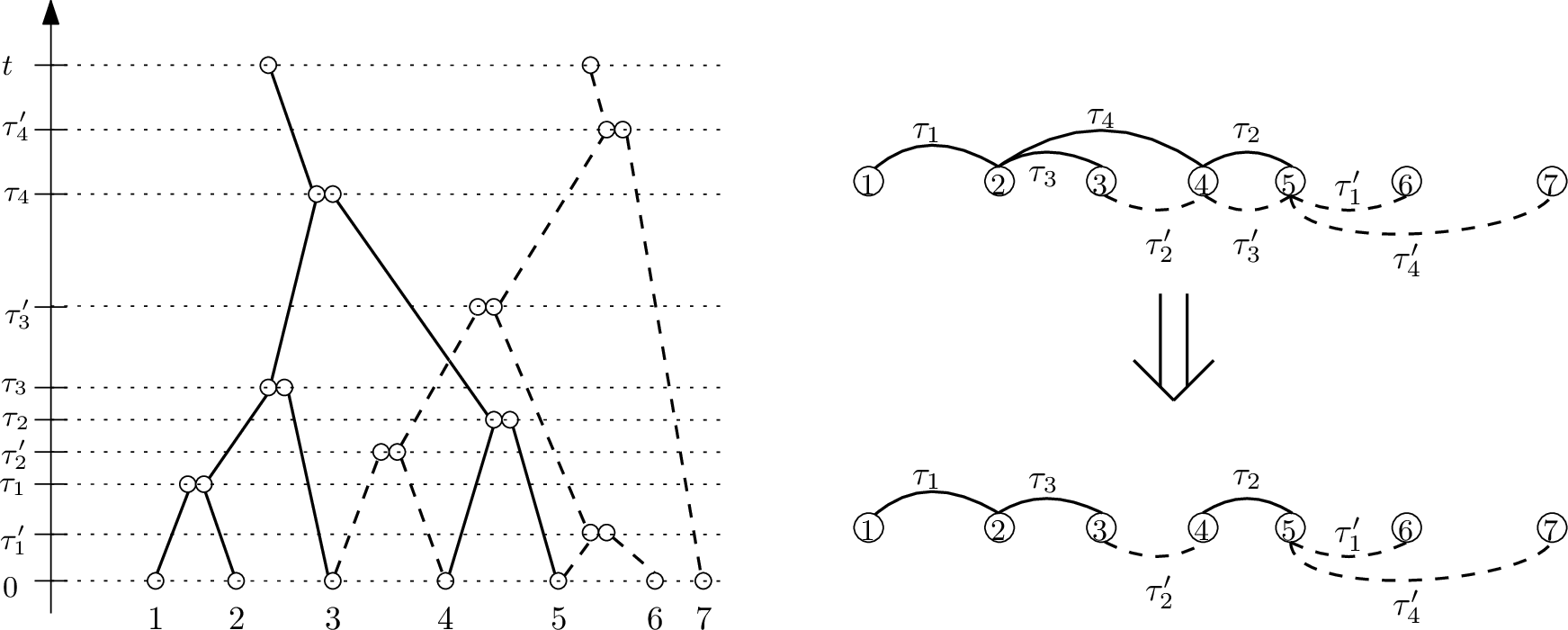
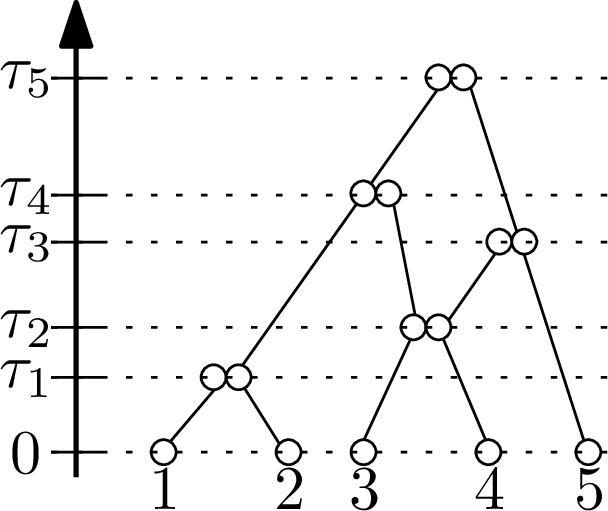
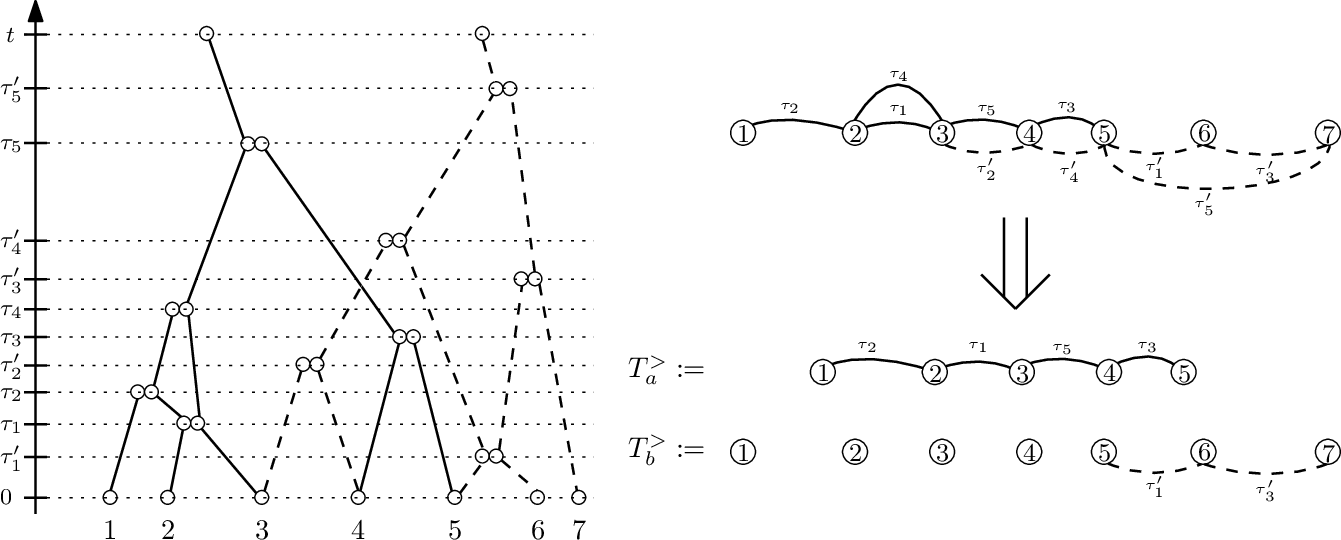
Enumeration along pseudotrajectories: The empirical field at time t is developed as a sum over "pseudotrajectories"—trees of possible creation, annihilation, and collision events, encoding possible particle histories that can contribute to the field even after possible recollisions.
Figure 2: Example of a pseudotrajectory associated to a specific sequence of creation, removal, and recollision events, encoding possible hard-sphere dynamical histories.
Recollision Control via Conditioning: Two levels of conditioning on initial data are introduced:
A symmetric conditioning, amounting to a constraint on the maximum size of distance clusters (see "distance cluster" definition), ensures that during small enough time intervals, no group of more than a moderate number of particles can interact, enforcing a local sparseness.
An asymmetric conditioning, acting on clusters dynamically associated to the distinguished ("tagged") particles, efficiently suppresses pathological histories where large numbers of recollisions would concentrate and cause combinatorial proliferation.
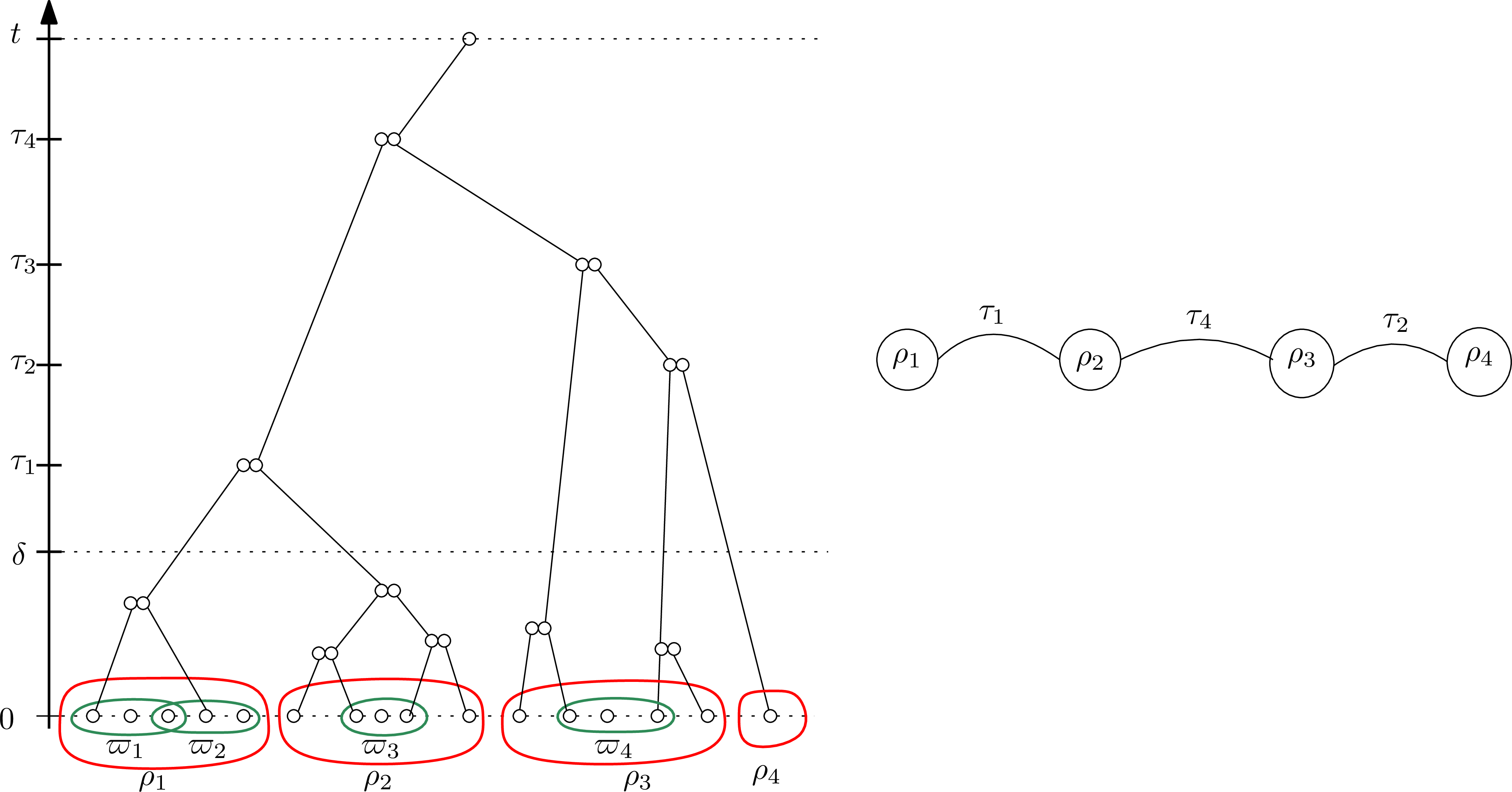
Figure 4: Example of a clustering tree construction, representing the hierarchical merging of dynamically interacting clusters over time.
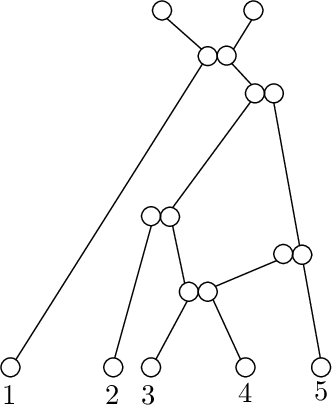
Figure 1: Illustration of "parent," "connector," and "tutor" events in the collision graph of a pseudotrajectory, central to the combinatorial structure tracking recollision genealogies.
Cluster Tree Representation and Sampling: Trajectories are recast as clusters and clustering trees (constructible from the collision graph), with explicit bounds supplied on the possible growth of cluster trees given the conditioning. This combinatorial structure enables precise tree expansions and analysis.
Figure 7: Construction of clustering sets—spatially localized groups of particles that may interact within a specified time window, forming the building blocks of the combinatorial expansion.
Dynamical Cumulant Expansion: To deal with high-order dependencies induced by recollisions, a dynamical cumulant expansion is performed, analogously to the static cumulant expansion of the initial equilibrium state. This enables the crucial control of nonpathological and pathological contributions.
Error Control and Estimations
The expansion breaks contributions to expectation values into principal and error terms, which are specifically controlled:
Main term: Admits a limiting description in terms of the pseudotrajectory structure matching the collision trees of the linearized Boltzmann equation, realizing the correct hierarchy in the scaling limit.
Cluster and Recollision error terms: Pathological terms, arising from large clusters or persistent recollisions, are shown to be exponentially small or polynomially controllable by the elaborate conditioning, cluster tree parameters, and dynamical cumulant bounds.
Explicit error estimates are provided for all forms of cluster/recollision phenomena, with detailed combinatorics and geometric measure bounds to ensure the validity of the kinetic description over macroscopic time scales.
Figure 3: Construction of clustering trees for a pair of dynamically correlated pseudotrajectories, a core technical element in the error analysis.
Convergence and Duality to the Linearized Boltzmann Equation
The explicit pseudotrajectory combinatorics permit a duality argument showing that the limiting covariance is exactly the time-correlation defined by the linearized Boltzmann evolution semigroup. The proof utilizes an iterative Duhamel expansion, matching particle collision trees with the iterated application of L in the kinetic framework.
Transition from particle system to kinetic limit then amounts to showing the negligible weight of histories in which recollision (i.e., deviation from first collision approximation) persists macroscopically.
Implications and Future Directions
Practical Implications:
This new, geometric-free proof significantly widens the class of physically relevant systems for which one may hope to rigorously derive kinetic fluctuation equations—beyond hard spheres to, e.g., compact support, possibly soft, or more general pairwise potentials.
The method is modular and can be adapted to nonequilibrium fluctuation theory, as well as to quantify higher order (non-Gaussian) fluctuation functionals.
Theoretical Implications:
The work clarifies the operational scope of the Boltzmann-Grad limit, highlighting that billiard-based geometric facts are not essential provided combinatorial/probabilistic regularization can be effectively enforced.
It formalizes in a rigorous sense the connection between kinetic (Boltzmann) and stochastic field (fluctuation) descriptions in dilute gases, crucial for both equilibrium and near-equilibrium statistical mechanics.
Future Directions:
Extension to more general interaction potentials, including soft-sphere or even non-pairwise interactions, exploiting the flexibility of the cumulant-based combinatorial method.
Investigation of higher order correlation function limits, large deviations, and full fluctuation theorems in kinetic scaling.
Generalization to multi-species systems, tracer-particle setups in complex backgrounds, and possibly quantum extensions.
Conclusion
This paper succeeds in removing a central technical obstacle in the derivation of kinetic fluctuation equations for hard sphere systems by bypassing billiard theory, instead providing combinatorially sharp and probabilistically robust control over recollision events. The approach rests on a dual cumulant expansion, a hierarchy of initial data conditioning, and careful description of collision trees and clustering, yielding a convergent description of the fluctuation field covariance for all kinetic times. The methodology paves the way for a broader, more flexible class of kinetic theory derivations in classical statistical mechanics.