- The paper introduces a novel framework that efficiently generates diverse and actionable recourse plans using advanced interpolation schemes.
- It employs QUAD and graph-based methods to optimize diversity and enforce actionable constraints, outperforming baseline models on standard datasets.
- Numerical results demonstrate a favorable trade-off between recourse cost and diversity, validated through Pareto frontiers and ablation analysis.
Feasible Recourse Plan via Diverse Interpolation
The paper "Feasible Recourse Plan via Diverse Interpolation" (2302.11213) addresses the challenge of generating recourse plans for individuals subject to automated decision-making systems. Specifically, it focuses on providing actionable, cost-effective, valid, and diverse sets of recourses for inputs resulting in unfavorable outcomes as classified by black-box models. The diversity requirement is critical; prior works either fail to enforce data manifold constraints or generate insufficiently diverse recourse options, limiting their practical and ethical utility.
Methodology: Diverse and Actionable Interpolation Schemes
The principal innovation is a recourse generation framework that leverages diverse interpolation schemes in both Euclidean and non-Euclidean spaces. The framework consists of two main algorithms: QUAD, which optimizes diversity via metrics such as Determinantal Point Processes (DPP), and its extensions incorporating actionability constraints via graph-based interpolation.
For tabular data, the paper justifies the use of Euclidean distance in constructing the similarity matrices central to diversity (for both DPP and QUAD), aligning with dominant conventions in the recourse literature. For scenarios where actionability must be strictly enforced, the graph interpolation scheme is essential; it encodes feasibility constraints directly in the selection process of prototypes by manipulating the underlying neighborhood structure in graph construction.
In handling mixed data types, the schemes exploit min-max normalization for continuous features and one-hot encoding for categorical variables. Interpolation with one-hot encodings is relaxed probabilistically, enabling the framework to propagate smoothly between categorical values while ultimately yielding sparse and interpretable recourses.
Numerical Results and Diversity-Cost Analysis
Empirical evaluation is conducted across standard datasets (e.g., German Credit, COMPAS), strictly following the preprocessing protocol established by the CARLA benchmark. The paper demonstrates quantitatively that the proposed methods outperform existing baselines (LORE, CCHVAE, CRUDS, DiCE) by enhancing both diversity (as measured by Anti-Diversity and DPP metrics) and manifold adherence.
A critical aspect is the nuanced examination of the trade-off between recourse cost and diversity, visualized via Pareto frontiers and sensitivity to the number of proposed recourse actions K.
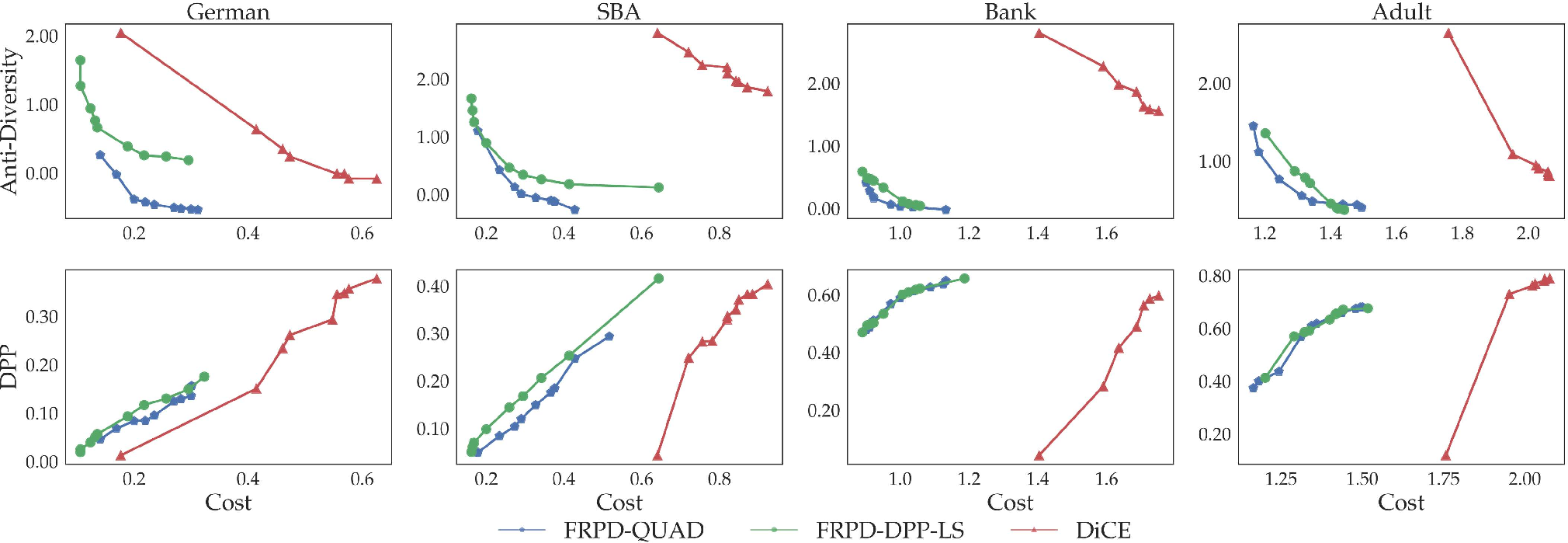
Figure 1: Cost-diversity Pareto frontiers indicate that the proposed methods achieve lower Anti-Diversity and DPP scores for a given cost, across multiple datasets.
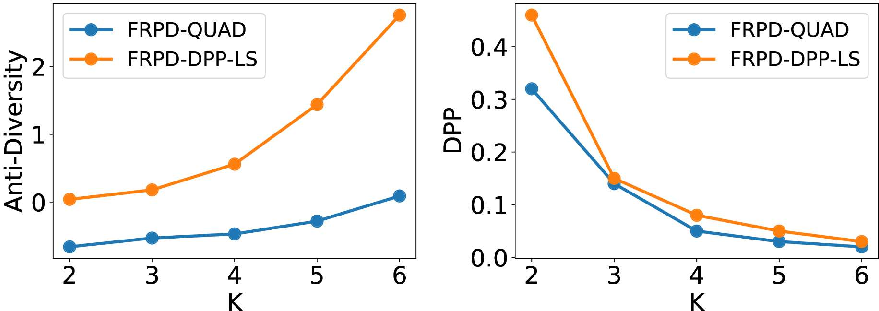
Figure 2: Increasing the number of recourses K results in diminishing gains in diversity, highlighting a cost-diversity saturation effect.
Further, direct comparisons illuminate issues in baseline methods: for example, DiCE generates recourses that violate the data manifold, while FACE does not produce sufficiently diverse options.
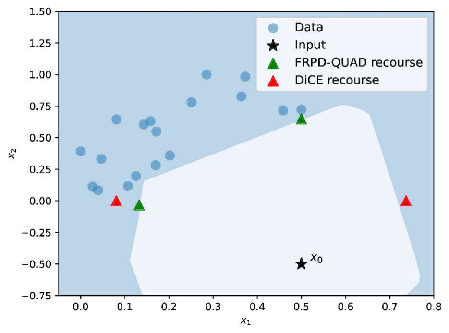
Figure 3: DiCE recourses (red triangle) do not respect the underlying data manifold, resulting in implausible recommendations.
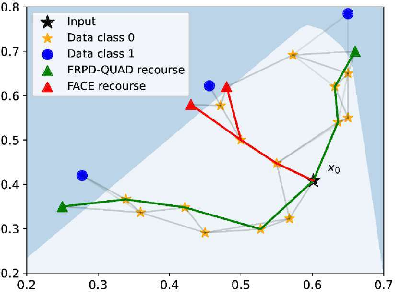
Figure 4: FACE recourses (red triangles) are clustered, exemplifying limited diversity.
Additional ablation studies reveal that the runtime of the proposed QUAD-based methods scales sub-linearly with the ambient data dimensionality, as computational cost is dominated by sample size and the number of prototypes. The model-agnostic property of the framework is also underscored: it trivially extends to black-box classifiers of arbitrary complexity (neural networks, tree ensembles, etc.).
Actionability and Sparsity Guarantees
The methodology enables explicit encoding of actionability and sparsity constraints. The graph-based recourse enumeration ensures that only transitions feasible for human agents are suggested. The approach can prune prototype candidates violating interpretability or action constraints before optimization—resulting in recourses that are both feasible and parsimonious.
Moreover, the framework supports black-box scenarios, enabling practical deployment regardless of model structure or feature modality. The performance on datasets of varying feature types and complexities confirms robust generalization.
Theoretical and Practical Implications
The main theoretical implication is the demonstration that diversity-maximizing recourse can be both algorithmically feasible and computationally tractable, circumventing the traditional trade-off versus cost and validity observed in prior works. From a practical standpoint, this enables recourse systems that do not merely perform "closest plausible fix" search, but instead produce sets of substantively different, actionable interventions—aligning with fairness, transparency, and user autonomy mandates.
The approach’s adaptability to other domains (such as high-dimensional vision or NLP data) is noted, although the paper restricts itself to structured/tabular contexts given the complexities of defining recourse feasibility and actionability in such settings. The framework’s modular construction, however, lays the groundwork for such extensions.
Conclusion
The paper establishes an effective and extensible framework for generating diverse, actionable, and feasible recourse plans for automated decision systems. Through rigorous empirical and theoretical analyses, it demonstrates that diversity and validity constraints can be reconciled, achieving superior performance on multiple benchmarks in both diversity and feasibility measures. Future research directions include extending this framework to unstructured domains (e.g., images, text) and refining actionability constraints for complex real-world tasks.