- The paper introduces an efficient phase-field method that integrates deviatoric stress split for accurate shear fracture simulations.
- It validates the model with benchmark problems including direct shear tests and slope failure analyses under varied loading conditions.
- The model shows robustness through insensitivity to phase-field length parameters, boosting computational efficiency in geomechanical simulations.
An Efficient Phase-Field Model of Shear Fractures Using Deviatoric Stress Split
Introduction to Phase-Field Models for Shear Fractures
Phase-field models have emerged as robust tools for simulating complex fracture patterns in brittle materials. The paper introduces an efficient phase-field approach utilizing deviatoric stress decomposition (DSD) to model shear fractures. This method represents a comprehensive adaptation of cohesive shear fracture models into the DSD framework, enhancing the ability to simulate geomechanical problems with precision.
The traditional methods in finite element modeling of shear fractures include Discrete Fracture Models (DFMs) based on Linear Elastic Fracture Mechanics (LEFM) and Smeared Fracture Models (SFMs) grounded in Continuum Damage Mechanics (CDM). Meanwhile, phase-field models provide thermodynamically consistent approximations suitable for diverse fracture dynamics, especially in geo-structural simulations.
Governing Equations and Stress Decomposition
The paper delineates the governing equations for phase-field modeling of crack propagation. The phase-field approach transitions discrete fracture surfaces into continuous representations, incorporating a fracture surface density function γ(d) via phase-field variable d. This formulation captures the transition from intact to fractured states within the continuum domain.
Deviatoric stress decomposition involves splitting strain into volumetric and deviatoric components. The paper adapts the deviatoric stress split s=e, contributing to characterizing fracture behavior under shear. This approach simplifies damage criteria by directly influencing shear modulus, thereby allowing expansive application beyond Mohr-Coulomb models often used in geomechanical fracture scenarios.
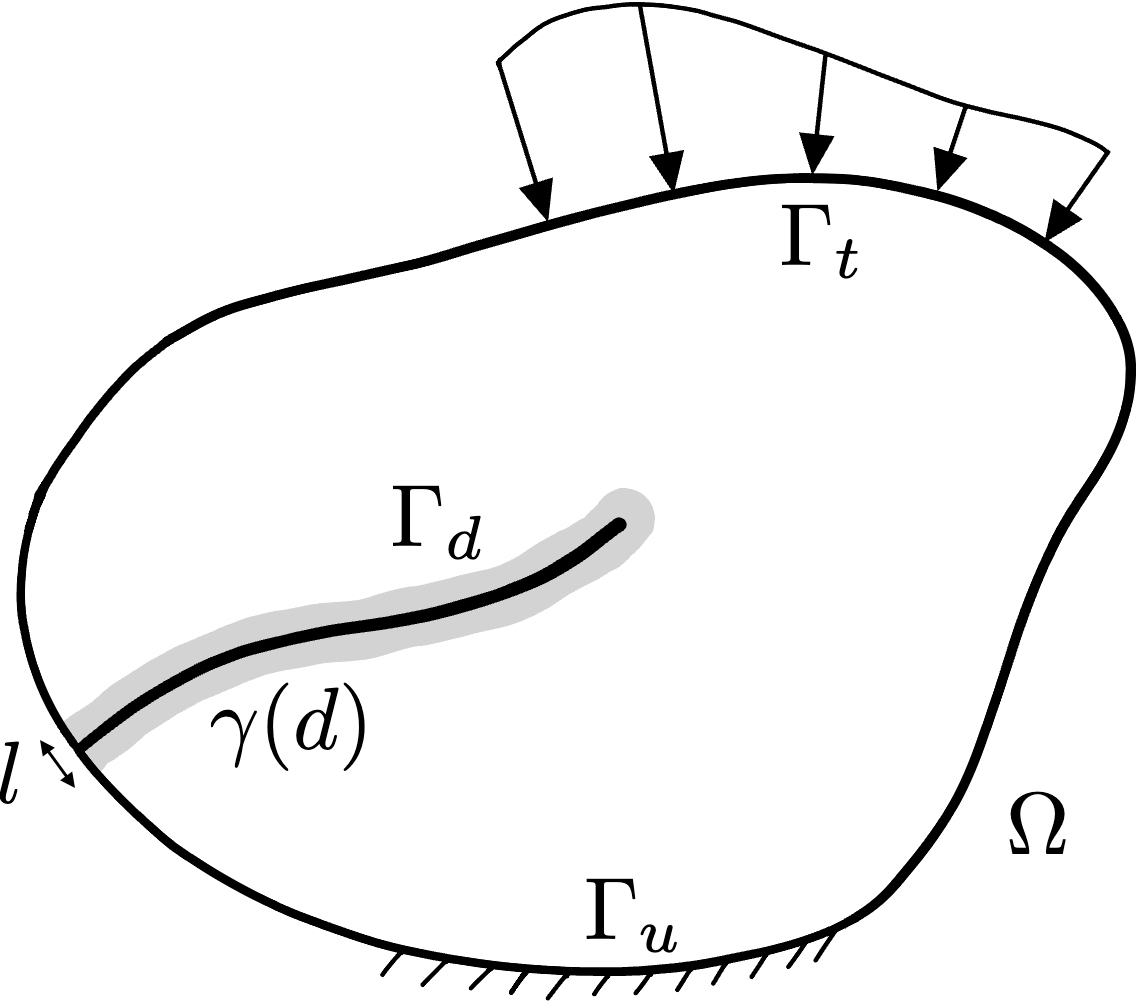
Figure 1: Domain Omega with boundary Gamma, Dirichlet boundary Gamma_u, and Neumann boundary Gamma_t. The discontinuity surface is represented by Gamma_d with its phase-field diffused representation as gamma(d).
Benchmark Problem and Numerical Validation
The authors verify their model through benchmark problems like direct shear tests, biaxial compression, and slope failure analysis. These scenarios demonstrate the model's capability in capturing failure modes under varied loading conditions.
Direct Shear Test
The direct shear test validates horizontal fracture propagation within the material domain under controlled boundary conditions. The study displays satisfactory agreement between simulation outputs and theoretical expectations in terms of peak and residual shear forces.
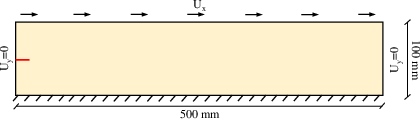
Figure 2: Direct shear test setup. The domain is 500 mm long, 100 mm tall, and an initial 10-mm horizontal fracture is carved in the middle of the left boundary --red fracture--.
The model demonstrates insensitivity to phase-field length parameters, a significant advantage for computational efficiency and reliability when meshing domains for simulation. Figures in the paper highlight the consistency across varying mesh sizes and phase-field parameters, underlining model robustness against discretization changes.
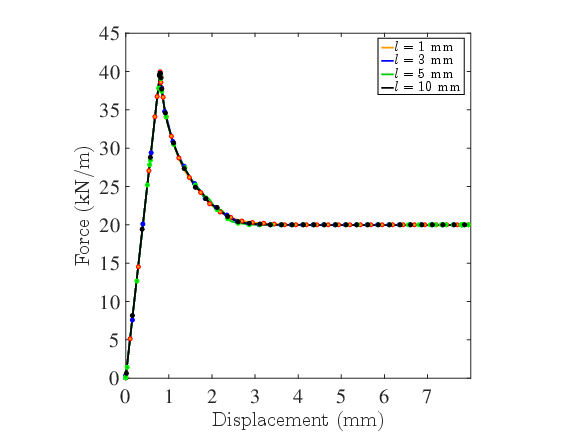
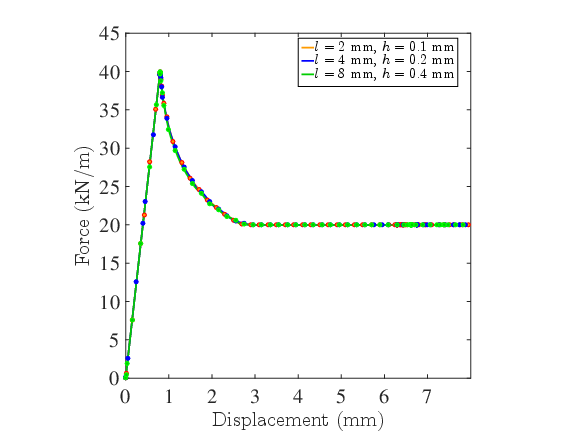
Figure 3: Force-displacement curves for the direct shear test with several phase-field length parameters, l.
Slope Failure Analysis
Slope stability is assessed under practical loading conditions, revealing complex shear band formations. Multiple damage paths are examined, showcasing the model's ability to capture localized strain progressions in slopes subjected to external forces. The model is effective in predicting failure onset and progression, corroborated by limit-equilibrium methods.
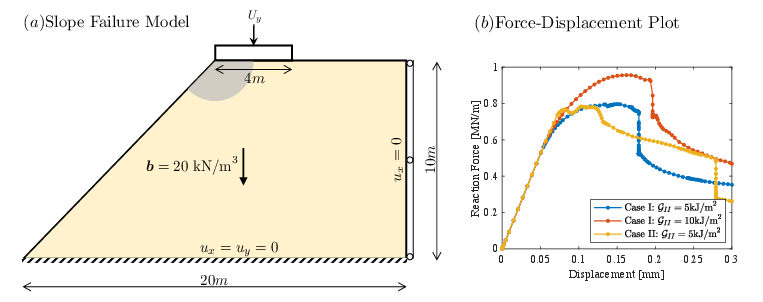
Figure 4: Slope failure analysis. Model setup for the slope failure analysis indicating the domain configuration.
Conclusion
The phase-field model with DSD for shear fractures offers substantial improvements in simulating fracture mechanics within geo-structural contexts. The model's ability to automatically compute fracture initiation, propagation, and final patterns without pre-specified orientations marks a significant advancement over traditional methods. Future work may extend these formulations into three-dimensional realms or incorporate fluid-driven fracture dynamics.
In summary, this paper provides a rigorous methodological framework and computational strategy for simulating shear fractures in brittle materials. The introduction of DSD enhances phase-field approaches, promising applications across diverse geotechnical and structural engineering challenges.