- The paper introduces reversible call options to mitigate liquidation spirals by incentivizing external collateral support.
- It leverages the Black-Scholes model to accurately price options, optimizing collateral incentives during market downturns.
- Empirical results over 41 months show that Miqado effectively restrains collateral release, reducing systemic instability compared to traditional mechanisms.
Mitigating Decentralized Finance Liquidations with Reversible Call Options
Introduction
The paper "Mitigating Decentralized Finance Liquidations with Reversible Call Options" (2303.15162) addresses the inherent challenges and risks associated with liquidation mechanisms in Decentralized Finance (DeFi). Liquidation processes serve a dual function: they protect lenders from capital losses but can simultaneously incite systemic instability and liquidation spirals. This work introduces an innovative financial instrument termed "reversible call options" to replace traditional liquidation mechanisms, creating a protocol named Miqado. The Miqado protocol mitigates liquidation events by incentivizing external entities to invest additional collateral, thus preventing immediate collateral sales and granting borrowers more time to stabilize their positions.
Background and Motivation
DeFi operates on smart contracts within blockchain environments like Ethereum, providing a decentralized alternative to traditional financial services such as lending and borrowing. However, DeFi borrowers face significant risks due to fixed spread liquidation (FSL) mechanisms, which can trigger a cascade of liquidations during price fluctuations, further destabilizing markets. Liquidation spirals occur when collateral prices plummet, leading to additional liquidations and market-wide panic. Moreover, liquidations are a primary source of miner extractable value (MEV), disrupting miner incentives and undermining blockchain security.

Figure 1: A real liquidation event with a subsequent downward price trend of the collateral asset. The liquidator immediately sold parts of the redeemed ETH collateral from a Compound liquidation, which decreased the ETH price on Uniswap by 6.95\%.
Miqado Protocol Architecture
The Miqado protocol introduces reversible call options as a mechanism to alleviate liquidation pressures. To implement Miqado:
- Initialization: A supporter contributes additional collateral to a borrowing position when its health factor falls below one, buying the right to mitigate liquidation through reversible call options.
- Pre-Maturity: The borrower can terminate the option before maturity by compensating the supporter, thus incentivizing the initial collateral support.
- Maturity: At maturity, the supporter can either proceed with a full takeover of the borrowing position or default, determining their financial payoff.
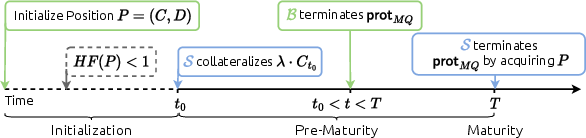
Figure 2: High-level overview of the Miqado protocol which realizes a reversible call option in DeFi.
Pricing and Practical Implementation
The Miqado protocol employs the Black-Scholes model to price reversible call options, allowing supporters to evaluate their investments based on expected volatility and interest rates. This involves calculating an optimal premium factor to ensure profitability for supporters while mitigating systemic risks. Practically, Miqado can coexist with traditional liquidation processes by implementing a buffer strategy to manage support opportunities effectively.
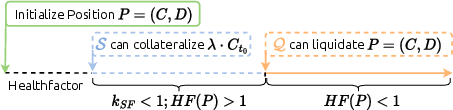
Figure 3: Practical Instantiation of Miqado on top of a traditional liquidation mechanism. The supporter has an advantage over the liquidator to support a temporarily unhealthy position.
Empirical Evaluation and Results
The empirical analysis spans 41 months, revealing that traditional FSL liquidations resulted in substantial collateral release ($1.33$B USD), which exacerbated price declines. Miqado effectively restrained collateral release, mitigating liquidation spirals and enhancing market stability by maintaining a controlled supply of collateral within lending pools.
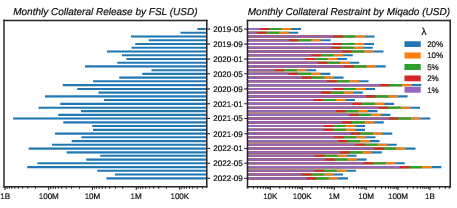
Figure 4: Over a time-frame of~41 months, the collateral release by the FSL mechanism accumulates significantly, whereas the Miqado protocol restrains additional collateral in the lending pool.
Conclusions
Miqado represents a strategic innovation in DeFi lending, providing a viable path to stabilize lending markets by reducing systemic risks associated with liquidation spirals and over-liquidation. By leveraging reversible call options, Miqado offers a dual benefit: protecting lenders from losing capital while giving borrowers an opportunity to recover from price swings without triggering mass collateral sales. Future developments may focus on refining the pricing models and exploring broader applications of reversible financial instruments in DeFi ecosystems, potentially setting new standards for financial stability in decentralized arenas.
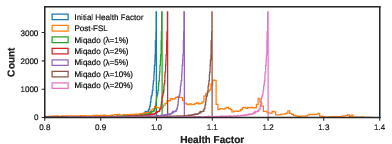
Figure 5: The health factor distributions pre- and post-FSL liquidations, with Miqado showing improvements in restoring borrowing position health.