- The paper introduces a recursive method that derives closed-form solutions for the SSH model in arbitrary dimensions.
- It demonstrates how the vectored Zak phase generalizes bulk topological invariants, linking them to edge, hinge, and corner states.
- The study compares the hierarchical structure with the BBH model, highlighting implications for engineering robust higher-order topological insulators.
Analytic Solution and Hierarchical Structure in the n-Dimensional SSH Model
Overview and Motivation
The Su-Schrieffer-Heeger (SSH) model is a paradigmatic 1D lattice model for describing topological phases, originally formulated for polyacetylene (Heeger et al. 1988). Higher-order topology, whereby robust states appear at boundaries of codimension greater than one, has received sustained interest both theoretically and experimentally, following the bulk-edge correspondence's extension to bulk-corner and bulk-hinge correspondence in recent years. The present work "Analytic Solution of n-dimensional Su-Schrieffer-Heeger Model" (2304.11933) systematically derives analytic solutions for SSH models in arbitrary dimension, reveals their hierarchical structure, introduces the vectored Zak phase as a generalized topological invariant, and links their bulk topology to higher-order boundary states across dimensions. The study also situates the SSH model within the framework of hierarchical topological insulators and provides a comparative analysis with the Benalcazar-Bernevig-Hughes (BBH) model.
Hierarchical Construction and Analytic Solution
The nD SSH model is constructed recursively: the unit cell and Hamiltonian at dimension n are composed from the (n−1)D counterpart by embedding an extra sublattice degree of freedom, labeled naturally in binary notation. This hierarchical structure enables a closed-form analytic solution for the eigenvalues and eigenfunctions in arbitrary dimension. The Hamiltonian recursively aggregates lower-dimensional blocks via Kronecker products, resulting in a 2n×2n matrix for the nD case:
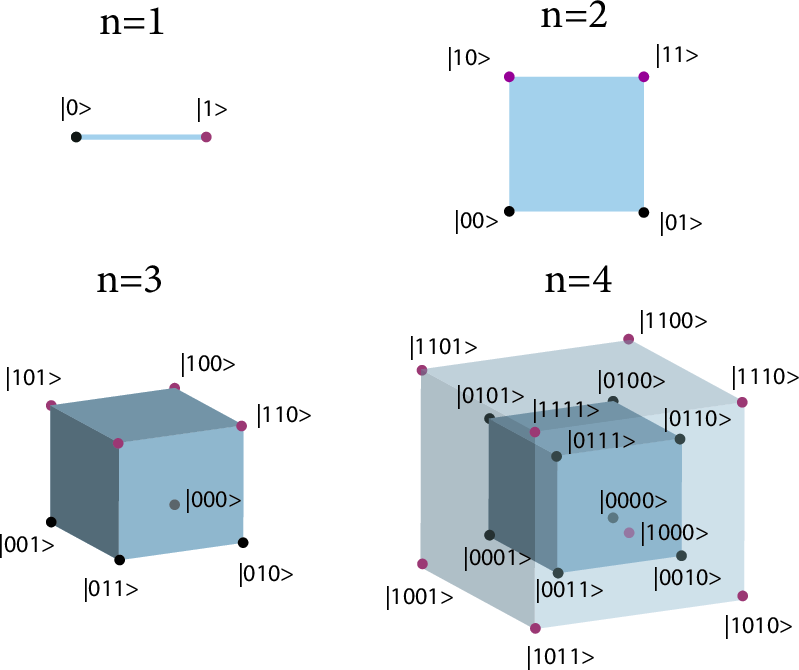
Figure 1: Unit cells of 1D, 2D, 3D, and 4D SSH models illustrating hierarchical sublattice structure. The 4D cell forms a hypercube.
The eigenenergy for the nD SSH model is given by:
E(nD)=∑isi∣ρi∣
where si∈{±1} and ρi encodes the hopping amplitudes and phase for each dimension. The bulk eigenstates are recursively built from the 1D SSH solution, yielding explicit forms for all bands, including higher-order (corner, hinge) states.
Topological Invariants: Vectored Zak Phase
The SSH model's 1D topology is well-captured by the winding of ρ(k), equivalent to the Zak phase—a Berry phase describing the polarization or Wannier center. In nD, the Zak phase becomes a vector (Zx,Zy,...), with each component corresponding to the winding in a Cartesian direction, thus generalizing the bulk topological invariant.
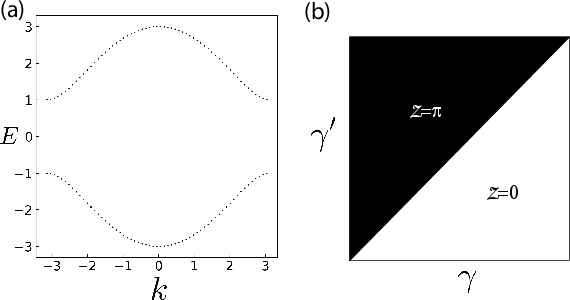
Figure 2: (a) Bulk spectrum of the 1D SSH model for ∣γ/γ′∣=2.0. (b) Topological phase diagram in terms of the Zak phase.
For the 2D SSH model, the topological phase diagram—classified by (Zx,Zy)—predicts the emergence of edge ((π,0) or (0,π)) and corner ((π,π)) states. Recursively, higher dimensional SSH models exhibit more intricate boundary state structures, including intermediate-order hinge states in 3D, as evidenced in the corresponding phase diagrams.
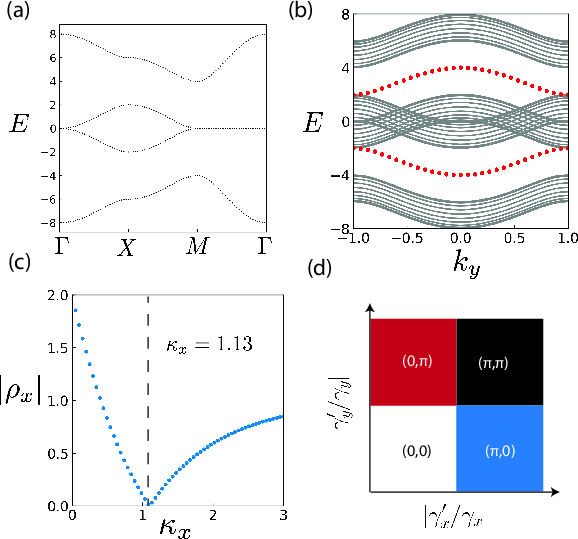
Figure 3: (a) Bulk energy spectrum and (d) topological phase diagram of the 2D SSH model with respect to vectored Zak phase.
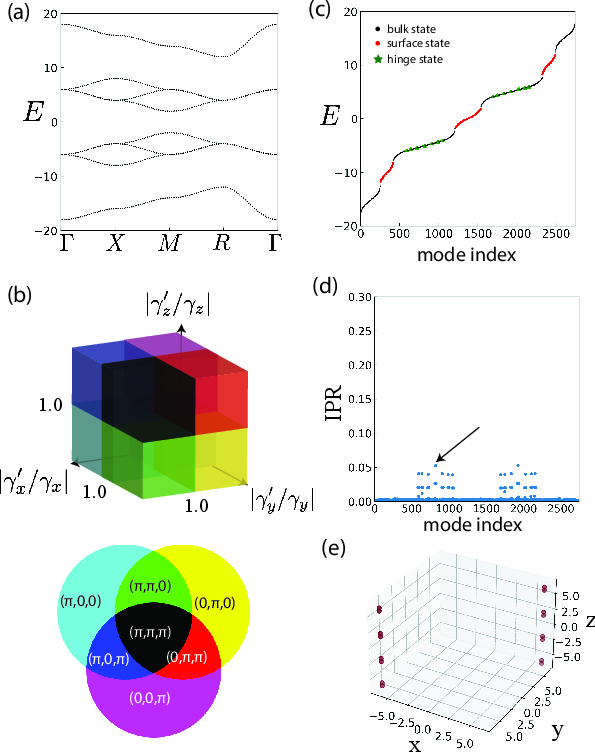
Figure 4: (a) Bulk energy spectrum and (b) topological phase diagram of the 3D SSH model. (c/d/e) Identification of hinge states as intermediate-order topological states.
The generalized topological invariant Q(l) is defined as the product of l nontrivial Zak phases, ensuring robust boundary states of codimension l.
Bulk-Edge and Higher-Order Correspondence
The combination of hierarchical Hamiltonian structure and vectored Zak phase allows the n-(n−l) bulk-boundary correspondence to be established. For each direction with nontrivial winding, analytic solutions predict the existence of exponentially localized edge, hinge, or corner states—protected by subsymmetry or partial chiral symmetry within the hierarchy.
For finite systems, quantization conditions on quasi-wavenumber connect the emergence of imaginary solutions to the winding of ρi, precisely capturing the boundary state's localization characteristics:
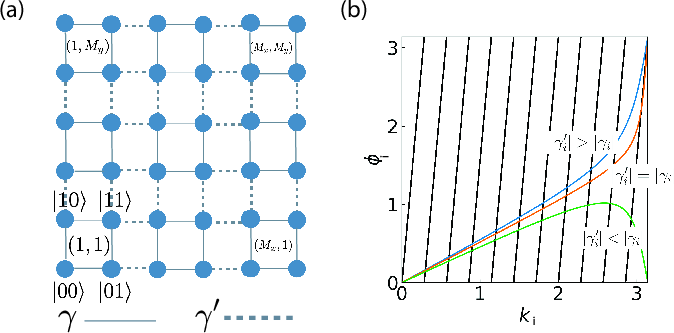
Figure 5: Open boundary condition quantization in the 2D SSH model yields real or imaginary quasi-wavenumber solutions depending on topological phase.
The robustness of these states is further analyzed under local perturbations. While chiral symmetry guarantees the protection of zero-energy modes, the hierarchical structure establishes that edge and hinge states remain robust even when only subchiral symmetries are preserved (i.e., perturbation along certain directions):
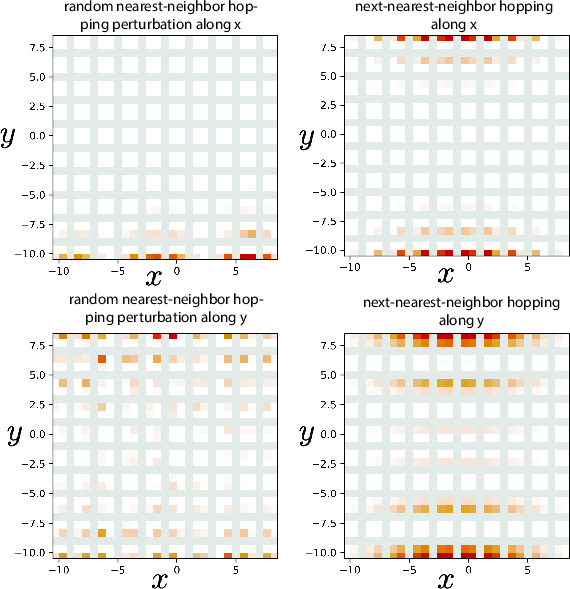
Figure 6: Edge state resilience in 2D SSH under perturbations along x and y directions—robustness stems from hierarchical symmetries.
Hierarchical Topological Insulators and Comparison with BBH Model
The hierarchy extends to the BBH model, originally formulated for higher-order topological insulators hosting quantized corner states via synthetic flux insertion. The analysis confirms that the BBH model can be written in a similar recursive block fashion and possesses a hierarchy of topological boundary states comparable to SSH models.
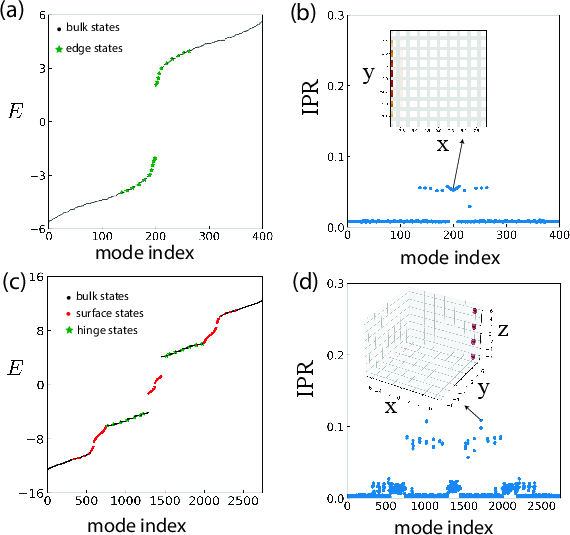
Figure 7: (a/c) Eigenenergy spectra and (b/d) IPR analysis of the 2D/3D BBH model. Hinge states exist without corner states for specific parameter regimes.
Topological invariants for the BBH model are constructed via Wilson loops with selective gauge choice, and the hierarchy enables analytic solution to all eigenstates. The presence or absence of corner states in the BBH model mirrors the SSH case, underscoring the universality of hierarchical topological insulators defined by inter-dimensional Hamiltonian structure and vectored Zak phase.
Implications and Future Directions
This analytic foundation for nD SSH models offers a framework for systematic study of hierarchical topological insulators. The identification of intermediate-order states, fractional topological states governed by partial band topology, and explicit recursive solutions to wavefunctions and eigenenergies are relevant for:
- Engineering robust quantum devices leveraging higher-order topology (waveguides, quantum computation platforms).
- Understanding the interplay between symmetry breaking, synthetic dimensions, and topological protection.
- Extending hierarchical constructions to non-crystalline, photonic, and acoustic systems.
- Guiding experimental realization of SSH and BBH models in d>3 via synthetic dimensions and control of inter-sublattice couplings.
Conclusion
"Analytic Solution of n-dimensional Su-Schrieffer-Heeger Model" (2304.11933) establishes a recursive, hierarchical analytic structure for SSH models in arbitrary dimension, elucidates the generalization of bulk-boundary correspondence via the vectored Zak phase, and demonstrates how a hierarchy of topological boundary states is protected. Both SSH and BBH models are unified as hierarchical topological insulators, capable of hosting intermediate-order states reflecting band topology only in partial Brillouin zones. This work provides foundational insight into the theoretical classification, analytic solvability, and practical design of higher-order topological materials.