- The paper introduces operational semantics for MeTTa, establishing formal state algebras and rewrite rules similar to those in the JVM and Ethereum Yellow Paper.
- It demonstrates compiler correctness via bisimulation by translating MeTTa to rho-calculus, ensuring secure and independent implementations.
- The study incorporates resource-based transition costs and meta-level computation, paving the way for robust AGI interaction frameworks.
Operational Semantics of MeTTa
The paper "Meta-MeTTa: an operational semantics for MeTTa" (2305.17218) provides a comprehensive operational semantics for MeTTa, a language developed to facilitate the interaction between humans and AGIs within the OpenCog and Hyperon projects. The authors detail the structural and computational foundations of MeTTa, akin to the JVM specification or Ethereum's Yellow paper, to assist developers in creating compliant implementations of MeTTa clients.
Common Language for Computational Dynamics
The authors assert that physics, computer science, and mathematics converge on a model shape adequate for computation, involving an algebra of states and "laws of motion." Computer science typically represents these laws through rewrite rules dictating state transitions. The paper exemplifies this concept using several calculi—λ-calculus, π-calculus, rho-calculus—and the JVM, revealing consistent patterns in state algebra and transitions.
Examples from Computer Science: The paper illustrates operational semantics through λ-calculus, π-calculus, and rho-calculus. For instance, λ-calculus employs α-equivalence and β-reduction for state congruence and transitions, respectively. The rho-calculus differs slightly by incorporating built-in processes, offering flexibility to define infinite terms and facilitate interactions with remote data sources.
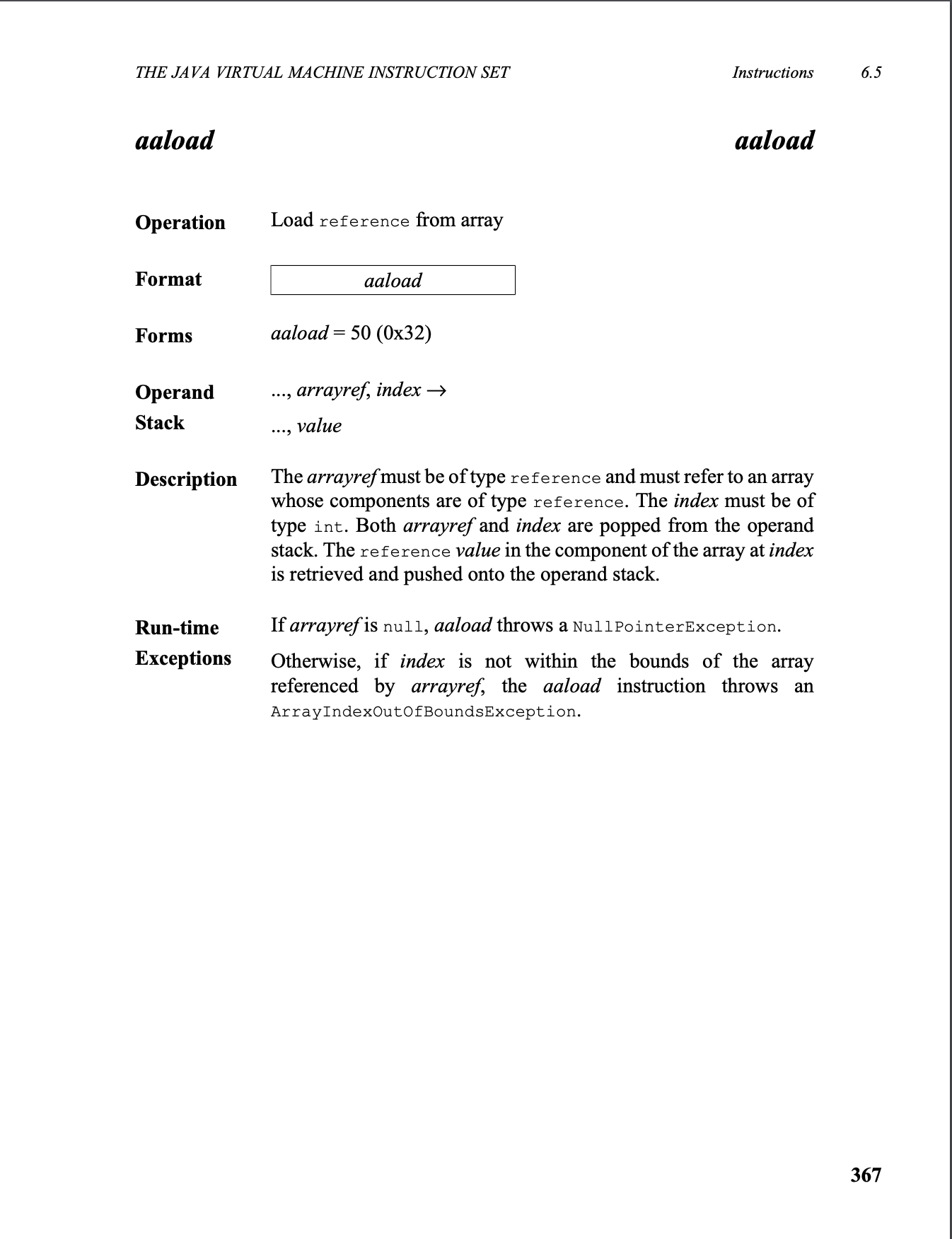
Figure 1: AALOAD instruction specification
The JVM specification demonstrates operational semantics where states encompass stacks, heaps, and registers, unlike the direct term states in the previous examples.
MeTTa's Semantics Presentation
MeTTa's semantics necessitates a dual presentation of algebra of states and rewrite rules, modeling computation akin to a meta-circular evaluator. This recursive formalization offers advantages such as program equality, independent implementations, and meta-level computation capabilities.
Effective Program Equality: Identified as bisimulation, program equality facilitates correctness proofs for MeTTa implementations, promoting correct-by-construction development methodologies. This approach mitigates bytecode injection attacks and concurrency issues by formalizing operational semantics rigorously.
Independent Implementations: Leveraging a specification akin to Ethereum's Yellow Paper, MeTTa fosters multiple compliant implementations, decentralizing development costs and risks while enhancing robustness against individual project failures.
Meta-level Computation: Future prospects include extensive modeling by diverse intelligences, potentially AGIs, expanding MeTTa's adaptability. The complexity of MeTTa's semantics bridges λ-calculus simplicity and JVM complexity, advocating for WYSIWYG versions.
Transition System and Bisimulation
The paper elucidates the transition system in MeTTa, recovering bisimulation notions pertinent for correctness evaluation of compilation. The authors propose adapting approaches from asynchronous π-calculus for bisimulation, addressing the intricacies of substitutions in rules.
Cost of Transitions: MeTTa adopts Ethereum's token-based resource management to prevent denial-of-service attacks, introducing computational effort objects (EOs) purchased via tokens. This framework precisely defines transition costs, aligning with Ethereum's stepwise computational resource policies.
Compilation from MeTTa to rho-Calculus
The authors develop a compiler from MeTTa to rho-calculus, showcasing the operational semantics value. Utilizing channels for registers, this translation incorporates semantic functions defining configurations and evaluations.
Compiler Correctness: The translation is correct-by-construction, maintaining bisimulation relations between MeTTa computations and their rho-calculus analogs. The formal proof employs input, working, and output registers as barbs for bisimulation, establishing correctness through semantic bridges.
Resource-bounded Compilation: Extending the translation to rholang requires accounting for resource constraints, reprising the correctness proof strategy with enhanced complexity due to resource management.
Conclusion
The paper delivers two operational semantics versions for MeTTa: one tailored for private implementations, another for decentralized settings. Future work includes deriving a type system using Meredith and Stay's OSLF, incorporating spatial and behavioral types for MeTTa clients. This groundwork promises advancements in type-driven program equality and robust decentralized application deployment.