- The paper introduces a novel process matrix tomography method using a passively-stable quantum SWITCH to experimentally verify indefinite causal orders.
- It employs comprehensive time-bin encoded measurements and an ultra-fast optical switch in a Mach-Zehnder interferometer to achieve passive phase stability.
- The reconstructed process matrix shows a fidelity of approximately 0.920, confirming robust causal non-separability and potential for advanced quantum computing.
Higher-order Process Matrix Tomography of a Passively-Stable Quantum SWITCH
The paper introduces a novel methodology for characterizing higher-order quantum operations, specifically deploying a passively-stable quantum SWITCH architecture. The development marks a significant advancement in the experimental verification of indefinite causal orders (ICO) in quantum processes through complete process matrix tomography.
The formalism underlying higher-order quantum operations is centered on the process matrix, which accounts for quantum operations that manipulate other quantum operations. The Choi-Jamiołkowski isomorphism is integral in deriving a mathematical representation of these processes, transforming quantum channels into standard matrices.
The quantum SWITCH, as a device leveraging ICO to enable computational advantages, is mathematically formulated via process vectors. These vectors describe coherent superpositions of different quantum channel orders, essentially capturing the SWITCH as a transformation of quantum channels beyond classical causal structures.
Experimental Setup and Passive Stability
The experimental realization of the quantum SWITCH focuses on achieving passive phase stability using a time-bin encoding method for control qubits. This is accomplished through an ultra-fast optical switch (UFOS)-mediated Mach-Zehnder interferometer, which stabilizes phase relationships over long-term measurements crucial for exhaustive process tomography.
The optical setup (Figure 1) is tailored to sustain experimental consistency, facilitating the execution of extensive sets of operations and measurements needed to reconstruct the complete process matrix. This experimental configuration is robust against phase drifts, allowing thorough data acquisition without frequent recalibration.
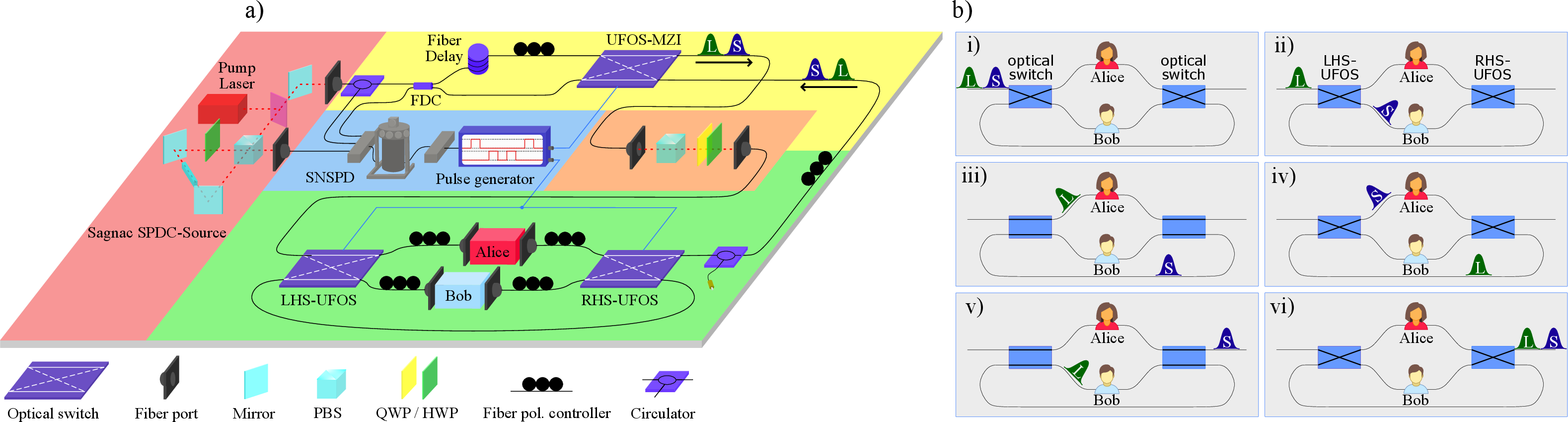
Figure 1: The complete experimental setup illustrating the major components involved in generating and measuring time-bin control qubits and executing the SWITCH operation.
Process Matrix Tomography Protocol
A comprehensive process matrix tomography is conducted by performing a vast array of measurements. This includes preparing standard quantum states and executing diverse quantum instruments to interact with the SWITCH. The methodology extends traditional quantum process tomography by incorporating superposition states as inputs and outputs, demanding an extensive evaluation of settings to ensure completeness.
The core challenge in this protocol is the scaling of settings, which increases exponentially compared to conventional tomography. Nevertheless, this comprehensive methodological approach successfully reconstructs the process matrix, predicting quantum behavior reliably.
Results and Analysis
The experimentally reconstructed process matrix (Figure 2) closely aligns with theoretical expectations, confirming high fidelity in the deployment of the quantum SWITCH. The fidelity measured at approximately 0.920 highlights the efficacy of the passive stability approach and the accuracy of the implemented quantum operations.
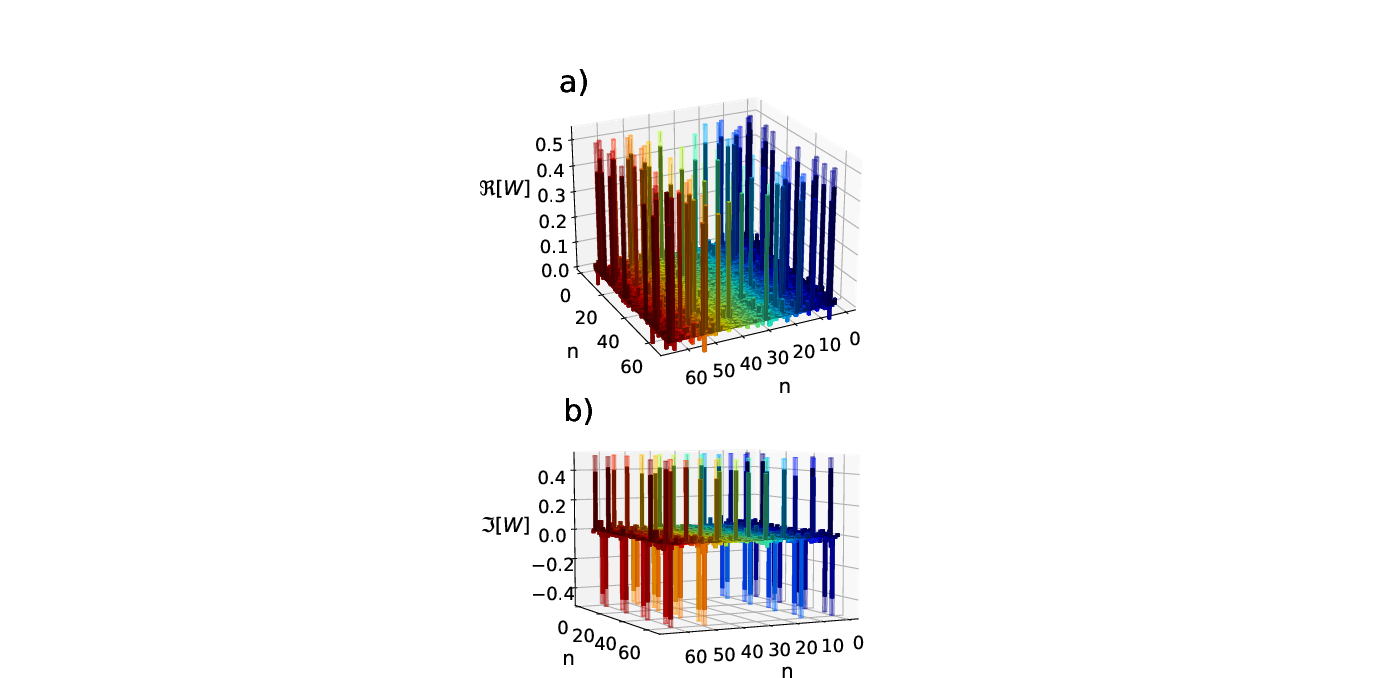
Figure 2: The experimentally recreated process matrix of the quantum SWITCH showing the real parts that contribute to determining causal order.
Causal Non-Separability and Witness Analysis
The quantum SWITCH's causal non-separability is further validated through generalized robustness and white noise witness analyses. Causal witnesses are constructed based on the process matrix data, demonstrating robust non-separability even when accounting for potential noise disturbances. Experimental findings indicate that the SWITCH retains its causal efficacy under white noise scenarios, proving its resiliency.
Conclusion
This paper effectively establishes a detailed framework for the experimental exploration of higher-order quantum processes. Through innovative methodologies in quantum tomography paired with a robust experiment design, this work advances capabilities in quantum computing paradigms where causality is indecisive. The demonstrated quantum SWITCH serves as a significant milestone in how quantum operations might evolve, foreshadowing increased processing power and novel computational paradigms leveraging ICOs. Future studies might explore scalability of this system towards even more complex setups or integrating additional quantum parties.