Papers
Topics
Authors
Recent
Search
2000 character limit reached

Reducing circuit depth with qubitwise diagonalization

Published 31 May 2023 in quant-ph | (2306.00170v3)

Abstract: A variety of quantum algorithms employ Pauli operators as a convenient basis for studying the spectrum or evolution of Hamiltonians or measuring multi-body observables. One strategy to reduce circuit depth in such algorithms involves simultaneous diagonalization of Pauli operators generating unitary evolution operators or observables of interest. We propose an algorithm yielding quantum circuits with depths $O(n \log r)$ diagonalizing $n$-qubit operators generated by $r$ Pauli operators. Moreover, as our algorithm iteratively diagonalizes all operators on at least one qubit per step, it is well suited to maintain low circuit depth even on hardware with limited qubit connectivity. We observe that our algorithm performs favorably in producing quantum circuits diagonalizing randomly generated Hamiltonians as well as molecular Hamiltonians with short depths and low two-qubit gate counts.

Definition Search Book Streamline Icon: https://streamlinehq.com
References (26)
  1. Y. Manin, Computable and Uncomputable (in Russian) (Sovetskoye Radio, Moscow, 1980).
  2. P. Benioff, Journal of Statistical Physics 22, 563 (1980).
  3. R. P. Feynman, International Journal of Theoretical Physics 21, 467 (1982).
  4. R. P. Feynman, Foundations of Physics 16, 507 (1986).
  5. S. Lloyd, Science 273, 1073 (1996).
  6. M. A. Nielsen and I. L. Chuang, Quantum Computation and Quantum Information: 10th Anniversary Edition (Cambridge University Press, 2010).
  7. U. Fano, Rev. Mod. Phys. 29, 74 (1957).
  8. E. van den Berg and K. Temme, Quantum 4, 322 (2020).
  9. S. Aaronson and D. Gottesman, Phys. Rev. A 70, 052328 (2004).
  10. E. M. Rains,   (1997), arXiv:quant-ph/9703048 .
  11. A. Klappenecker and P. K. Sarvepalli, Proceedings of the Royal Society of London Series A 463, 2887 (2007).
  12. R. Koenig and J. A. Smolin, J. Math. Phys. 55, 122202 (2014).
  13. R. M. Karp, “Reducibility among combinatorial problems,” in Complexity of Computer Computations: Proceedings of a symposium on the Complexity of Computer Computations, held March 20–22, 1972, at the IBM Thomas J. Watson Research Center, Yorktown Heights, New York, and sponsored by the Office of Naval Research, Mathematics Program, IBM World Trade Corporation, and the IBM Research Mathematical Sciences Department, edited by R. E. Miller, J. W. Thatcher,  and J. D. Bohlinger (Springer US, Boston, MA, 1972) pp. 85–103.
  14. T. Volgenant and R. Jonker, The Journal of the Operational Research Society 38, 1073 (1987).
  15. S. E. Dreyfus, Operations Research 17, 395 (1969).
  16. T. Ibaraki, SIAM Review 15, 309 (1973).
  17. Çetin K. Koç and S. N. Arachchige, Journal of Parallel and Distributed Computing 13, 118 (1991).
  18. P. Høyer and R. Špalek, Theory of Computing 1, 81 (2005).
  19. D. Gottesman, Stabilizer codes and quantum error correction, Ph.D. thesis, California Institute of Technology (1997).
  20. E. Knill and R. Laflamme, Phys. Rev. A 55, 900 (1997).
  21. N. J. Cerf and R. Cleve, Phys. Rev. A 56, 1721 (1997).
  22. A. Vardy, IEEE Transactions on Information Theory 43, 1757 (1997).
  23. V. Bergholm et al.,   (2018), arXiv:1811.04968 [quant-ph] .
  24. S. B. Bravyi and A. Y. Kitaev, Annals of Physics 298, 210 (2002).
  25. Qiskit contributors, “Qiskit: An open-source framework for quantum computing,”  (2023).
  26. M. Hostetter, “Galois: A performant NumPy extension for Galois fields,”  (2020).
Citations (2)

Summary

  • The paper introduces an algorithm that reduces quantum circuit depth by diagonalizing multi-qubit Pauli operators on a per-qubit basis.
  • It employs tableau representation and Clifford gate operations to transform commuting operators, achieving a complexity of O(n log r).
  • Empirical tests on randomized benchmarks and molecular Hamiltonians show significant reductions in CNOT counts and overall circuit depth.

Reducing Circuit Depth with Qubitwise Diagonalization

The paper "Reducing circuit depth with qubitwise diagonalization" introduces a novel algorithm designed to produce quantum circuits with significantly reduced depths for diagonalizing multi-qubit Pauli operators. This algorithm is particularly relevant for quantum computing, where reducing circuit complexity can lead to decreased error rates and more efficient utilization of quantum resources. The paper presents theoretical analysis and empirical evaluations, demonstrating the advantages of the proposed method over existing techniques.

Introduction

Quantum algorithms often utilize generalized Pauli operators as a basis to simulate Hamiltonian dynamics or measure observables. The depth of quantum circuits implementing these tasks can increase rapidly with the number of Pauli operators involved, especially given the constraints on qubit connectivity in current hardware. The proposed algorithm tackles this challenge by iteratively diagonalizing Pauli operators over individual qubits, maintaining low circuit depth and reducing the need for complex inter-qubit connections.

Theoretical Framework

The primary contribution of the paper is an algorithm that transforms a collection of commuting Pauli operators into a set of diagonal operators with reduced circuit depth. This transformation is achieved by leveraging properties of the tableau representation of Pauli operators, focusing on independent generating sets to minimize depth.

The algorithm employs classical symplectic geometry to identify the necessary transformations and uses Clifford gate operations (combinations of H, S, and CNOT gates). The paper thoroughly covers the mathematical underpinnings, offering a detailed description of stabilizer theory and symplectic matrices to support the design of the algorithm.

Algorithm Description

The algorithm progresses through a series of stages:

  1. Initial Setup: Begins with identifying a set of independent Pauli operators from the entire collection.
  2. Iterative Diagonalization: In each step, a single qubit is diagonalized simultaneously across all operators in the set.
  3. Optimization: Steps involve applying single-qubit gates followed by CNOT gates in a precise manner to reduce the non-diagonal elements incrementally.

The authors provide pseudocode and a formal complexity analysis, proving that the circuit depth can be reduced to O(nlogr)O(n \log r), where nn is the number of qubits and rr is the number of independent Pauli operators.

Implementation and Results

Upon implementing the algorithm, several experiments were conducted:

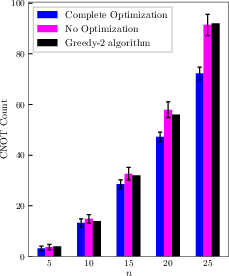
  • Randomized Benchmarking: The paper evaluates the algorithm on random sets of Pauli operators, demonstrating substantial reductions in circuit depth and CNOT counts compared to existing methods.
  • Molecular Hamiltonians: The algorithm was applied to various molecular systems (e.g., HeH+^+, LiH), yielding low-depth circuits across different Hamiltonian decompositions.
  • Connectivity Accommodations: Tests on hardware with linear qubit connectivity were performed, showing that the algorithm efficiently capitalizes on available infrastructure while minimizing additional SWAP gates. Figure 1

    Figure 1: The number of CNOT gate conjugations involved in diagonalizing n commuting Pauli operators acting on n qubits, evaluated via randomized benchmarking.

Conclusion

The qubitwise diagonalization algorithm offers a promising approach to reducing the complexity of quantum circuits required for simulating Hamiltonian evolution and measuring observables. By iteratively focusing on one qubit at a time, the algorithm achieves low-depth circuits, making it an attractive solution for near-term quantum devices with connectivity limits. Future work may explore further optimizations and extensions to accommodate a broader array of quantum architectures.

Paper to Video (Beta)

No one has generated a video about this paper yet.

Whiteboard

No one has generated a whiteboard explanation for this paper yet.

Open Problems

We haven't generated a list of open problems mentioned in this paper yet.

Collections

Sign up for free to add this paper to one or more collections.