Papers
Topics
Authors
Recent
Search
2000 character limit reached

Data Availability Sampling in Ethereum: Analysis of P2P Networking Requirements

Published 20 Jun 2023 in cs.NI and cs.CR | (2306.11456v1)

Abstract: Despite their increasing popularity, blockchains still suffer from severe scalability limitations. Recently, Ethereum proposed a novel approach to block validation based on Data Availability Sampling (DAS), that has the potential to improve its transaction per second rate by more than two orders of magnitude. DAS should also significantly reduce per-transaction validation costs. At the same time, DAS introduces new communication patterns in the Ethereum Peer-to-Peer (P2P) network. These drastically increase the amount of exchanged data and impose stringent latency objectives. In this paper, we review the new requirements for P2P networking associated with DAS, discuss open challenges, and identify new research directions.

Definition Search Book Streamline Icon: https://streamlinehq.com
References (15)
  1. The merge: Ethereum switch to proof-of-stake. https://ethereum.org/en/upgrades/merge/. Accessed on February 14, 2023.
  2. TERA: topic-based event routing for peer-to-peer architectures. In Inaugural international conference on Distributed event-based systems, DEBS, 2007.
  3. The generals’ scuttlebutt: Byzantine-resilient gossip protocols. In 29th ACM SIGSAC Conference on Computer and Communications Security, CCS, page 595–608, 2022.
  4. Gossip-based peer sampling. ACM Transactions on Computer Systems (TOCS), 25(3):8–es, 2007.
  5. Constant-size commitments to polynomials and their applications. In International conference on the theory and application of cryptology and information security, ASIACRYPT, pages 177–194. Springer, 2010.
  6. Under the hood of the ethereum gossip protocol. In Nikita Borisov and Claudia Diaz, editors, Financial Cryptography and Data Security, pages 437–456, Berlin, Heidelberg, 2021. Springer Berlin Heidelberg.
  7. Kademlia: A peer-to-peer information system based on the XOR metric. In International Workshop on Peer-to-Peer Systems, IPTPS, pages 53–65. Springer, 2002.
  8. Joachim Neu. Data availability sampling: From basics to open problems. Technical report, Paradigm, 2022. Accessed on February 17, 2023.
  9. Riccardo Pecori. S-Kademlia: A trust and reputation method to mitigate a Sybil attack in Kademlia. Computer Networks, 94:205–218, 2016.
  10. Performance analysis of ethereum transactions in private blockchain. In 8th International Conference on Software Engineering and Service Science, ICSESS, pages 70–74. IEEE, 2017.
  11. Layer 2 blockchain scaling: A survey. arXiv preprint arXiv:2107.10881, 2021.
  12. Chord: a scalable peer-to-peer lookup protocol for internet applications. IEEE/ACM Transactions on networking, 11(1):17–32, 2003.
  13. Gossipsub: Attack-resilient message propagation in the filecoin and eth2. 0 networks. arXiv preprint arXiv:2007.02754, 2020.
  14. Reed-Solomon codes and their applications. John Wiley & Sons, 1999.
  15. Blockchain use cases and their feasibility. Applied Computer Systems, 23(1):12–20, 2018.
Citations (3)

Summary

  • The paper introduces Data Availability Sampling as a novel approach to enhance Ethereum's scalability by decoupling data verification from validators.
  • It details how optimized P2P networking protocols, including improvements over traditional gossip and DHT systems, enable rapid data sampling within 4 to 10 seconds.
  • The findings suggest that leveraging Ethereum's consensus dynamics can mitigate Sybil attacks and support off-chain rollups for enhanced throughput.

Data Availability Sampling in Ethereum: Analysis of P2P Networking Requirements

Introduction

The paper "Data Availability Sampling in Ethereum: Analysis of P2P Networking Requirements" (2306.11456) addresses the scalability challenges in Ethereum and investigates the integration of Data Availability Sampling (DAS) mechanisms to significantly enhance throughput while maintaining high security and decentralization levels. Ethereum, despite its popularity and flexibility in supporting smart contracts, has faced limitations with its low transaction processing throughput averaging 14 TPS. The shift towards rollups introduces a potential solution to increase scalability by processing transactions off-chain and posting only small data commitments on-chain.

Data Availability Sampling Mechanism

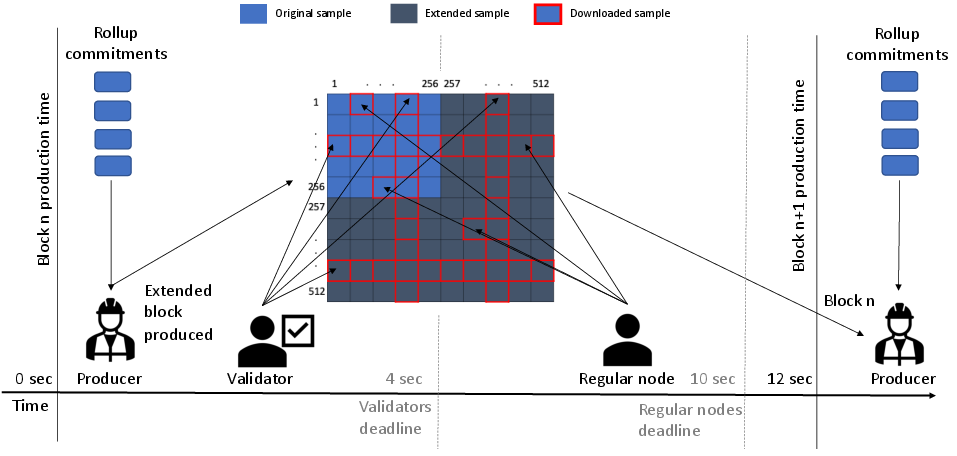
DAS introduces a paradigm shift by detaching commitment data verification from Ethereum validators. Validators only require assurance of data availability rather than correctness, achieved via random sampling. Blocks appended to the blockchain encompass an extended data blob, subjected to random sample requests by validators and regular nodes to ensure its successful dissemination and retrieval. This method circumvents the necessity for validators to store entire blobs, thus optimizing resource usage. Figure 1

Figure 1: Block data sampling. The producer gathers rollup commitments from the clients and creates an extended block. The block must be sampled by validators within 4~s from the block production by requesting 2 random rows and 2 random columns. Non-validator nodes sample the block within 10~s by requesting 75 random cells. After 12~s from the initial block production, the next block is created by a new block producer.

P2P Networking Requirements

The adoption of DAS necessitates sophisticated modifications in the peer-to-peer (P2P) networking layer. Traditional gossip protocols are inadequate to handle the increased data exchange and stringent latency requirements imposed by DAS. Validators require rapid access to sampled data within 4 seconds, and general nodes within 10 seconds. The paper discusses three critical functional and non-functional requirements for the network:

  1. Openness: The network remains permissionless, allowing any participant to join.
  2. Request Unlinkability: Protecting against network split attacks by ensuring the block producer cannot trace request origins.
  3. Efficiency and Economic Viability: Optimal data exchange must be achieved to prevent prohibitive costs, threatening Ethereum’s decentralization ethos.

Exploring Classical Networking Approaches

The paper critically analyzes centralized, unstructured P2P, and DHT-based strategies for DAS implementation:

  • Centralized Approach: Direct data retrieval from block producers, feasible yet economically and operationally prohibitive, risking DoS vulnerabilities.
  • Unstructured P2P Networks: Leverages gossip protocol; however, lacks efficiency in multicast data distribution, complicating timely sample retrieval.
  • DHT-Based Approach: Poses a promising framework but faces challenges with Sybil attacks and lookup overheads potentially affecting timely DAS operations.

Research Directions

To address identified insufficiencies, the paper proposes avenues for improving P2P approaches:

  • Leveraging Honest Majority: Incorporating Ethereum's consensus mechanism assumptions to construct Sybil-resistant networks.
  • Flexible Sampling Schemes: Implementing k out of n sampling designs to tolerate failures and enhance network resilience.
  • Spatial Routing in DHTs: Developing routing protocols based on spatial regions rather than specific hash keys to mitigate attack risks.

Conclusion

The research paper underlines the necessity of evolving Ethereum's networking layer to accommodate DAS, aiming to enable mainstream adoption of blockchain technology through substantial throughput enhancements. Resolving P2P networking challenges aligns with Ethereum’s strategic vision of achieving high transaction processing without compromising decentralization and security. Future work should focus on refining suggested approaches and ensuring they integrate seamlessly with existing blockchain infrastructures.

Paper to Video (Beta)

No one has generated a video about this paper yet.

Whiteboard

No one has generated a whiteboard explanation for this paper yet.

Open Problems

We haven't generated a list of open problems mentioned in this paper yet.

Collections

Sign up for free to add this paper to one or more collections.