Papers
Topics
Authors
Recent
Search
2000 character limit reached

Mutually Guided Few-shot Learning for Relational Triple Extraction

Published 23 Jun 2023 in cs.CL and cs.AI | (2306.13310v1)

Abstract: Knowledge graphs (KGs), containing many entity-relation-entity triples, provide rich information for downstream applications. Although extracting triples from unstructured texts has been widely explored, most of them require a large number of labeled instances. The performance will drop dramatically when only few labeled data are available. To tackle this problem, we propose the Mutually Guided Few-shot learning framework for Relational Triple Extraction (MG-FTE). Specifically, our method consists of an entity-guided relation proto-decoder to classify the relations firstly and a relation-guided entity proto-decoder to extract entities based on the classified relations. To draw the connection between entity and relation, we design a proto-level fusion module to boost the performance of both entity extraction and relation classification. Moreover, a new cross-domain few-shot triple extraction task is introduced. Extensive experiments show that our method outperforms many state-of-the-art methods by 12.6 F1 score on FewRel 1.0 (single-domain) and 20.5 F1 score on FewRel 2.0 (cross-domain).

Definition Search Book Streamline Icon: https://streamlinehq.com
References (23)
  1. “DBpedia: A Nucleus for a Web of Open Data” In ISWC/ASWC, Lecture Notes in Computer Science, 2007, pp. 722–735
  2. Kurt D. Bollacker, Robert P. Cook and Patrick Tufts “Freebase: A Shared Database of Structured General Human Knowledge” In AAAI, 2007, pp. 1962–1963
  3. “DEKR: Description Enhanced Knowledge Graph for Machine Learning Method Recommendation” In SIGIR, 2021, pp. 203–212
  4. “DiaKG: An Annotated Diabetes Dataset for Medical Knowledge Graph Construction” In CCKS, Communications in Computer and Information Science, 2021, pp. 308–314
  5. “Few-Shot Event Detection with Prototypical Amortized Conditional Random Field” In ACL/IJCNLP (Findings), Findings of ACL, 2021, pp. 28–40
  6. “Relation-Guided Few-Shot Relational Triple Extraction” In SIGIR, 2022, pp. 2206–2213
  7. “BERT: Pre-training of Deep Bidirectional Transformers for Language Understanding” In NAACL-HLT (1), 2019, pp. 4171–4186
  8. Li Fei-Fei, Rob Fergus and Pietro Perona “One-shot learning of object categories” In IEEE transactions on pattern analysis and machine intelligence, 2006, pp. 594–611
  9. “FewRel 2.0: Towards More Challenging Few-Shot Relation Classification” In EMNLP, 2019, pp. 6249–6254
  10. “Don’t Stop Pretraining: Adapt Language Models to Domains and Tasks” In ACL, 2020, pp. 8342–8360
  11. “FewRel: A Large-Scale Supervised Few-shot Relation Classification Dataset with State-of-the-Art Evaluation” In EMNLP, 2018, pp. 4803–4809
  12. “Reinforced Anchor Knowledge Graph Generation for News Recommendation Reasoning” In KDD, 2021, pp. 1055–1065
  13. Lance A. Ramshaw and Mitch Marcus “Text Chunking using Transformation-Based Learning” In VLC@ACL, 1995
  14. Jake Snell, Kevin Swersky and Richard S. Zemel “Prototypical Networks for Few-shot Learning” In NIPS, 2017, pp. 4077–4087
  15. Charles Sutton, Khashayar Rohanimanesh and Andrew McCallum “Dynamic conditional random fields: factorized probabilistic models for labeling and segmenting sequence data” In ICML, ACM International Conference Proceeding Series, 2004
  16. Shuai Wang “On the Analysis of Large Integrated Knowledge Graphs for Economics, Banking and Finance” In EDBT/ICDT Workshops, CEUR Workshop Proceedings, 2022
  17. “A Novel Cascade Binary Tagging Framework for Relational Triple Extraction” In ACL, 2020, pp. 1476–1488
  18. “Wlinker: Modeling Relational Triplet Extraction As Word Linking” In ICASSP, 2022, pp. 6357–6361
  19. “Simple and Effective Few-Shot Named Entity Recognition with Structured Nearest Neighbor Learning” In EMNLP (1), 2020, pp. 6365–6375
  20. “Multi-Level Matching and Aggregation Network for Few-Shot Relation Classification” In ACL, 2019, pp. 2872–2881
  21. “Bridging Text and Knowledge with Multi-Prototype Embedding for Few-Shot Relational Triple Extraction” In COLING, 2020, pp. 6399–6410
  22. “Prototype Completion With Primitive Knowledge for Few-Shot Learning” In CVPR, 2021, pp. 3754–3762
  23. “Multimodal Relation Extraction with Efficient Graph Alignment” In ACM Multimedia, 2021, pp. 5298–5306
Citations (2)

Summary

  • The paper introduces the MG-FTE framework, which utilizes mutually guided proto-decoders to enhance both relation classification and entity extraction.
  • The proto-level fusion module integrates entity and relation prototypes, resulting in significant F1 score improvements in both single domain and cross-domain settings.
  • Experimental results on FewRel datasets demonstrate MG-FTE's adaptability and robustness, especially when paired with domain-specific models like RoBERTa-BioMed.

Mutually Guided Few-shot Learning for Relational Triple Extraction

Overview

The rise of few-shot learning techniques aims to tackle the challenge of relational triple extraction from unstructured texts when faced with limited labeled data. This paper proposes the Mutually Guided Few-shot Learning Framework for Relational Triple Extraction (MG-FTE), which utilizes a novel approach to efficiently classify relations and extract entities.

Framework Design

The MG-FTE framework comprises two main components: an entity-guided relation proto-decoder and a relation-guided entity proto-decoder.

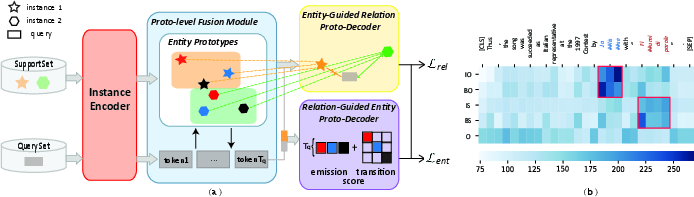
  1. Entity-Guided Relation Proto-Decoder: This component uses learned entity prototypes to guide relation classification. By measuring the semantic match between query instances and relation prototypes, the system mitigates the misleading influence of non-relational entities and enhances classification accuracy. Figure 1

    Figure 1: Subfigure (a) is our framework of MG-FTE under the 2-way-1-shot setting. The color red, blue, and black denote subjects, objects, and other words, respectively. The color orange and green represent different relations. Subfigure (b) visualizes the relationships between entity prototypes and query tokens in the proto-level fusion module.

  2. Relation-Guided Entity Proto-Decoder: Post relation classification, this component focuses solely on extracting entities pertinent to the classified relations. By integrating both original and fused token representations, the system ensures accurate entity recognition while preserving inherent entity features.

Proto-level Fusion Module

To strengthen the connection between entities and relations, a proto-level fusion module is introduced. It learns mixed features from entity prototypes and query tokens, thereby fostering a symbiotic relationship between relational entities and semantics. This module enhances generalization abilities, especially in cross-domain settings, proven through substantive improvements in various experimental configurations.

Experimental Evaluation

Single Domain

The MG-FTE framework's efficacy is demonstrated through extensive testing on FewRel 1.0, showing superior performance over baseline methods. Notably, the framework achieves a significant improvement in F1 scores, indicating robust triple extraction capabilities across diverse few-shot settings. Critical components such as the proto-decoder modules and fusion module contribute distinctly to this success.

Cross Domain

In FewRel 2.0's cross-domain setting, MG-FTE continues to outperform, reinforced further when paired with domain-specific pre-trained models like RoBERTa-BioMed. This success underscores the framework's adaptability and effectiveness across domain shifts, ensuring reliable relational triple extraction with limited domain data.

Conclusion

MG-FTE presents a compelling approach for relational triple extraction with few-shot learning. The mutually guided framework, coupled with the proto-level fusion module, enhances both entity and relation extraction processes. As a result, the MG-FTE framework emerges as a robust solution, demonstrating notable improvements in both domain-specific and cross-domain tasks. Future research may explore further optimization of the proto-level fusion module to extend its applicability to even more domains and scenarios.

Paper to Video (Beta)

No one has generated a video about this paper yet.

Whiteboard

No one has generated a whiteboard explanation for this paper yet.

Open Problems

We haven't generated a list of open problems mentioned in this paper yet.

Collections

Sign up for free to add this paper to one or more collections.