- The paper highlights that AI/ML practitioners face complex challenges in co-producing Responsible AI values due to conflicting institutional structures and role-specific pressures.
- It uses interviews with 23 practitioners across 10 organizations to reveal how both rigid top-down and burdensome bottom-up approaches hinder effective RAI integration.
- The findings advocate for 'value levers'—structured communication, external expertise, and scenario-based discourse—to align and reconcile diverse RAI priorities.
Examining AI/ML Practitioners' Challenges in Co-Producing Responsible AI Values
Introduction
The paper investigates the co-production challenges experienced by AI/ML practitioners during the integration of Responsible AI (RAI) values. The study is rooted in the context established by UNESCO's 2021 agreement, which standardizes the ethics of AI, yet reveals gaps in awareness, deliberation, and execution. The authors focus on unpacking these challenges through interviews with 23 practitioners across 10 organizations. The findings highlight the complex interplay between institutional structures and individual roles in upholding RAI values while navigating both top-down and bottom-up approaches.
Challenges in Institutional Structures
Bottom-Up Structures: Burden and Educational Responsibility
Practitioners described scenarios where bottom-up approaches led to a concentration of RAI value stewardship among a few "vigilantes" within teams. This self-assignment, driven by a personal commitment to ethical development, placed significant burdens on individual practitioners. The educational responsibility often fell to those who happened to express an interest, regardless of their role's primary focus, thus leading to potential overwork and stress.
Top-Down Structures: Rigidity and Limited Discourse
Conversely, top-down structures often pre-determined which RAI values were to be prioritized based on organizational directives or compliance concerns. This rigidity reduced the opportunity for practitioners to engage in open discovery, often stifling meaningful discourse. Front-line practitioners reported difficulties engaging deeply with RAI values that were not directly aligned with the incentivized organizational benchmarks.
Challenges in RAI Value Discourse and Implementation
Superficial Engagement and Insufficient Familiarity
Teams encountered challenges when unfamiliar with certain RAI values, leading to superficial engagement. Practitioners noted that while established values like privacy had clear methodologies and benchmarks, newer or more abstract values like explainability were often deprioritized due to a lack of understanding or perceived applicability.
Interpretation and Conflict of Values
There were tensions when different roles within a team interpreted the same values differently or when team values clashed with those expected by clients or end-users. For example, values such as equity could be interpreted variably, leading to conflicting implementation strategies. Practitioners reported that such tensions often led to incomplete or halted RAI projects.
Conflicts Between RAI Values
Implementing specific RAI values often revealed conflicts with other values. For instance, prioritizing model accuracy could inadvertently harm diversity considerations, causing cascading dependencies of RAI concerns that were challenging to manage without clear guiding strategies.
Mitigation Strategies Through Value Levers
The study identifies the concept of 'value levers' as critical strategies facilitating the co-production of RAI values across organizational and project contexts.
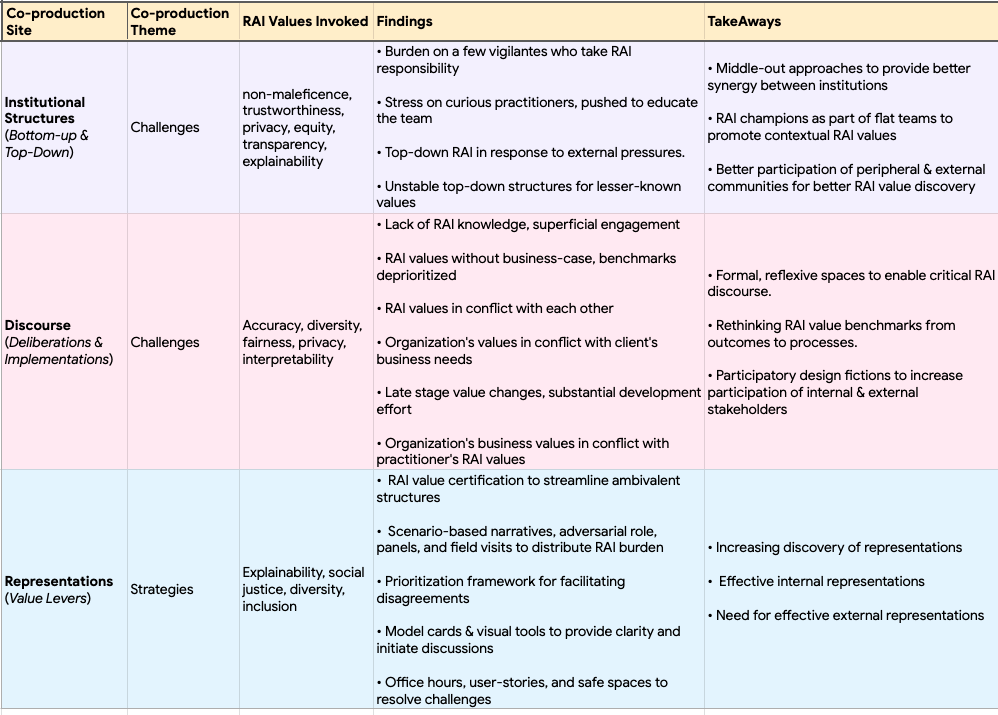
Figure 1: A summary of co-production activities mapped to \citet{jasanoff2004idiom}.
Institutional Levers: Incorporating External Expertise
Organizations sometimes sought external support to standardize RAI practices, leveraging external certifications and expertise to provide a comprehensive approach to the diverse RAI requirements. By doing so, they aimed to consolidate and streamline diffuse RAI efforts.
Discourse Levers: Promoting Engagement and Reducing Abstractness
Strategies such as role-playing, scenario-based discussions, and using visual tools (e.g., model and data cards) facilitated engagement across teams. Visual levers helped demystify abstract RAI values, making them more approachable, and promoted discourse that could lead to more aligned interpretations and implementations of these values.
Implementation Levers: Structured Communication
Structured communication avenues such as office hours with RAI experts and creating safe spaces for dialogue reduced tensions and promoted a smoother workflow in implementing RAI values. These mechanisms allowed practitioners to engage in productive conflict resolution, ensuring that diverse values were respected and integrated meaningfully.
Conclusion
The paper concludes by emphasizing the need for middle-out structures that synergize the stability of top-down approaches with the flexibility of bottom-up initiatives. Such structures could alleviate the burdens on individual practitioners while facilitating open discussions on RAI values that acknowledge and address conflicts inherent in the field. Moreover, leveraging external expertise and systematically employing value levers across discourse and implementation stages appear critical for fostering comprehensive and embedded RAI practices in AI/ML development. The research underscores the importance of continued exploration and refinement of institutional and representational strategies to enhance the efficacy and inclusivity of Responsible AI initiatives.