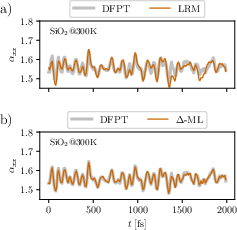
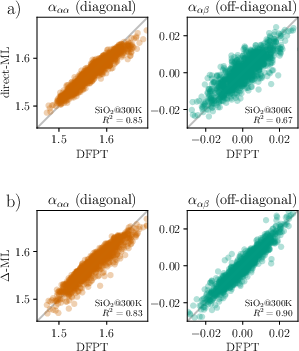
- The paper proposes a Δ-ML approach that utilizes linear response models followed by machine learning refinement, achieving near-unity R² for polarizability predictions.
- The methodology leverages kernel-based techniques and symmetry-adapted descriptors like SOAP to significantly reduce computational costs relative to full DFPT calculations.
- Results demonstrate robust performance across systems such as SiO₂, AlN, and NaCl, enabling accurate and efficient predictions of Raman spectra and dielectric responses.
Delta Machine Learning for Predicting Dielectric Properties and Raman Spectra
Introduction
This paper proposes a novel delta machine learning (Δ-ML) approach designed to enhance the predictive capabilities of Raman spectra through the efficient estimation of dielectric properties. Raman spectra serve as a pivotal tool in analyzing the dynamical behavior of molecular and solid-state systems at finite temperatures. However, these computations are traditionally resource-intensive, constrained by the necessity of extensive molecular dynamics (MD) trajectory sampling. The presented Δ-ML method circumvents these computational burdens by utilizing a two-step process, combining classical linear-response models (LRMs) with symmetry-adapted machine learning techniques, thereby streamlining data requirements and improving prediction accuracy.
Methodology
The Δ-ML method enhances the prediction of polarizabilities, the cornerstone of Raman spectra calculation, by first applying a computationally economical LRM. This model acts as a precursor, capturing baseline dielectric responses, which are successively refined through machine learning algorithms adapted for tensorial properties.
- Linear Response Model (LRM):
- The LRM is conceptualized via the Taylor expansion of a polarizability tensor component relative to atomic displacements (Equation 1). This expansion isolates the constant term α(x0) through initial density functional perturbation theory (DFPT) calculations and further involves the first-order derivatives, which are extracted through additional DFPT analyses on displaced atomic coordinates.
- Machine Learning Enhancements:
- The ML component leverages kernel-based methods, employing descriptors that encapsulate atomic configuration symmetries facilitated through smooth overlap of atomic positions (SOAP) and à la carte enhancements like λ-SOAP for covariant considerations.
The Δ-ML model demonstrates robust predictive performance across various molecular and solid-state configurations, showing significant improvements over direct machine learning models notably in reducing the necessary training set sizes while maintaining prediction accuracy.
Validation against DFPT reference datasets revealed that the Δ-ML model regularly achieves a coefficient of determination (R2) close to unity with considerably smaller training sets, improving computational efficiency.
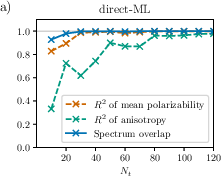
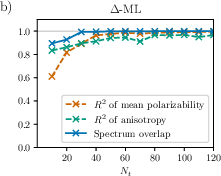
Figure 3: Performance metrics for direct ML predictions in \ch{SiO2}.
Systems including \ch{SiO2}, AlN, and NaCl illustrated the model's versatility across varying interatomic interactions and complexities due to LO/TO splitting effects. Notably, the LRM-model synergy exhibited resilience even in challenging non-first-order Raman inactive materials like NaCl.
Implications and Future Work
The proposed method offers a substantial leap forward in the computational prediction of dielectric properties, with implications extending well beyond Raman spectra, potentially including infrared spectra and transport coefficient calculations. The Δ-ML approach provides a framework ready for adaptation with advanced physical models, alternative descriptors, and refined hyperparameter tuning strategies.
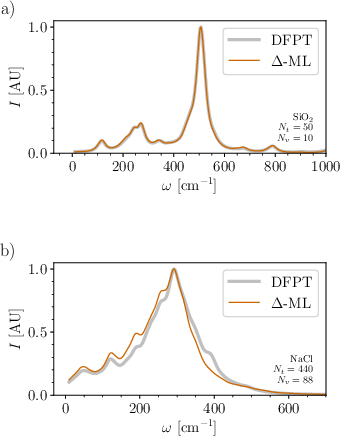
Figure 4: Raman spectrum for \ch{SiO2} computed from Δ-ML predictions.
Conclusion
In summary, Δ-ML stands as a promising technique enhancing the accuracy and efficiency of Raman spectra predictions by bridging conventional response models with sophisticated machine learning for real-time molecular simulations. It offers high predictive accuracy with reduced data, resource requirements, and computational expenses. Future explorations may determine broader applications in fields requiring real-time monitoring and predictions of dynamic atomic interactions under varying conditions.