- The paper introduces the CIGF as a unified framework that extends classical and fractional entropy measures.
- It details the CIGF’s application in systems reliability and stress-strength models, enhancing risk analysis.
- Generalized Gini functions are derived via distortion methods, providing robust variability measures in reliability contexts.
This essay analyzes the paper titled "Cumulative Information Generating Function and Generalized Gini Functions" (2307.14290), which introduces and studies the cumulative information generating function (CIGF). It provides a unifying mathematical framework that addresses classical and fractional entropies via the cumulative distribution function (CDF) and survival function (SF). The study presents the CIGF as a variability measure, extending concepts like the Gini mean semi-difference and exploring its implications in reliability theory and risk analysis.
Introduction and Motivation
The paper begins by addressing the need for novel uncertainty measures to support diversified applications in reliability and risk analysis. The authors propose the CIGF, which unifies and extends both cumulative residual entropy and cumulative entropy, including their generalized and fractional forms. Specifically, the CIGF is defined for nonnegative, absolutely continuous random variables and harnesses the information generating function concept introduced by Golomb, linking it to differential entropy.
Mathematical Framework
Definition and Properties
The cumulative information generating function is introduced to leverage the CDF and SF of a random variable. If X has a CDF F(x) and an SF F(x), the CIGF is:
GX(α,β)=∫lr[F(x)α][F(x)β]dx
where (l,r) is the support of X. The CIGF not only captures entropy but also serves as a measure of variability, analogous to the Gini mean semi-difference.
Relational Entropies
The CIGF is shown to yield several entropy metrics like the cumulative residual entropy (CRE) and cumulative entropy (CE) upon differentiation with respect to its parameters. These connections allow researchers to compute these entropies from the CIGF efficiently, providing a cohesive foundation for further exploration of reliability metrics.
Applications in Reliability Theory
Systems Reliability
The paper extends its mathematical findings to systems with multiple components, such as k-out-of-n systems, where the system functions if at least k of its n components do. The CIGF facilitates a unified measure to compute system reliability, particularly in stress-strength analyses where component strength resilience under stress is evaluated.
Stress-Strength Models
For systems exposed to random stresses, the reliability can be expressed in terms of the CIGF, markedly simplifying the determination of survival probabilities in multicomponent setups.
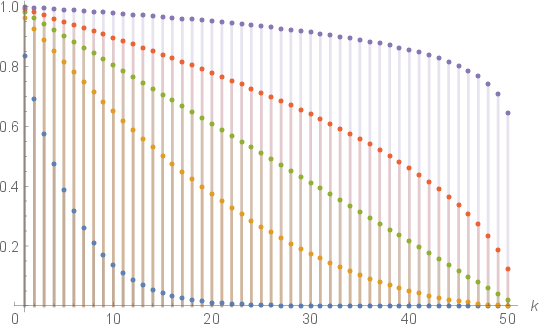
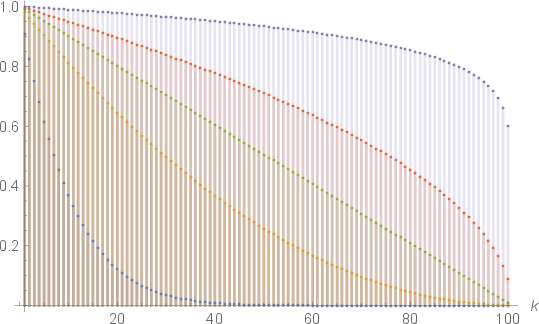
Figure 1: Plots of the reliability of the multi-component stress-strength system with underlying Power(θ) distribution.
Generalized Gini Functions
Distortion Functions
The paper introduces the generalized Gini functions, utilizing distortion functions to expand the CIGF. These distorted Gini functions serve as variability measures and are critical in assessing the differences between distributions within reliability and risk contexts.
Variational Analysis
The authors prove that the proposed generalized Gini functions retain properties such as dilution and variability measure characterization. This provides a robust foundation for deploying these functions across various applications where risk assessment and entropy calculations are pivotal.
Multi-Dimensional Extensions
Bidimensional Analysis
The paper also ventures into two-dimensional cases, proposing a bidimensional CIGF that can analyze joint information measures of random variable pairs, potentially benefiting areas like multivariate reliability studies and systems analysis.
Conclusion
The study of the CIGF and its extensions provides significant advancements in measuring uncertainty and variability. Through intricate mathematical formulation, it lays the groundwork for substantial improvements in reliability theory, offering systematic measures that encapsulate both classical and novel entropy forms. Future research paths include exploring connections with other divergence measures, enhancing the CIGF's application scope, particularly in multivariate and complex systems.