- The paper introduces a novel S3IM loss that leverages stochastic patches to incorporate structural similarity across nonlocal pixel groups.
- The method outperforms traditional MSE by delivering significant PSNR gains and robust performance in noisy and sparse-data scenarios.
- S3IM's model-agnostic design enhances neural radiance field and surface reconstruction tasks, paving the way for broader applications.
S3IM: Stochastic Structural SIMilarity and Its Unreasonable Effectiveness for Neural Fields
Introduction
The paper "S3IM: Stochastic Structural SIMilarity and Its Unreasonable Effectiveness for Neural Fields" (2308.07032) introduces a novel training paradigm for Neural Radiance Fields (NeRF) and other neural field methods. The authors propose a Stochastic Structural Similarity (S3IM) loss that leverages nonlocal multiplex training to process multiple data points collectively, thereby capturing structural information across distant pixels. This approach aims to overcome the conventional limitations of point-wise loss functions, such as Mean Squared Error (MSE), which fail to incorporate the rich spatial relationships in image data.
Methodology
The core innovation of the paper lies in the S3IM loss function, which operates on patches of pixels rather than individual ones. By treating pixel groups as stochastic patches, S3IM evaluates the structural similarity over these patches, thereby integrating nonlocal information into the training process. This multiplex loss is expressed as:
LM(Θ)=∣R∣1r∈R∑lMSE(Θ,r)+λLS3IM(Θ,R)
where LS3IM(Θ,R) encodes the novel multiplex style by examining the collective structural similarity. The hyperparameter λ controls the balance between point-wise and structural losses.
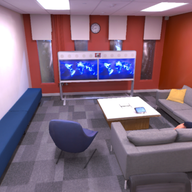
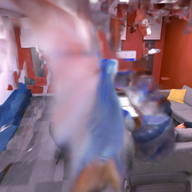
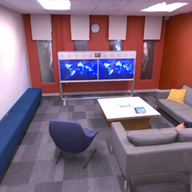




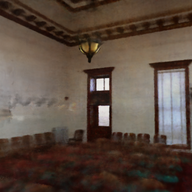
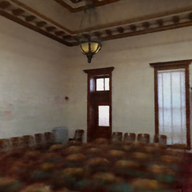

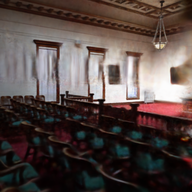

Figure 1: Qualitative comparison of standard training and multiplex training for neural radiance field on Replica Dataset.
Empirical Results
The empirical evaluations showcase the remarkable effectiveness of S3IM across several benchmark datasets, including the Replica and Tanks and Temples Advanced (T&T) datasets. Notably, in static scene synthesis tasks using accelerated NeRF variants like DVGO and TensoRF, S3IM delivered unprecedented improvements in image quality metrics, with PSNR gains reaching up to 24.75 over baseline methods.
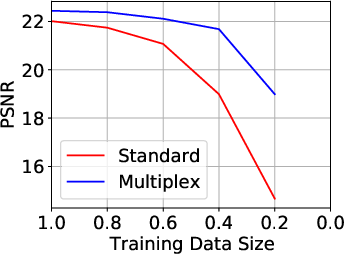
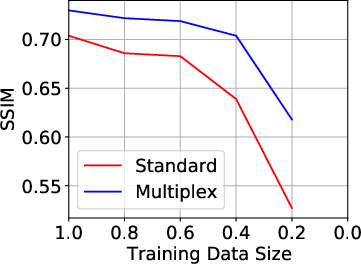
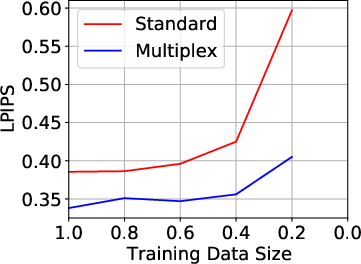
Figure 2: Improvement in PSNR and SSIM with respect to the training data size in the DVGO model on T&T-Truck dataset.
Robustness and Few-shot Learning
S3IM demonstrates robustness under challenging conditions, such as sparse inputs and corrupted images. In scenarios with limited training data, the performance gain from S3IM is even more pronounced, indicating its potential for few-shot learning applications. Furthermore, the method improves the robustness of models trained on noisy data, effectively mitigating the impacts of Gaussian noise.
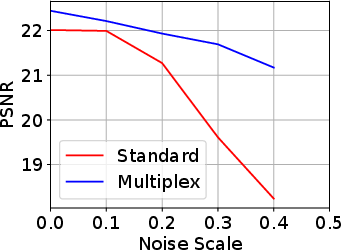
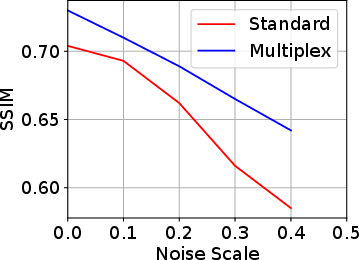
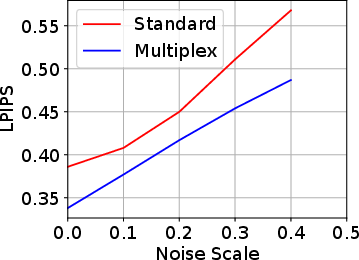
Figure 3: Performance boost in PSNR and SSIM under various image noise levels in the DVGO model on T&T-Truck dataset.
Surface Reconstruction
Beyond novel view synthesis, the effectiveness of S3IM extends to neural surface reconstruction tasks. When applied to NeuS, an implicit surface representation model, S3IM not only enhances the visual quality of RGB renderings but also significantly improves geometric metrics, such as the Chamfer Distance and F-score, underscoring its versatility across different neural field tasks.

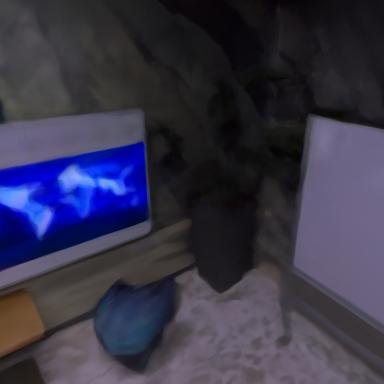

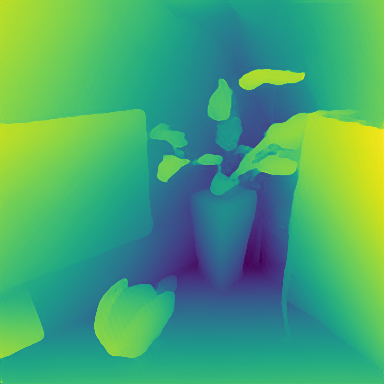
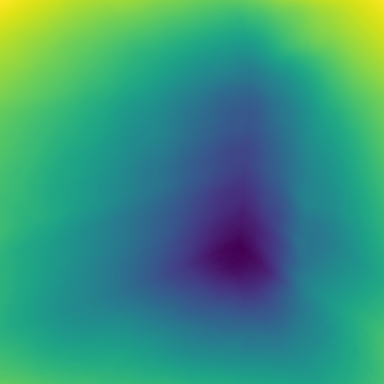
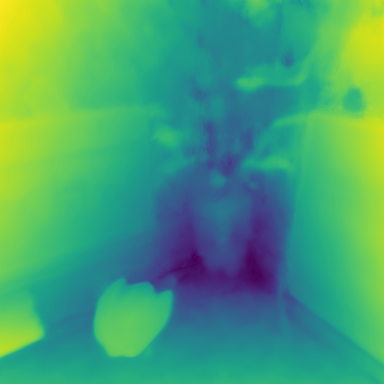
Figure 4: Enhanced RGB and depth renderings through S3IM in NeuS model on Replica Scene.
Implications and Future Directions
S3IM's ability to integrate structural information makes it a robust training paradigm for various neural field applications. Its model-agnostic nature allows seamless integration with existing methods, enhancing generalization without significant computational overhead. Future research could explore its application to other domains, such as physics-informed neural networks and graph neural networks, where point-wise loss paradigms are prevalent.
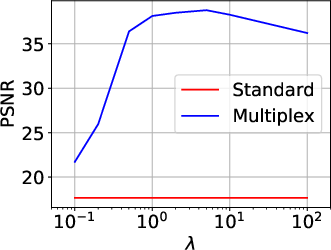
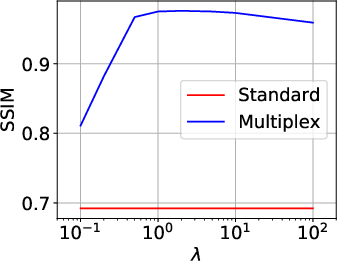
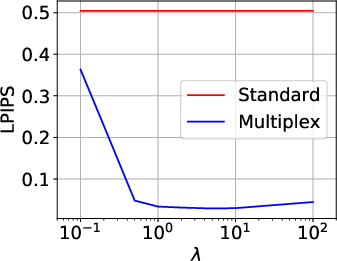
Figure 5: S3IM's robustness to different hyperparameter values (λ) in the DVGO model on Replica dataset.
Conclusion
The S3IM framework represents a significant leap forward in neural field optimization, conceiving a robust methodology that efficiently leverages collective pixel information. By rigorously improving quality metrics without substantial computational cost, S3IM paves the way for more complex and versatile applications of neural fields in visual computing and beyond.