- The paper demonstrates that QGNNs significantly improve fraud detection accuracy by leveraging quantum properties like superposition and entanglement.
- It employs a hybrid approach combining PCA, topological data analysis, and variational quantum circuits for effective feature encoding and classification.
- Experimental results show QGNN models achieve higher precision and recall than classical GraphSAGE architectures on imbalanced financial datasets.
Financial Fraud Detection using Quantum Graph Neural Networks
Introduction
The paper presents an innovative approach to financial fraud detection using Quantum Graph Neural Networks (QGNNs), exploiting the potential benefits of Quantum Computing (QC) over classical machine learning techniques. The digital transformation in industries has increased susceptibility to cyber threats, necessitating the enhancement of fraud detection systems. QGNNs leverage QC's principles such as superposition and entanglement to offer superior performance in complex financial networks compared to conventional methods.
Quantum machine learning (QML) interfaces QC with classical machine learning, offering promising solutions for fraud detection. QML capabilities include efficient data processing with quantum parallelism, enabling refined class discrimination in transactional datasets, and feature representation enhancement via quantum kernel methods.
Graph-based methodologies have demonstrated potential in fraud detection by modelling intricate interconnections within fraudulent networks through nodes and edges. Utilizing graph structures, these approaches effectively capture complex fraud patterns, surpassing traditional rule-based systems.
Transitioning to QGNNs introduces QC's computational advantages, precluding the restrictions posed by classical graph structures. The inherent features of QC can transcend classical computational limits, fostering an enriched fraud detection methodology that merges QC traits with graph-based contexts.
Classical Graph Neural Networks
Classical graph neural networks (GNNs) form the foundation for analysing graph-structured data by considering nodes and their interconnections using adjacency matrices. GNN architectures, including Feed-Forward GNNs, Graph RNNs, and Graph Convolutional Networks (GCNNs), utilize graph convolutions to aggregate information across nodes to perform tasks such as node classification and link prediction.
GraphSAGE Networks exemplify efficient sampling and aggregation techniques allowing enhanced scalability and adaptability across diverse graph structures extending classical GCNN capabilities. By aggregating information from neighbourhood node samples, GraphSAGE models achieve greater flexibility in handling vast datasets.
The GraphSAGE model implementation in the context of fraud detection involves processing graph data through neural networks and utilizing activation functions such as ReLU, structured in a model architecture that iteratively aggregates neighbor information.

Figure 1: Architecture of the GraphSage. It comprises successive GraphSAGE layers, each followed by a ReLU activation function.
Quantum Graph Neural Networks
QGNNs offer an advanced framework extending classical GNN methodologies by harnessing QC's inherent properties. The proposed QGNN approach involves several critical steps:
- Graph Construction: Each transaction is visualized as a graph with nodes representing encoded features post-PCA analysis, composed of 28 nodes per graph.
- Topological Data Analysis: TDA is employed to differentiate between fraudulent and non-fraudulent cases by embedding graphs into a 1D scatter plot and clustering nodes to aid contextual understanding.
- Quantum Encoding: Node features are encoded into quantum states using angle encoding, with data transformation facilitating efficient quantum parallel processing.
- Variational Quantum Circuit Design: Utilizes a multi-layer VQC structure, integrating rotational gates to enhance node features, akin to classical dense layers in ANNs, implemented through quantum circuits.
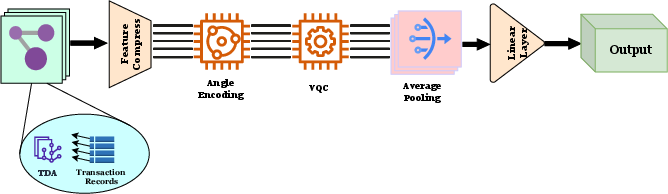
Figure 2: Architecture of the quantum graph neural network. The QGNN starts with a graph as input, followed by a feature compression step. Angle encoding prepares the data for the VQC processing.
This integration allows nodes to be classified based on VQC output, distinguishing fraudulent transactions effectively through complex node interactions and optimally leveraging QC for classification tasks.
The Dataset
The analysis leverages a credit card transaction dataset composed of 284,807 records with significant class imbalance. Each transaction corresponds to encoded feature vectors processed via PCA, with the transactions labelled as fraudulent (1) or non-fraudulent (0).
Correlation matrix visualizations and histogram representations elucidate feature interdependencies and provide insights into data distribution patterns, essential for understanding underlying transaction characteristics.
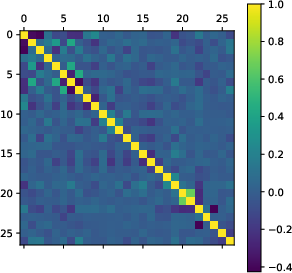
Figure 3: Correlation matrix (v1−v28) of the dataset.
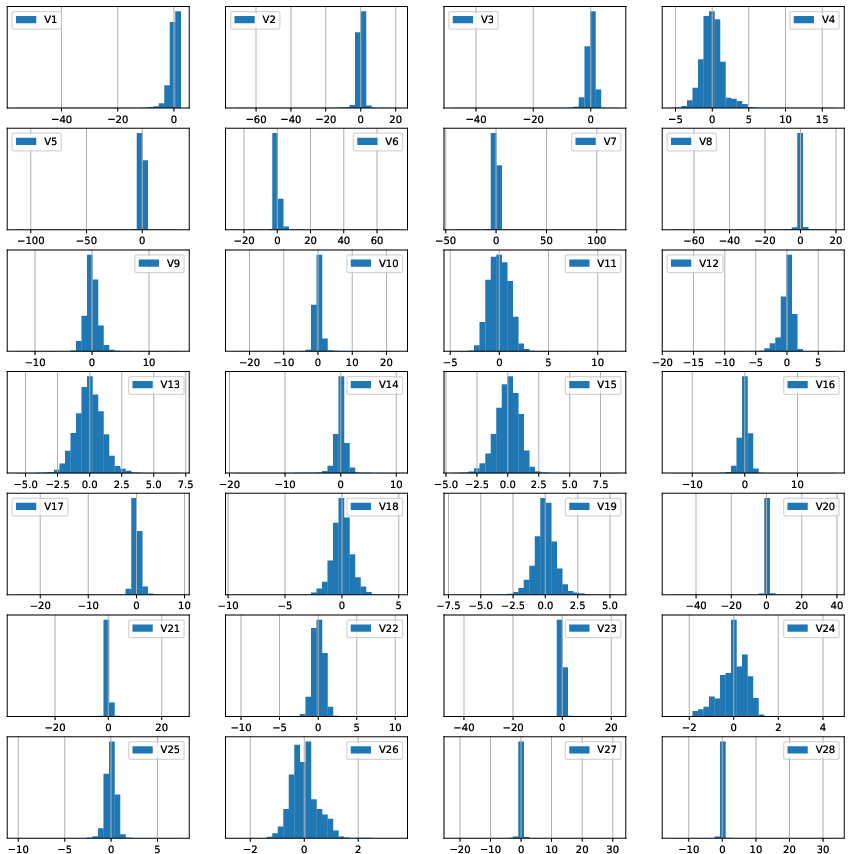
Figure 4: Histograms illustrating the distribution of all features in the dataset.
Results and Discussion
Experimental evaluation comparing Quantum Graph Neural Networks with classical GraphSAGE models provides compelling evidence for QGNNs' superior accuracy and feature representation efficacy. The QGNN models, optimized with a small number of qubits, demonstrated stronger performance indicators across precision, recall, and F1-score metrics, illustrating marked improvement over classical approaches.
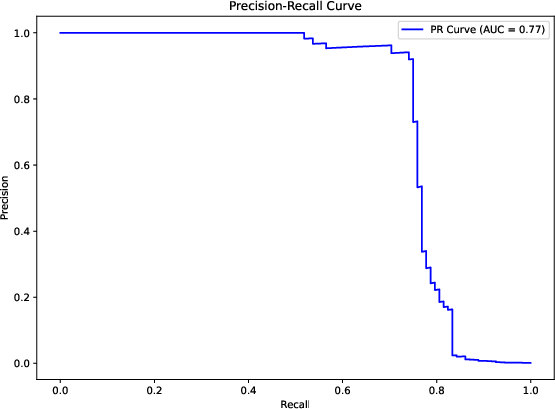
Figure 5: Receiver Operating Characteristic Curve for the GraphSAGE model with an AUC of 0.77.
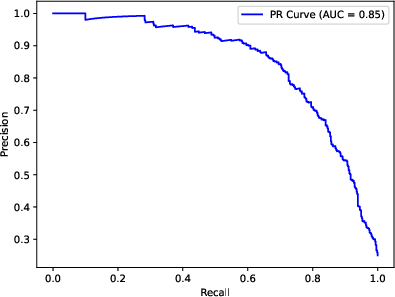
Figure 6: Receiver Operating Characteristic curve for QGNN model with 6 qubits and 1 hidden layer, with an AUC of 0.85.
The results underscore the capacity for QGNNs to process data more effectively and reveal latent fraud patterns, making them ideally suited for highly imbalanced datasets.
Conclusion
This paper highlights the promise of Quantum Graph Neural Networks as a viable fraud detection method capitalizing on QC's robust computational capabilities. The QGNN models perform considerably better than classical counterparts when applied to complex and imbalanced financial datasets.
The experimentation affirms quantum systems' potential to enhance prediction accuracy significantly, paving pathways to future explorations into QC applicability for diverse fraud detection mechanisms in financial settings. Possible extensions for QC-based systems encompass exploring deeper quantum architectures and investigating inter-feature entanglement strategies to attain unprecedented fraud detection efficiency.
In summary, QGNN offers a feasible solution for financial institutions grappling with sophisticated fraud, endorsing continual advancements in integrating QC within data-centric frameworks for fraud mitigation.