- The paper introduces a framework that reconstructs PDFs by maximizing Shannon entropy under moment and symmetry constraints, reducing traditional bias.
- It employs a sine basis expansion and an iterative self-consistent (SCF) method to achieve sub-percent accuracy with sufficient moment constraints.
- The approach enables unbiased PDF extraction with uncertainty quantification, offering new insights for lattice QCD and hadronic structure analyses.
Maximum Entropy Parton Distribution Function Reconstruction from Moments
Introduction
This work proposes a methodology for reconstructing parton distribution functions (PDFs) based on the maximum entropy principle, using moment constraints derived from QCD inputs. Existing approaches typically postulate an ansatz for the functional form of the PDF and fit free parameters to available moments. This introduces an inherent bias and impedes faithful quantification of uncertainty. The method advanced in this work circumvents these limitations by formulating the reconstruction as a constrained variational problem, maximizing the Shannon entropy subject to moment and symmetry constraints, and explicitly incorporating experimental or lattice-determined moment uncertainties by relaxing the constraint equations using Gaussian weighting.
The Shannon entropy of the PDF f(x) is maximized under constraints derived from the symmetries and the calculated Mellin moments:
S=−∫01f(x)logf(x)dx
subject to normalization, symmetry, and moment constraints,
∫01f(x)dx=1,f(x)=f(1−x),∫01xif(x)dx=μi
where μi are the available moments. Rather than parametrizing f(x) with a fixed form, a complete sine basis expansion is used, rendering the optimization agnostic with respect to explicit functional assumptions. The constrained maximization is solved using an iterative self-consistent field (SCF) approach akin to Hartree schemes in quantum mechanics, updating both the Lagrange multipliers and the basis coefficients until convergence. When moments have associated errors, Gaussian relaxations are introduced, and a balancing parameter β modulates the strictness of constraint enforcement.
The formulation is both general and extensible to asymmetric distributions, provided a suitable basis set reflecting the required symmetry properties is chosen.
Numerical Behavior and Validation
Parameter Selection and Convergence Properties
The accuracy of the SCF solution depends on the truncated basis size and numerical quadrature grid. With only the second-order moment fixed, the analytical form of the maximum entropy solution is Gaussian, allowing precise benchmarking. The SCF reconstruction achieves sub-percent level relative errors in entropy for adequate grid and basis resolution.
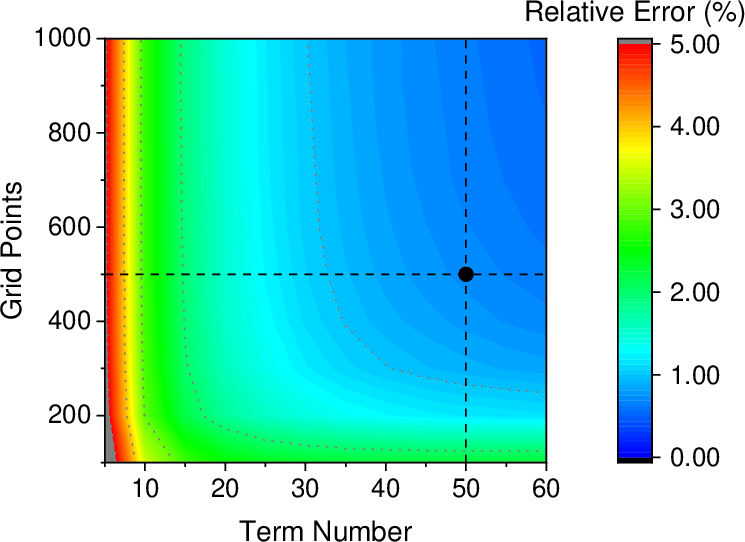
Figure 1: Relative errors of entropy by the SCF method with various parameters. The black point indicates parameters adopted in the subsequent reconstructions.
A pointwise comparison between the SCF and analytic solution confirms that the recovered PDF closely tracks the theoretical optimum, with minor oscillations localized near the endpoints due to basis truncation.
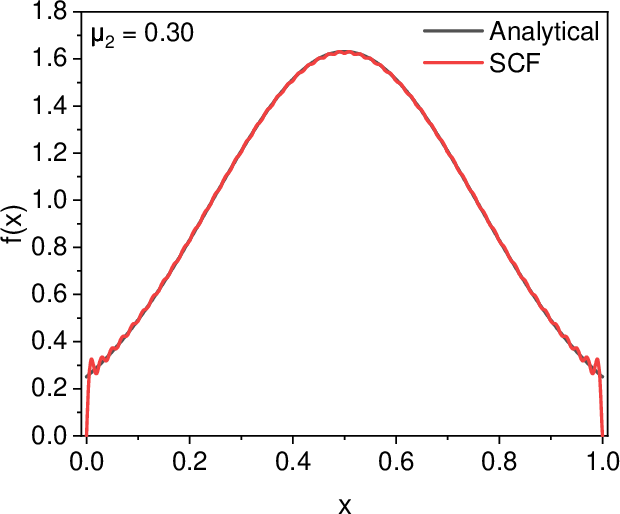
Figure 2: Comparison of the analytical and the SCF result for the constrained function.
Constraint Number and Reconstruction Efficiency
The amount and order of moment constraints directly determine the ambiguity of the reconstructed PDF. Using as a target the standard symmetric functional form f(x)=Nρlog(1+x2(1−x)2/ρ2), the effect of varying the number of constraint moments is thoroughly explored. Reconstructions with four or fewer constraints yield broad, low-fidelity distributions; however, introducing six or more moment constraints yields PDFs with maximal relative errors of O(1%), and further increase offers diminishing returns.
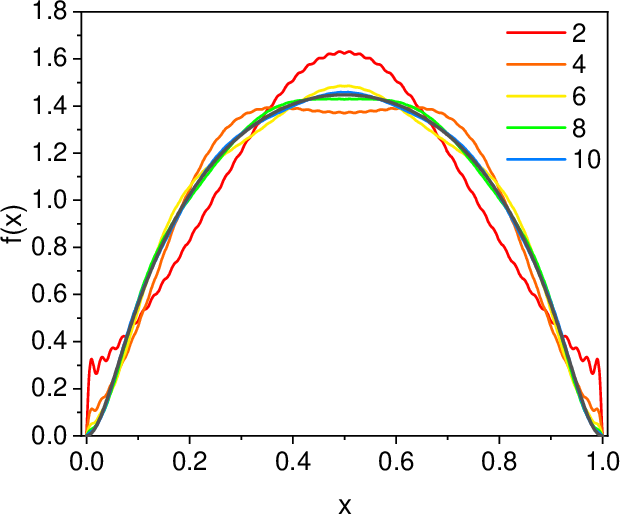
Figure 3: Variation in reconstruction results under different numbers of constraints, with the black curve as the target symmetric function.
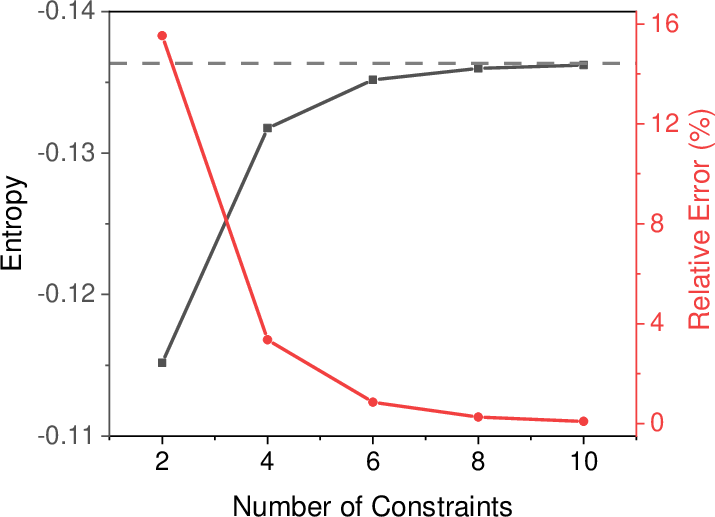
Figure 4: Entropy and relative error variation as a function of number of constraint moments.
Across a range of plausible values for the dominant (second) moment, six or more constraints keep the reconstruction error bounded below 5%, confirming this criterion's robustness for practical applications.
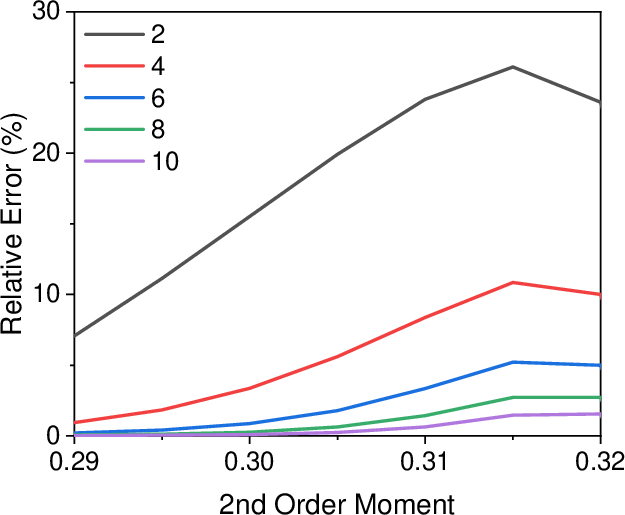
Figure 5: Variation in the relative error of entropy with the second-order moment.
Treatment of Moment Uncertainties
When reconstructing from real QCD or lattice moments—inevitably extracted with uncertainties—the method employs Gaussian relaxations on the moment constraints and tunes the enforcement strength via β. The interplay between entropy maximization and moment constraint satisfaction as a function of β is systematically quantified.
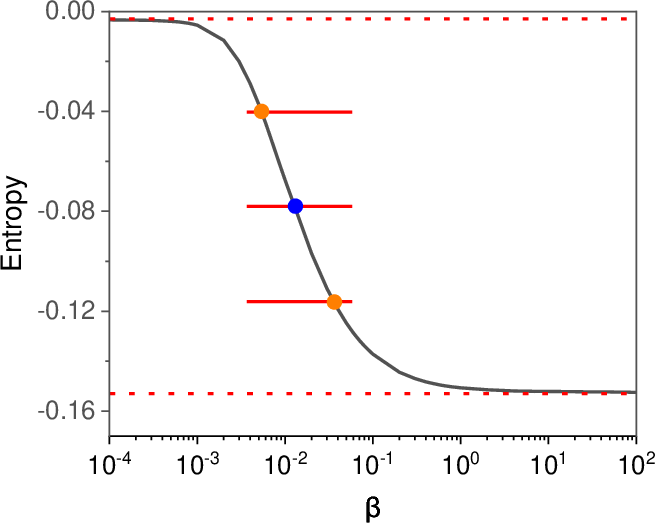
Figure 6: Entropy dependence on β for the reconstruction with moment errors. The median and boundaries of the appropriate β interval are indicated.
Optimal β is chosen based on the entropy plateau region, and uncertainty propagation is visualized by the solution's range for β within the central half of the plateau.
Applying the formalism to evolved lattice QCD moments for the pion yields reconstructed PDFs consistent with independent analysis, with explicit uncertainty bands reflecting the lattice input spread and intrinsic method regularization.
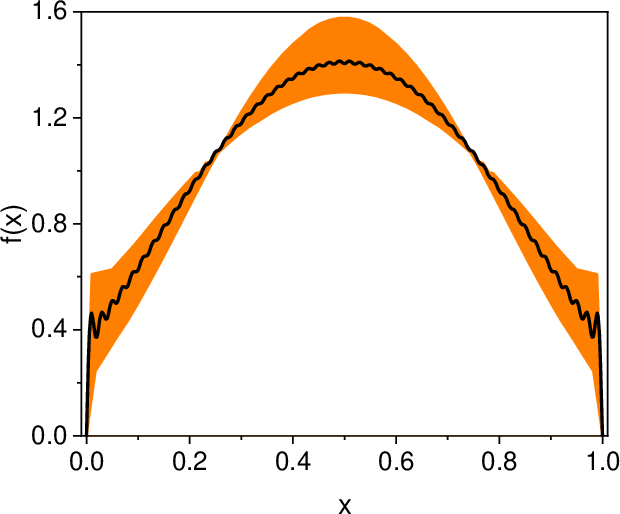
Figure 7: Reconstructed distribution function from lattice QCD moments, with error bands determined from β variation.
Moment-level validation confirms that the reconstructed moments with propagated uncertainties are compatible with the original lattice values, with a tendency for the reconstruction-induced uncertainty to exceed the original input for higher moments due to the maximum entropy regularization's nonparametric smoothing.
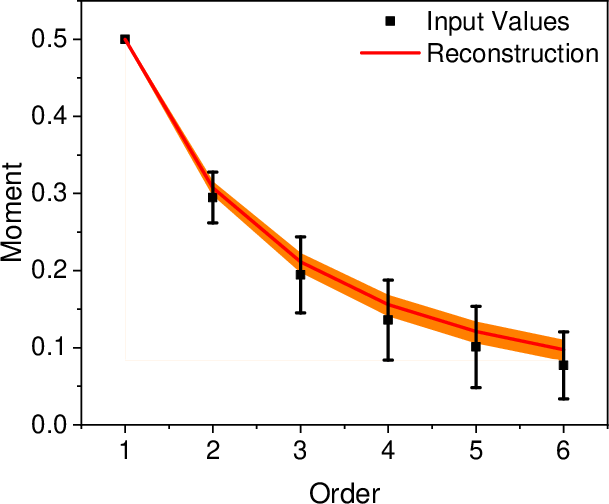
Figure 8: Comparison between the lattice input and the reconstructed moment error ranges.
Implications and Future Directions
This maximum entropy-based framework formalizes PDF reconstruction in a fully data-driven, bias-minimized manner. Its ability to nonparametrically incorporate all available moment information (with or without uncertainties) establishes new standards for both statistical rigor and result interpretability in hadronic structure studies. The approach directly supports theoretical investigations of the moment problem for PDFs and practical extraction and uncertainty quantification for experimental or lattice QCD inputs.
Methodological extensions could include optimal, systematically justified selection of the constraint enforcement strength (β) and incorporation of adaptive or problem-specific basis sets for asymmetric or more complex partonic distributions. Further, the nonparametric and extensible nature of the formulation facilitates its application to generalized parton distributions, transverse-momentum dependent PDFs, and other QCD observables for which moment constraints are available.
Conclusion
The presented approach provides an entropy-maximizing, nonparametric method for reconstructing PDFs from Mellin moments under physically motivated constraints and uncertainty quantification. The thorough validation and robust performance with as few as six moments signify both immediate utility and theoretical soundness. This framework obviates bias from assumed PDF forms and incorporates constraint uncertainties in a principled, transparent manner, thereby offering a platform for future precision hadron structure analyses and methodological developments.