- The paper introduces TS-QHOSVD, a two-sided quaternion higher-order singular value decomposition method that generalizes matrix SVD to tensor data.
- It details efficient parallelizable algorithms, error-bound truncation strategies, and consistent unfolding operations for accurate color video reconstruction.
- The method improves multidimensional data compression by capturing 3D correlations, benefiting practical applications in signal and image processing.
A Parallelizable Quaternion Higher-Order Singular Value Decomposition with Applications
Introduction
The paper presents a parallelizable method for Quaternion Higher-Order Singular Value Decomposition (QHOSVD), extending the matrix SVD to quaternion tensors. The motivation lies in the advantage offered by quaternions in representing multidimensional data like color videos, due to their ability to incorporate three-dimensional information in a compact form.
Traditional methods like L-QHOSVD only involve left quaternion multiplications, but this paper introduces Two-Sided QHOSVD (TS-QHOSVD) using both left and right multiplications, ensuring consistency with matrix SVD when the tensor collapses to order 2. This paper also explores truncated versions of TS-QHOSVD, L-QHOSVD, and R-QHOSVD along with their error bounds.
Quaternion Tensor Operations
The method defines left and right mode-k products:
- Left mode-k unfolding arranges mode-k elements as columns (Definition \ref{lmu}).
- Right mode-k unfolding arranges them as rows (Definition \ref{rmu}).
The inconsistency in quaternion multiplication necessitates both left and right unfoldings to fully represent quaternion tensor structures.
TS-QHOSVD
The proposed TS-QHOSVD generalizes the matrix SVD to higher-order quaternion tensors while maintaining crucial properties:
Implementations of TS-, L-, and R-QHOSVD are given in the form of algorithms, detailing initialization steps and matrix operations needed at each step of decomposition. The focus on practical applications, such as color video compression, is highlighted through numerical examples.
Truncated QHOSVD and Error Analysis
The truncated versions reduce dimensions where data approximately lies in smaller subspaces while offering error bounds. Non-commutativity complicates traditional real matrix analyses, leading to more complex error bound derivations using residual tensors.
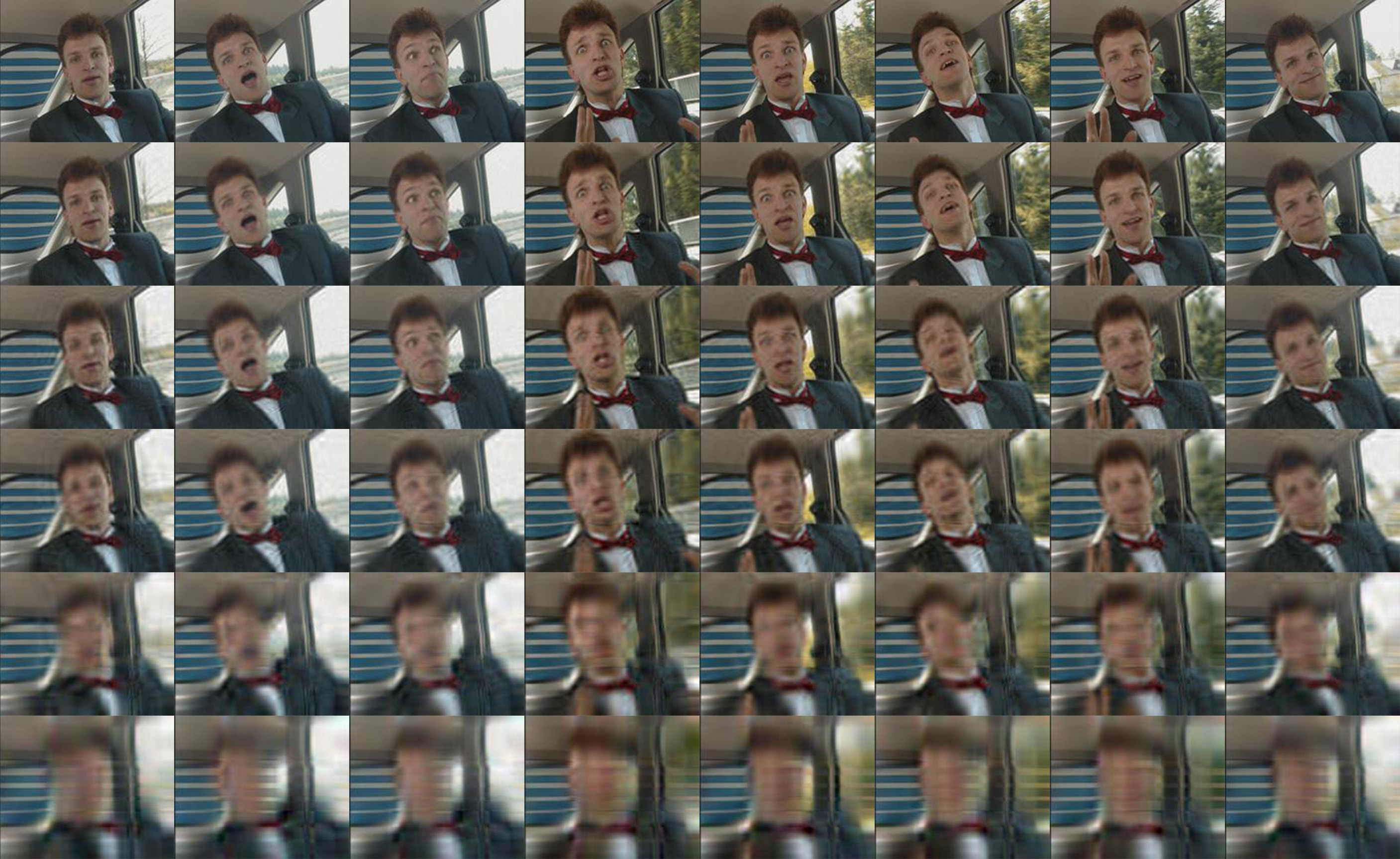
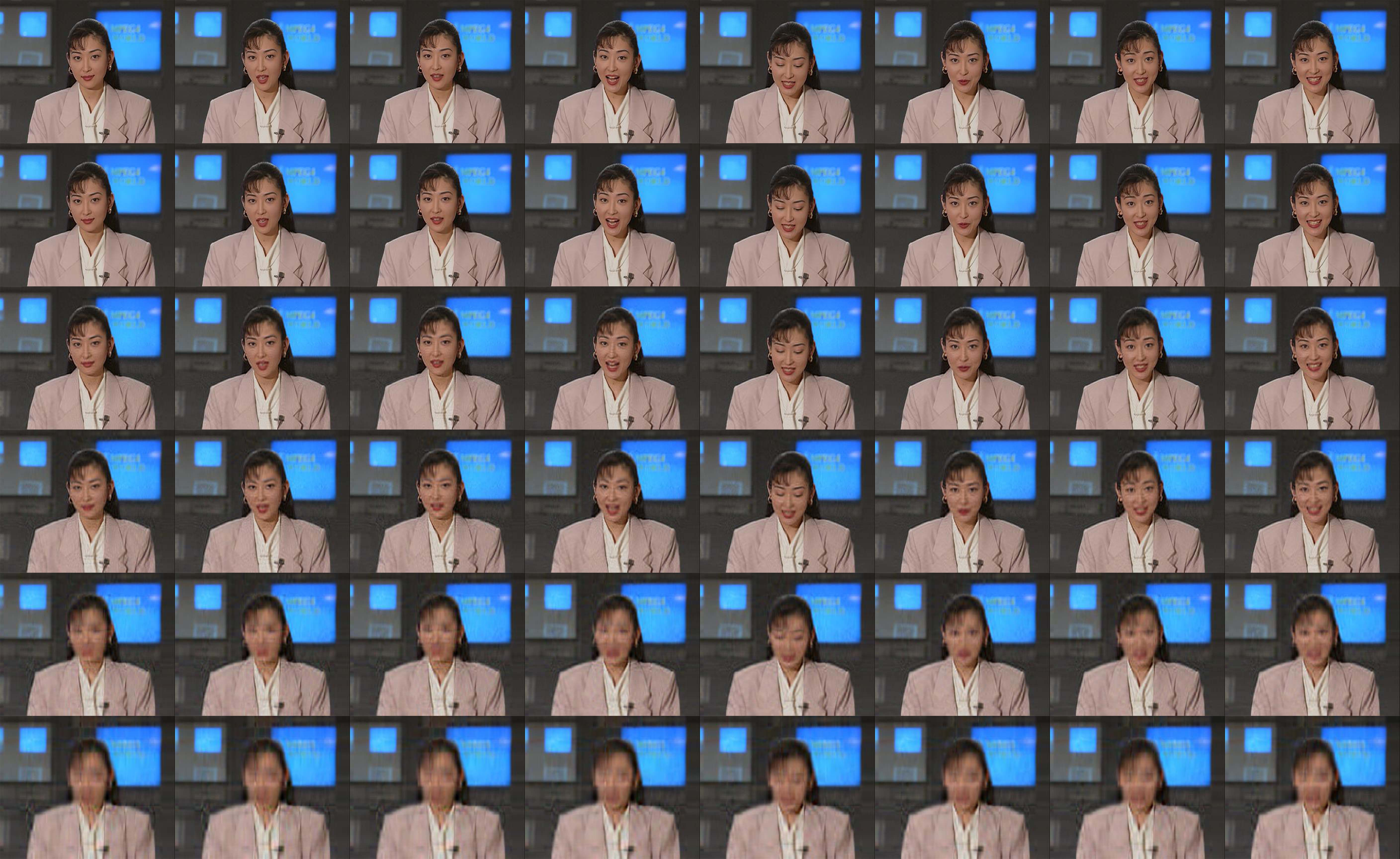
Figure 2: Reconstructed results by TS-QHOSVD with different truncated ratios in color video ``carphone''. The first row: the original frames. The second-to-last rows: frame reconstructed by truncated TS-QHOSVD.
Conclusions and Future Work
TS-QHOSVD offers a balanced approach, extending both the concepts of HOSVD and quaternion matrix operations to efficiently represent and compress multidimensional data. However, defining multilinear rank in quaternion tensors poses challenges due to non-standard rank definitions and inconsistency between quaternion matrix and its transpose. Future work will focus on relaxing computation constraints, better error bounding strategies, and improving the core tensor properties across all modes in QHOSVD.
Despite computational intricacies inherent in dealing with quaternions, the paper demonstrates a robust method, backed by numerical experiments, showing improvements over existing quaternion and tensor decomposition methods for data approximation, particularly in representing color images and videos.
This exploration sets a foundation for further advancements in quaternion tensor formulations, impacting domains like signal and image processing where 3D information can efficiently be encoded and processed.