Rehearsal: Simulating Conflict to Teach Conflict Resolution
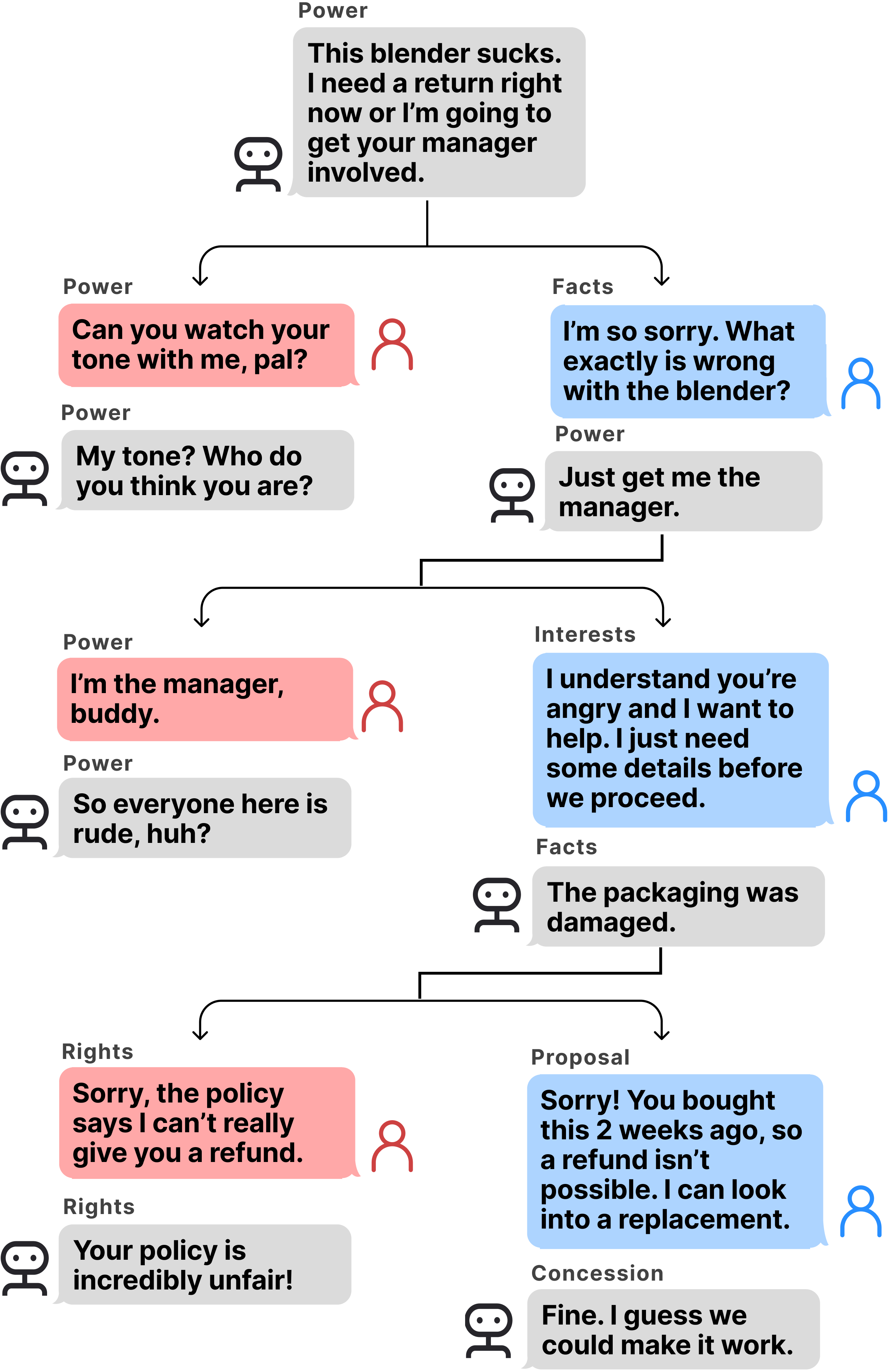
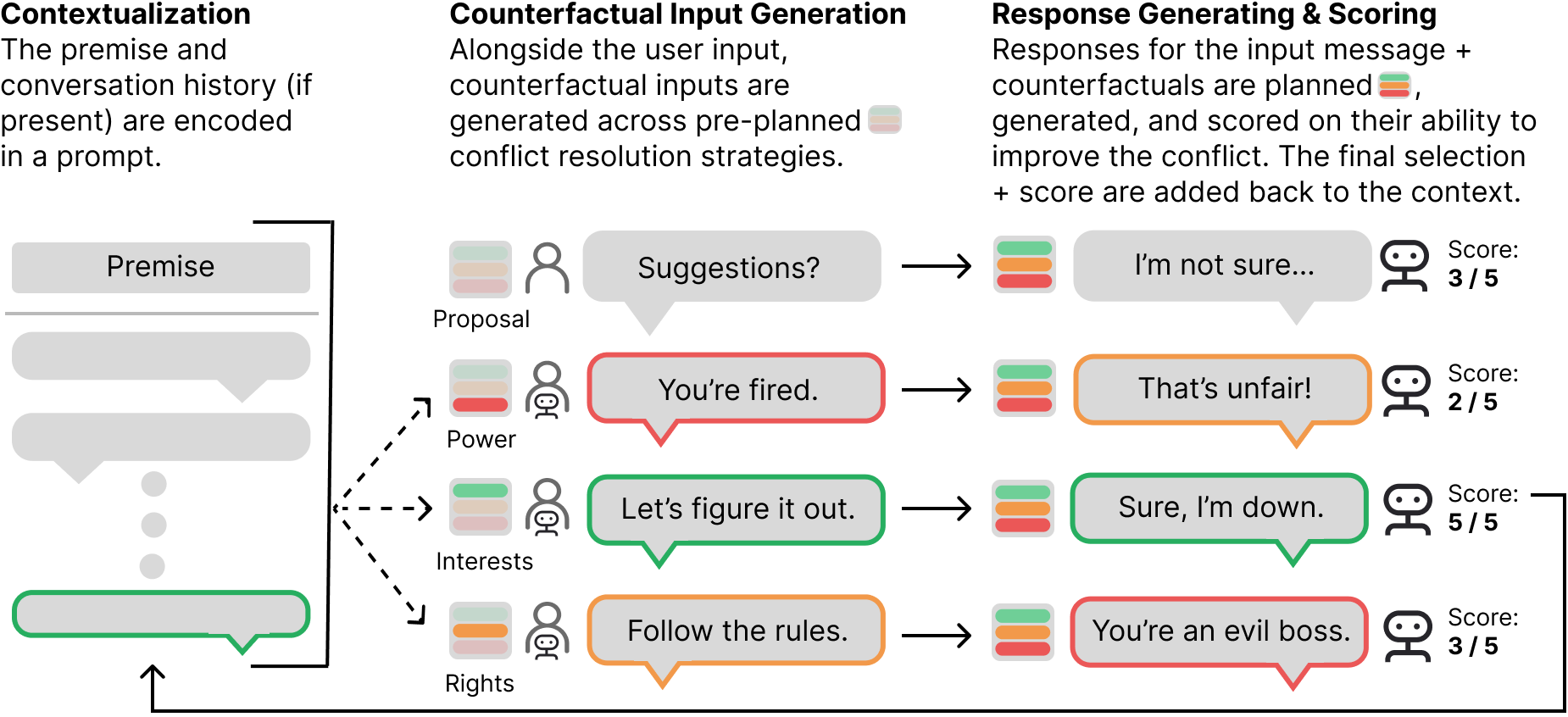
Abstract: Interpersonal conflict is an uncomfortable but unavoidable fact of life. Navigating conflict successfully is a skill -- one that can be learned through deliberate practice -- but few have access to effective training or feedback. To expand this access, we introduce Rehearsal, a system that allows users to rehearse conflicts with a believable simulated interlocutor, explore counterfactual "what if?" scenarios to identify alternative conversational paths, and learn through feedback on how and when to apply specific conflict strategies. Users can utilize Rehearsal to practice handling a variety of predefined conflict scenarios, from office disputes to relationship issues, or they can choose to create their own setting. To enable Rehearsal, we develop IRP prompting, a method of conditioning output of a LLM on the influential Interest-Rights-Power (IRP) theory from conflict resolution. Rehearsal uses IRP to generate utterances grounded in conflict resolution theory, guiding users towards counterfactual conflict resolution strategies that help de-escalate difficult conversations. In a between-subjects evaluation, 40 participants engaged in an actual conflict with a confederate after training. Compared to a control group with lecture material covering the same IRP theory, participants with simulated training from Rehearsal significantly improved their performance in the unaided conflict: they reduced their use of escalating competitive strategies by an average of 67%, while doubling their use of cooperative strategies. Overall, Rehearsal highlights the potential effectiveness of LLMs as tools for learning and practicing interpersonal skills.
- 2023. Program on Negotiation: Harvard Business School. https://www.pon.harvard.edu/.
- Learning through case comparisons: A meta-analytic review. Educational Psychologist 48, 2 (2013), 87–113.
- AI Chat Assistants can Improve Conversations about Divisive Topics. arXiv preprint arXiv:2302.07268 (2023).
- Out of one, many: Using language models to simulate human samples. Political Analysis 31, 3 (2023), 337–351.
- Susan M Barnett and Stephen J Ceci. 2002. When and where do we apply what we learn?: A taxonomy for far transfer. Psychological bulletin 128, 4 (2002), 612.
- Man is to computer programmer as woman is to homemaker? debiasing word embeddings. Advances in neural information processing systems 29 (2016).
- Staff training for business process improvement: The benefit of role-plays in the case of KreditSim. Journal of Workplace Learning 24, 3 (2012), 200–225.
- Breaking the bonds of reciprocity in negotiations. Academy of Management Journal 41, 4 (1998), 410–424.
- Language models are few-shot learners. Advances in neural information processing systems 33 (2020), 1877–1901.
- Amy S Bruckman. 2022. Should you believe Wikipedia?: online communities and the construction of knowledge. Cambridge University Press.
- John Burton and Frank Dukes. 1990. Conflict: Readings in management and resolution. Springer.
- Jie Cai and Donghee Yvette Wohn. 2023. Understanding Moderators’ Conflict and Conflict Management Strategies with Streamers in Live Streaming Communities. In Proceedings of the 2023 CHI Conference on Human Factors in Computing Systems. 1–12.
- My team will go on: Differentiating high and low viability teams through team interaction. Proceedings of the ACM on Human-Computer Interaction 4, CSCW3 (2021), 1–27.
- Thread With Caution: Proactively Helping Users Assess and Deescalate Tension in Their Online Discussions. Proceedings of the ACM on Human-Computer Interaction 6, CSCW2 (2022), 1–37.
- Marked Personas: Using Natural Language Prompts to Measure Stereotypes in Language Models. In Proceedings of the 61st Annual Meeting of the Association for Computational Linguistics (Volume 1: Long Papers). Association for Computational Linguistics, Toronto, Canada, 1504–1532. https://doi.org/10.18653/v1/2023.acl-long.84
- Jacob Cohen. 1960. A coefficient of agreement for nominal scales. Educational and psychological measurement 20, 1 (1960), 37–46.
- A theory-based measure of conflict management strategies in the workplace. Journal of Organizational Behavior: The International Journal of Industrial, Occupational and Organizational Psychology and Behavior 22, 6 (2001), 645–668.
- Conflict at work and individual well-being. International journal of conflict management 15, 1 (2004), 6–26.
- Carsten KW De Dreu and Annelies EM Van Vianen. 2001. Managing relationship conflict and the effectiveness of organizational teams. Journal of Organizational Behavior: The International Journal of Industrial, Occupational and Organizational Psychology and Behavior 22, 3 (2001), 309–328.
- Carsten KW De Dreu and Michael A West. 2001. Minority dissent and team innovation: The importance of participation in decision making. Journal of applied Psychology 86, 6 (2001), 1191.
- Morton Deutsch. 1949. A theory of co-operation and competition. Human relations 2, 2 (1949), 129–152.
- Morton Deutsch. 1973. The resolution of conflict: Constructive and destructive processes. Yale University Press.
- Morton Deutsch. 1994. Constructive conflict resolution: Principles, training, and research. Journal of social issues 50, 1 (1994), 13–32.
- The handbook of conflict resolution: Theory and practice. John Wiley & Sons.
- Noam Ebner and Yael Efron. 2005. Using tomorrow’s headlines for today’s training: Creating pseudo-reality in conflict resolution simulation games. Negotiation Journal 21, 3 (2005), 377–394.
- The role of deliberate practice in the acquisition of expert performance. Psychological review 100, 3 (1993), 363.
- From Pretraining Data to Language Models to Downstream Tasks: Tracking the Trails of Political Biases Leading to Unfair NLP Models. arXiv preprint arXiv:2305.08283 (2023).
- Getting to yes: Negotiating agreement without giving in. Penguin.
- What goes around comes around: The impact of personal conflict style on work conflict and stress. International Journal of Conflict Management (2000).
- Strategic Reasoning with Language Models. arXiv preprint arXiv:2305.19165 (2023).
- Conflict cultures in organizations: How leaders shape conflict cultures and their organizational-level consequences. Journal of Applied Psychology 97, 6 (2012), 1131.
- Learning and transfer: A general role for analogical encoding. Journal of educational psychology 95, 2 (2003), 393.
- Natasha Gill. 2015. Inside the box: Using integrative simulations to teach conflict, negotiation and mediation. ETH Zurich.
- Who Would You Like to Work With?. In Proceedings of the 2019 CHI Conference on Human Factors in Computing Systems (Glasgow, Scotland Uk) (CHI ’19). Association for Computing Machinery, New York, NY, USA, 1–15. https://doi.org/10.1145/3290605.3300889
- Jonathan Grudin. 1994. Groupware and social dynamics: Eight challenges for developers. Commun. ACM 37, 1 (1994), 92–105.
- John Hattie and Helen Timperley. 2007. The power of feedback. Review of educational research 77, 1 (2007), 81–112.
- TrueSkill™: a Bayesian skill rating system. Advances in neural information processing systems 19 (2006).
- Pamela J Hinds and Diane E Bailey. 2003. Out of sight, out of sync: Understanding conflict in distributed teams. Organization science 14, 6 (2003), 615–632.
- Sture Holm. 1979. A simple sequentially rejective multiple test procedure. Scandinavian journal of statistics (1979), 65–70.
- John J Horton. 2023. Large Language Models as Simulated Economic Agents: What Can We Learn from Homo Silicus? arXiv preprint arXiv:2301.07543 (2023).
- Helping the Helper: Supporting Peer Counselors via AI-Empowered Practice and Feedback. arXiv preprint arXiv:2305.08982 (2023).
- The effects of conflict asymmetry on mediation outcomes: Satisfaction, work motivation and absenteeism. International Journal of Conflict Management (2006).
- Robert Johansen. 1988. Groupware: Computer support for business teams. The Free Press.
- Aniket Kittur and Robert E. Kraut. 2010. Beyond Wikipedia: Coordination and Conflict in Online Production Groups. In Proceedings of the 2010 ACM Conference on Computer Supported Cooperative Work (Savannah, Georgia, USA) (CSCW ’10). Association for Computing Machinery, New York, NY, USA, 215–224. https://doi.org/10.1145/1718918.1718959
- He says, she says: conflict and coordination in Wikipedia. In Proceedings of the SIGCHI conference on Human factors in computing systems. 453–462.
- Roger Kneebone. 2005. Evaluating clinical simulations for learning procedural skills: a theory-based approach. Academic medicine 80, 6 (2005), 549–553.
- Justin Kruger and David Dunning. 1999. Unskilled and unaware of it: how difficulties in recognizing one’s own incompetence lead to inflated self-assessments. Journal of personality and social psychology 77, 6 (1999), 1121.
- Arnold A Lazarus. 1966. Behaviour rehearsal vs. non-directive therapy vs. advice in effecting behaviour change. Behaviour Research and Therapy 4, 1-2 (1966), 209–212.
- Crucial Learning. 1999. Explore Others’ Paths: Role Plays. https://ing.byui.edu/images/human-resources/training-development/Strengths%20Finder/Crucial%20Conversations/Crucial-Conversations-Role-Plays.pdf
- Holistic evaluation of language models. arXiv preprint arXiv:2211.09110 (2022).
- SwiftSage: A Generative Agent with Fast and Slow Thinking for Complex Interactive Tasks. arXiv preprint arXiv:2305.17390 (2023).
- Carol Livingstone. 1983. Role Play in Language Learning. ERIC.
- The strategic use of interests, rights, and power to resolve disputes. Negotiation Journal 15, 1 (1999), 31–51.
- George Mandler. 1980. Recognizing: The judgment of previous occurrence. Psychological review 87, 3 (1980), 252.
- GPTeach: Interactive TA Training with GPT Based Students. (2023).
- Karl Marx and Friedrich Engels. 1848. Manifesto of the Communist Party. Verlag von Otto Meissner.
- Frank J Massey Jr. 1951. The Kolmogorov-Smirnov test for goodness of fit. Journal of the American statistical Association 46, 253 (1951), 68–78.
- Debra Nestel and Tanya Tierney. 2007. Role-play for medical students learning about communication: guidelines for maximising benefits. BMC medical education 7 (2007), 1–9.
- OpenAI. 2023. GPT-4 Technical Report. ArXiv abs/2303.08774 (2023). https://api.semanticscholar.org/CorpusID:257532815
- Generative agents: Interactive simulacra of human behavior. arXiv preprint arXiv:2304.03442 (2023).
- Social Simulacra: Creating Populated Prototypes for Social Computing Systems. In Proceedings of the 35th Annual ACM Symposium on User Interface Software and Technology. 1–18.
- Measuring the Prevalence of Anti-Social Behavior in Online Communities. Proceedings of the ACM on Human-Computer Interaction 6, CSCW2 (2022), 1–29.
- Discovering language model behaviors with model-written evaluations. arXiv preprint arXiv:2212.09251 (2022).
- Transfer of learning. International encyclopedia of education 2 (1992), 6452–6457.
- Niloufar Salehi and Michael S Bernstein. 2018. Hive: Collective design through network rotation. Proceedings of the ACM on Human-Computer Interaction 2, CSCW (2018), 1–26.
- Donald A Schon. 1968. The reflective practitioner. New York (1968).
- The ABCs of how we learn: 26 scientifically proven approaches, how they work, and when to use them. WW Norton & Company.
- On Second Thought, Let’s Not Think Step by Step! Bias and Toxicity in Zero-Shot Reasoning. arXiv preprint arXiv:2212.08061 (2022).
- Human–AI collaboration enables more empathic conversations in text-based peer-to-peer mental health support. Nature Machine Intelligence 5, 1 (2023), 46–57.
- Reflexion: an autonomous agent with dynamic memory and self-reflection. arXiv preprint arXiv:2303.11366 (2023).
- Graham Upton and Ian Cook. 2014. A dictionary of statistics 3e. Oxford quick reference.
- Jeanne M Brett Ury and Jeanne M Brett. 1988. Getting Disputes Resolved: Designing Systems to Cut the Costs of Conflict. San Francisco: Jossey-Bass.
- Chain of thought prompting elicits reasoning in large language models. arXiv preprint arXiv:2201.11903 (2022).
- What makes online communities ‘better’? Measuring values, consensus, and conflict across thousands of subreddits. In Proceedings of the International AAAI Conference on Web and Social Media, Vol. 16. 1121–1132.
- Ai chains: Transparent and controllable human-ai interaction by chaining large language model prompts. In Proceedings of the 2022 CHI Conference on Human Factors in Computing Systems. 1–22.
- DOC: Improving Long Story Coherence With Detailed Outline Control. In Proceedings of the 61st Annual Meeting of the Association for Computational Linguistics (Volume 1: Long Papers). Association for Computational Linguistics, Toronto, Canada, 3378–3465. https://doi.org/10.18653/v1/2023.acl-long.190
- Re3: Generating Longer Stories With Recursive Reprompting and Revision. In Proceedings of the 2022 Conference on Empirical Methods in Natural Language Processing. Association for Computational Linguistics, Abu Dhabi, United Arab Emirates, 4393–4479. https://aclanthology.org/2022.emnlp-main.296
- React: Synergizing reasoning and acting in language models. arXiv preprint arXiv:2210.03629 (2022).
- Pengcheng Yin and Graham Neubig. 2017. A syntactic neural model for general-purpose code generation. arXiv preprint arXiv:1704.01696 (2017).
- Conversations Gone Awry: Detecting Early Signs of Conversational Failure. In Proceedings of the 56th Annual Meeting of the Association for Computational Linguistics (Volume 1: Long Papers). Association for Computational Linguistics, Melbourne, Australia, 1350–1361. https://doi.org/10.18653/v1/P18-1125
Paper Prompts
Sign up for free to create and run prompts on this paper using GPT-5.
Top Community Prompts
Collections
Sign up for free to add this paper to one or more collections.