Papers
Topics
Authors
Recent
Search
2000 character limit reached

Shedding Light on the Ageing of Extra Virgin Olive Oil: Probing the Impact of Temperature with Fluorescence Spectroscopy and Machine Learning Techniques

Published 21 Sep 2023 in cs.LG | (2309.12377v1)

Abstract: This work systematically investigates the oxidation of extra virgin olive oil (EVOO) under accelerated storage conditions with UV absorption and total fluorescence spectroscopy. With the large amount of data collected, it proposes a method to monitor the oil's quality based on machine learning applied to highly-aggregated data. EVOO is a high-quality vegetable oil that has earned worldwide reputation for its numerous health benefits and excellent taste. Despite its outstanding quality, EVOO degrades over time owing to oxidation, which can affect both its health qualities and flavour. Therefore, it is highly relevant to quantify the effects of oxidation on EVOO and develop methods to assess it that can be easily implemented under field conditions, rather than in specialized laboratories. The following study demonstrates that fluorescence spectroscopy has the capability to monitor the effect of oxidation and assess the quality of EVOO, even when the data are highly aggregated. It shows that complex laboratory equipment is not necessary to exploit fluorescence spectroscopy using the proposed method and that cost-effective solutions, which can be used in-field by non-scientists, could provide an easily-accessible assessment of the quality of EVOO.

Definition Search Book Streamline Icon: https://streamlinehq.com
References (37)
  1. Evolution of the oxidation process in olive oil triacylglycerol under accelerated storage conditions (40–60 c), Journal of the American oil chemists’ society 81 (2004) 177–184.
  2. Kinetic study for the development of an accelerated oxidative stability test to estimate virgin olive oil potential shelf life, European Journal of Lipid Science and Technology 110 (2008) 969–976.
  3. Thermal degradation kinetics of chlorophyll pigments in virgin olive oils. 1. compounds of series a, Journal of Agricultural and Food Chemistry 58 (2010) 6200–6208.
  4. Effect of light exposure on the quality of extra virgin olive oils according to their chemical composition, Food Chemistry 229 (2017) 726–733.
  5. Thermal degradation in edible oils by surface enhanced raman spectroscopy calibrated with iodine values, Vibrational Spectroscopy 106 (2020) 103018.
  6. Changes during storage of quality parameters and in vitro antioxidant activity of extra virgin monovarietal oils obtained with two extraction technologies, Food Chemistry 134 (2012) 1542–1548.
  7. Predicting extra virgin olive oil freshness during storage by fluorescence spectroscopy, Grasas y Aceites, 68 (4), e219. (2017).
  8. Temperature dependence of oxidation kinetics of extra virgin olive oil (evoo) and shelf-life prediction, Foods 9 (2020) 295.
  9. R. Aparicio-Ruiz, B. Gandul-Rojas, Thermal degradation kinetics of neoxanthin, violaxanthin, and antheraxanthin in virgin olive oils, Journal of agricultural and food chemistry 60 (2012) 5180–5191.
  10. Surface-enhanced raman spectroscopy for monitoring extravirgin olive oil bioactive components, Journal of Chemistry 2019 (2019).
  11. Front face fluorescence spectroscopy combined with pls-da allows to monitor chemical changes of edible vegetable oils during storage at 60° c, European Journal of Lipid Science and Technology 123 (2021) 2000088.
  12. C. R. B. Lopes, L. C. Courrol, Evaluation of steady-state and time-resolved fluorescence spectroscopy as a method for assessing the impact of photo-oxidation on refined soybean oils, Foods 12 (2023) 1862.
  13. Commission regulation (eec) no. 2568/91 of 11 july 1991 on the characteristics of olive oil and olive-residue oil and on the relevant methods of analysis official journal l 248, 5 september 1991, Offic. JL 248 (1991) 1–83.
  14. Commission implementing regulation no 1348/2013 of december 17 2013, Official Journal of the European Union 338 (2013) 31–67.
  15. Rapid analytical method to characterize the freshness of olive oils using fluorescence spectroscopy and chemometric algorithms, Journal of Analytical Methods in Chemistry 2020 (2020).
  16. Evaluation of the overall quality of olive oil using fluorescence spectroscopy, Food Chemistry 173 (2015) 927–934.
  17. Fluorescence spectroscopy in monitoring of extra virgin olive oil during storage, International journal of food science & technology 43 (2008) 52–61.
  18. R. Karoui, C. Blecker, Fluorescence spectroscopy measurement for quality assessment of food systems—a review, Food and Bioprocess technology 4 (2011) 364–386.
  19. Monitoring virgin olive oil shelf-life by fluorescence spectroscopy and sensory characteristics: A multidimensional study carried out under simulated market conditions, Foods 9 (2020) 1846.
  20. Cultivar and geographical origin authentication of italian extra virgin olive oil using front-face fluorescence spectroscopy and chemometrics, Food Control 121 (2021) 107604.
  21. E. Ordukaya, B. Karlik, Quality control of olive oils using machine learning and electronic nose, Journal of Food Quality 2017 (2017).
  22. Deep learning techniques to improve the performance of olive oil classification, Frontiers in chemistry 7 (2020) 929.
  23. Exploration of spanish olive oil quality with a miniaturized low-cost fluorescence sensor and machine learning techniques, Foods 10 (2021) 1010.
  24. Application of new emerging techniques in combination with classical methods for the determination of the quality and authenticity of olive oil: a review, Critical Reviews in Food Science and Nutrition (2021) 1–24.
  25. Long term storage of soybean and cottonseed salad oils, Journal of the American Oil Chemists’ Society 50 (1973) 218–222.
  26. M. T. Morales, R. Przybylski, Olive Oil Oxidation, in: R. Aparicio, J. Harwood (Eds.), Handbook of Olive Oil, Springer US, Boston, MA, 2013, pp. 479–522. URL: http://link.springer.com/10.1007/978-1-4614-7777-8_13. doi:10.1007/978-1-4614-7777-8_13.
  27. Influence of headspace oxygen on quality and shelf life of extra virgin olive oil during storage, Food Packaging and Shelf Life 23 (2020) 100433.
  28. Dataset of fluorescence eem and uv spectroscopy data of olive oils during ageing, Data 8 (2023) 1–6.
  29. Dataset of fluorescence eem and uv spectroscopy data of olive oils during ageing, Mendeley data (????). doi:10.17632/g6y69g8gwm.1.
  30. Multi-class adaboost, Statistics and its Interface 2 (2009) 349–360.
  31. Influence of extreme storage conditions on extra virgin olive oil parameters: traceability study, Journal of Analytical Methods in Chemistry 2016 (2016).
  32. Analysis of olive oils by fluorescence spectroscopy: methods and applications, Olive oil-constituents, quality, health properties and bioconversions (2012) 63–88.
  33. Fluorescence of vegetable oils: olive oils, Journal of agricultural and food chemistry 53 (2005) 759–766.
  34. Development of rapid extra virgin olive oil quality assessment procedures based on spectroscopic techniques, Agronomy 10 (2020) 41.
  35. A preliminary study on the potential of front face fluorescence spectroscopy for italian mono-cultivar extra virgin olive oil discrimination, Journal of Agricultural Engineering 50 (2019) 5–11.
  36. Simultaneous fluorometric determination of chlorophylls a and b and pheophytins a and b in olive oil by partial least-squares calibration, Journal of agricultural and food chemistry 51 (2003) 6934–6940.
  37. Laser diode induced excitation of pdo extra virgin olive oils for cognitive authentication and fraud detection, Sensors and Actuators B: Chemical 280 (2019) 1–9.
Citations (3)

Summary

  • The paper demonstrates that fluorescence spectroscopy combined with ML can effectively monitor EVOO ageing by tracking key oxidation parameters.
  • The study employs UV-Vis and excitation-emission measurements to quantify changes in pigments and tocopherols under thermal stress.
  • The simplified sensor approach using dual excitation wavelengths shows over 90% accuracy in classifying EVOO quality based on oxidation metrics.

Optical and Machine Learning Approaches to Monitoring Extra Virgin Olive Oil Ageing

Introduction

The paper presents a systematic investigation into the thermal oxidation of extra virgin olive oil (EVOO), employing both spectroscopic and ML tools to quantify ageing-induced quality loss. The methodology combines UV absorption and detailed fluorescence spectroscopy, evaluated on 24 commercially sourced EVOOs across several European provenances subjected to accelerated storage at 6060^{\circ}C. The principal objective is to identify minimally complex, cost-efficient sensing strategies for in-field EVOO quality assessment, circumventing the laborious and resource-intensive protocols prescribed by regulatory frameworks.

Experimental Design and Data Acquisition

The study’s experimental structure encompasses a wide diversity of EVOO samples to capture matrix variability. Thermal stress over 53 days is imposed in minimal-oxygen hermetic vials, a critical step to approximate in-bottle storage conditions and mitigate artificial acceleration of oxidative changes. At 10 temporal intervals, each sample undergoes both UV-Vis spectroscopy for established European-regulation absorption parameters (K232K_{232}, K268K_{268}, ΔK\Delta K) and comprehensive excitation-emission fluorescence matrix (EEM) acquisition (300–650 nm excitation, 300–800 nm emission).

Spectroscopy and Regulatory Quality Metrics

The evolution of K232K_{232} and K268K_{268}, quantifiers of primary and secondary oxidation products respectively, reveals strong inter-sample variability attributable to compositional heterogeneity. K268K_{268} demonstrates higher sensitivity, with a 143% mean increment over 53 days, and only 4/24 samples remaining within the extra virgin legal threshold after ageing. K232K_{232} is less discriminatory (26% mean increment; 7/24 below threshold). ΔK\Delta K is deemed unreliable for ML due to signal-to-noise limitations, as it exhibits changes comparable to intrinsic measurement error.

Fluorescence Spectral Analysis

Fresh EVOOs display strong fluorescence bands near 650–750 nm at 350–400 nm and 600–650 nm excitation, coinciding with chlorophyll signatures. Variance is mostly observed at excitation 310–350 nm and emission 350–600 nm, highlighting tocopherols, flavins, and oxidation derivatives. Importantly, all measurements are performed on undiluted samples, emphasizing the goal of non-destructive, sample-preparation-free assessment suitable for on-site application.

During thermal ageing, characteristic spectral changes are observed:

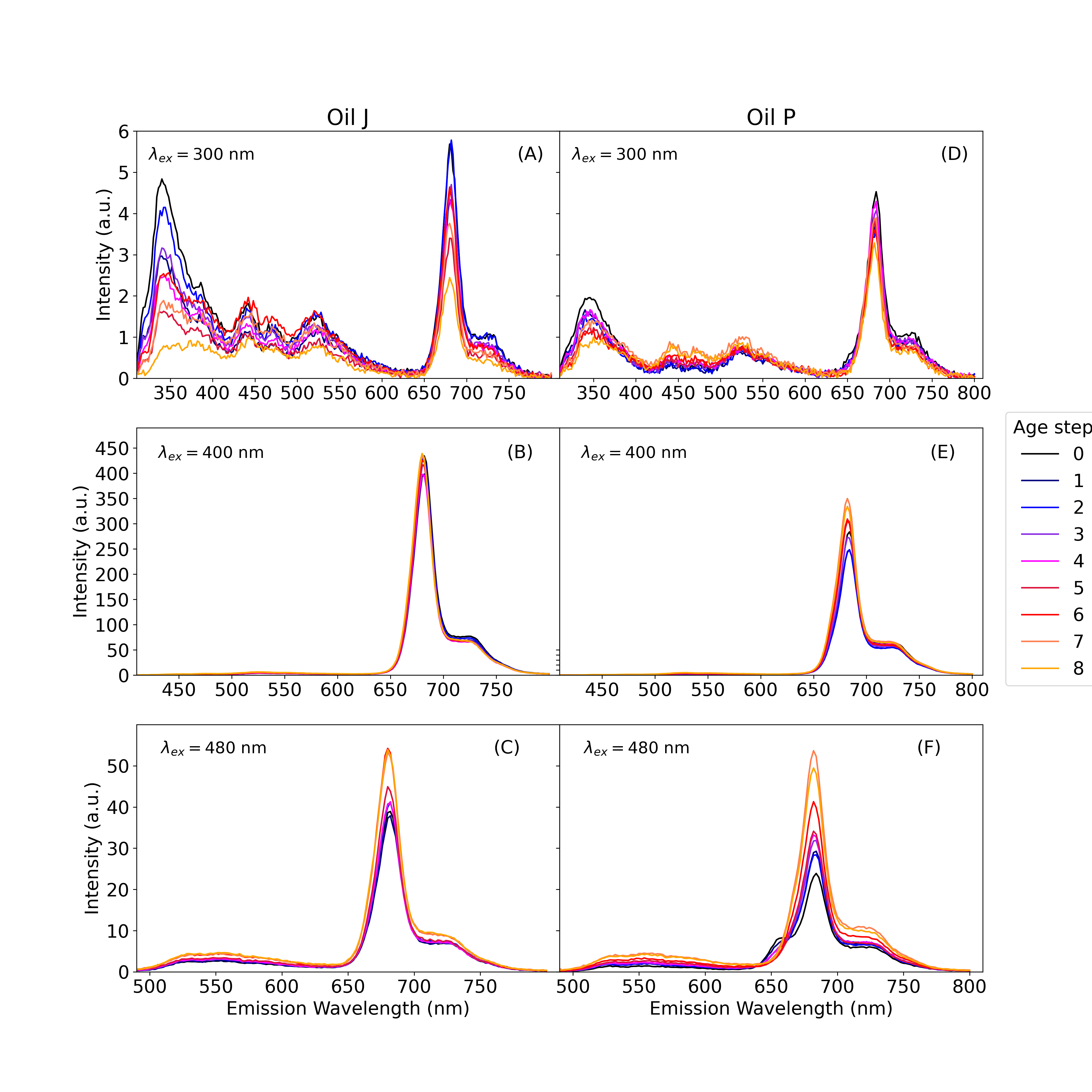
  • For 300 nm excitation, intensities at 350 nm (tocopherol-like) and 680 nm (chlorophyll) emissions decrease, supporting their oxidative degradation.
  • At 400 nm excitation, 680 nm emission tends to increase, likely due to complex interplay between pigment photochemistry and product formation.
  • Excitation at 480 nm consistently yields increased emission in the 500–625 nm and 680 nm regions, indicative of progressive product build-up and pigment transformations. Figure 1

    Figure 2: Evolution of the fluorescence emission with ageing for two representative oils, showing excitation-dependent intensity changes and spectral redistribution.

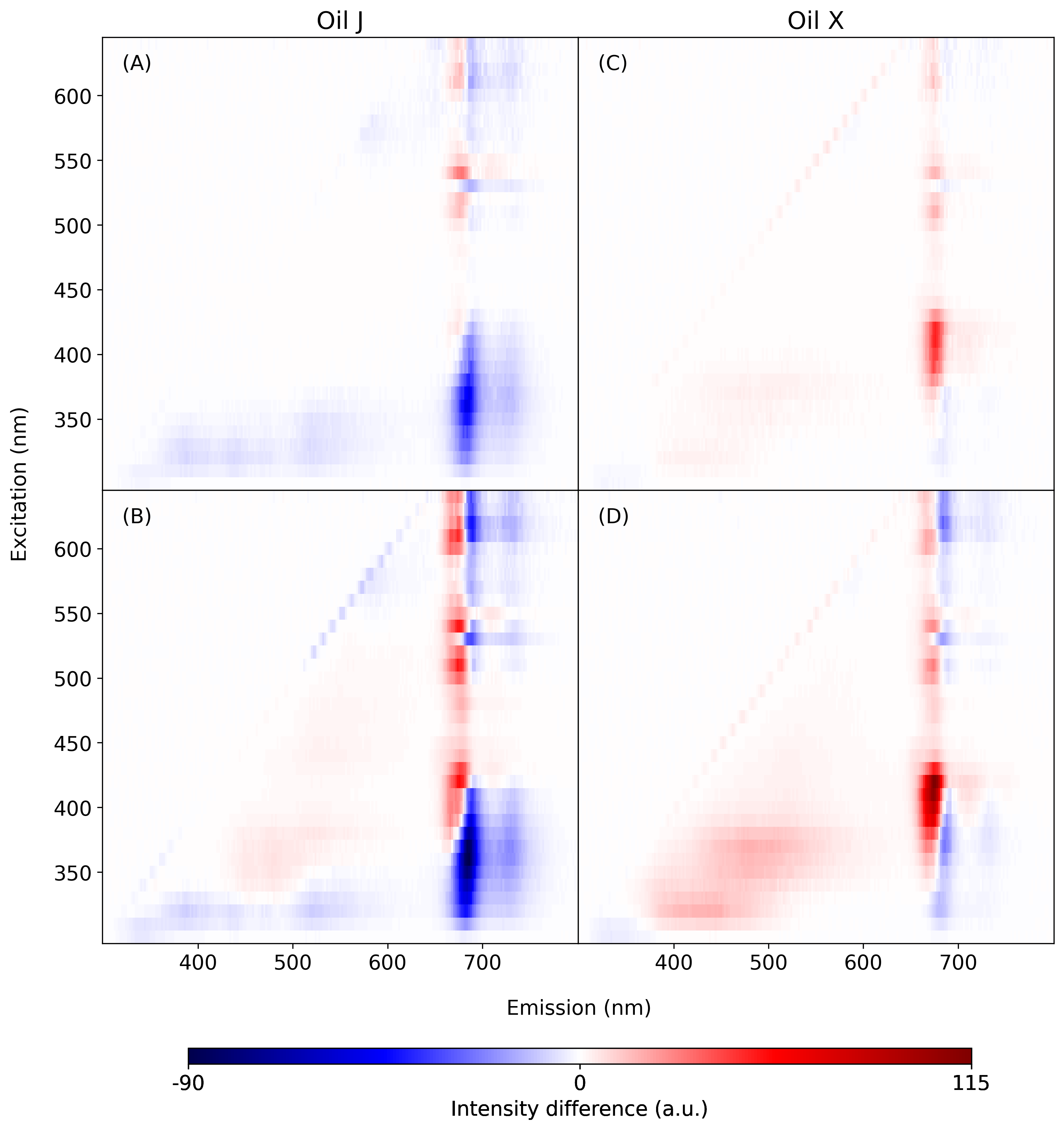
Differential fluorescence maps (aged–fresh) at multiple time points highlight both the generalized and oil-specific nature of spectral evolution. Figure 3

Figure 4: Difference in fluorescence intensity patterns at 9 and 53 days of ageing for two oils; red denotes increase, blue decrease, visualized on a log scale to emphasize subtle spectral shifts.

Feature Reduction and Sensor Practicality

A central hypothesis is that a simplified sensor measuring fluorescence at one or two excitation wavelengths suffices for binary EVOO versus non-EVOO classification. To operationalize this, an information theoretic criterion (relative error RERE) is used to rank excitation wavelengths by their ageing-induced spectral divergence. Across samples, 480 nm and 300 nm emerge as those providing the maximal or next-maximal RERE, supporting their discrimination power.

Correlation analysis shows RERE at selected excitation wavelengths and the canonical UV-absorption metrics (K268K_{268}, K232K_{232}) are monotonically related, validating the substitution of integrated fluorescence metrics for more complex spectral or chemical assessments.

Machine Learning Classification and Performance

AdaBoost (with decision stumps), Random Forests, logistic regression, and Naive Bayes are employed for the classification task—using only RERE features at 480 and 300 nm—against labels defined by the regulatory thresholds in K232K_{232} and K268K_{268}. AdaBoost yields the strongest performance. A sequential validation regime corresponding to either (i) future time points (extrapolation) or (ii) immediately next temporal step (interpolation) is adopted.

The classifier achieves:

  • Accuracy above 90% for K268K_{268}-based labels with three or more ageing points in training.
  • Slightly reduced accuracy for K232K_{232}, reflecting its lower sensitivity to thermal oxidation in the experimental conditions.
  • Sensitivity and specificity values in the range 0.5–0.95 (the scatter due to the inherent sparsity of "over-threshold" oils after ageing).

Notably, these results are robust despite the highly heterogeneous nature of the oils and minimal feature set—an explicit validation of the proposed “single or dual LED + photodiode” sensor architecture.

Theoretical and Practical Implications

The findings have both technological and methodological implications:

  • Sensor Simplification: Demonstrated that fluorescence measurements at only two judiciously chosen excitation wavelengths can replace full spectrum acquisition, supporting the design of inexpensive, portable, non-destructive EVOO screening instruments.
  • Aggregated Feature Sufficiency: While aggregation erases detailed compositional changes, it is adequate for the regulatory binary assignment—a relevant outcome for both producers and inspectors.
  • Robustness to Product Variability: The approach generalizes across oils spanning a diverse compositional space, suggesting practical applicability beyond the specific experimental cohort.

Theoretical implications pertain to the sufficiency of low-dimensional fluorescence descriptors in capturing high-order chemical complexity relevant for binary quality thresholds. From an ML perspective, the paradigm exemplifies effective feature-space dimensionality reduction guided by unsupervised physical insights.

Prospective AI Directions

Further integration with advanced ML strategies, e.g., self-supervised pretraining on raw EEMs, domain adaptation to oils from different geographic or production contexts, and regression rather than classification targets (e.g., shelf-life prediction), could extend the method’s utility. Miniaturization and embedding of real-time inference pipelines into low-power embedded systems is a foreseeable development pathway.

Conclusion

The study rigorously demonstrates that oxidative ageing assessment for EVOO can be reliably conducted using highly-aggregated fluorescence data and simple ML models, bypassing the need for laborious chemical assays or full-spectrum analysis. This has direct significance for rapid, cost-effective EVOO quality control at both producer and distribution levels, and sets a precedent for the deployment of physically interpretable, ML-powered minimalistic sensors in food quality assessment.

Paper to Video (Beta)

No one has generated a video about this paper yet.

Whiteboard

No one has generated a whiteboard explanation for this paper yet.

Open Problems

We haven't generated a list of open problems mentioned in this paper yet.

Collections

Sign up for free to add this paper to one or more collections.