Papers
Topics
Authors
Recent
Search
2000 character limit reached

One-Phase Batch Update on Sparse Merkle Trees for Rollups

Published 20 Oct 2023 in cs.DS | (2310.13328v1)

Abstract: A sparse Merkle tree is a Merkle tree with fixed height and indexed leaves given by a map from indices to leaf values. It allows for both efficient membership and non-membership proofs. It has been widely used as an authenticated data structure in various applications, such as layer-2 rollups for blockchains. zkSync Lite, a popular Ethereum layer-2 rollup solution, uses a sparse Merkle tree to represent the state of the layer-2 blockchain. The account information is recorded in the leaves of the tree. In this paper, we study the sparse Merkle tree algorithms presented in zkSync Lite, and propose an efficient batch update algorithm to calculate a new root hash given a list of account (leaf) operations. Using the construction in zkSync Lite as a benchmark, our algorithm 1) improves the account update time from $\mathcal{O}(\log n)$ to $\mathcal{O}(1)$ and 2) reduces the batch update cost by half using a one-pass traversal. Empirical analysis of real-world block data shows that our algorithm outperforms the benchmark by at most 14%.

Summary

  • The paper introduces a one-phase batch update algorithm for Sparse Merkle Trees, achieving constant-time leaf operations and reducing traversal complexity.
  • The method demonstrates up to a 14% performance improvement on zkSync Lite data, with significant gains in multi-threaded environments.
  • The proposed approach enhances blockchain state management, offering scalable solutions for Layer-2 rollups and future authenticated data structure optimizations.

One-Phase Batch Update on Sparse Merkle Trees for Rollups

Introduction to Sparse Merkle Trees in Blockchain

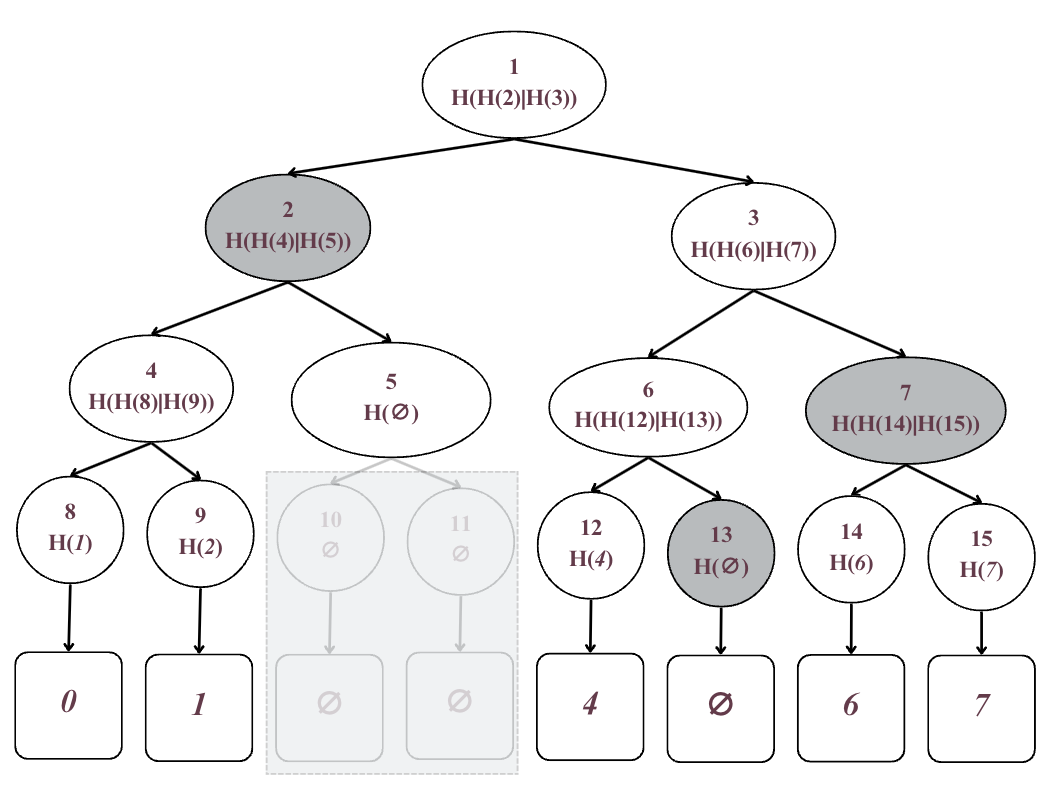
Sparse Merkle Trees (SMTs) serve as efficient authenticated data structures widely used in blockchain applications, such as Ethereum Layer-2 rollups like zkSync Lite. These data structures enable secure and scalable state management by utilizing cryptographic hashing to verify data integrity. This paper introduces a novel algorithm for one-phase batch updates on SMTs, optimizing the root hash computation by reducing traversal complexity. Figure 1

Figure 1: An SMT of 3 levels with internal nodes and keys corresponding to leaf indices.

Methodology: One-Phase Batch Update Algorithm

Leaf Operation Algorithms

The paper introduces optimized leaf operation algorithms for SMTs, including SMT.UpdateLeaf and SMT.RemoveLeaf, achieving constant-time complexity, O(1)\mathcal{O}(1), compared to the logarithmic complexity O(logn)\mathcal{O}(\log n) in previous implementations.

Batch Update Procedure

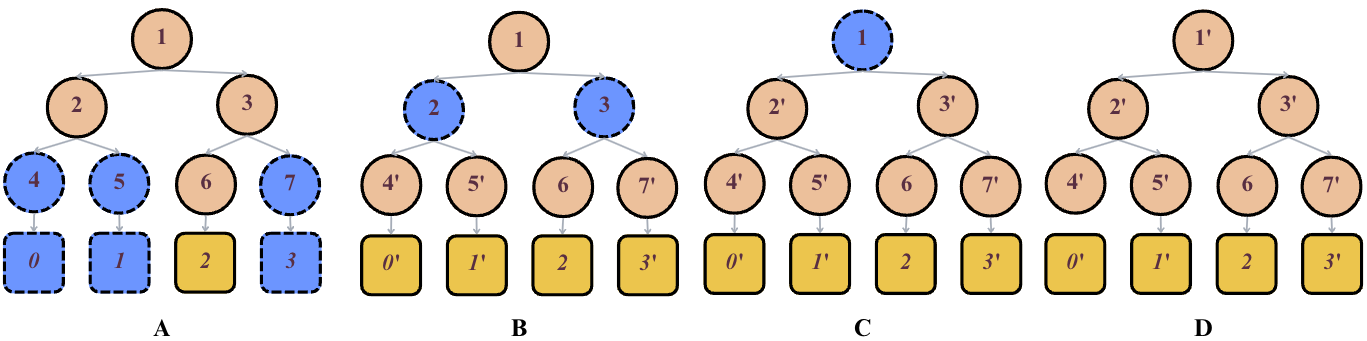
The proposed algorithm efficiently performs batch updates using a bottom-up traversal approach that processes operations in a single phase. This reduces traversal overhead from O(klogn)\mathcal{O}(k \log n) to O(k)\mathcal{O}(k), where kk represents the number of updates. The batch update algorithm leverages a queue to manage node updates, ensuring that parent nodes are sequentially processed for hash recalculation. Figure 2

Figure 2: An illustration of the batch update process, showcasing sequential operations applied in one phase.

Experimental Results and Performance Analysis

Micro-Benchmarks

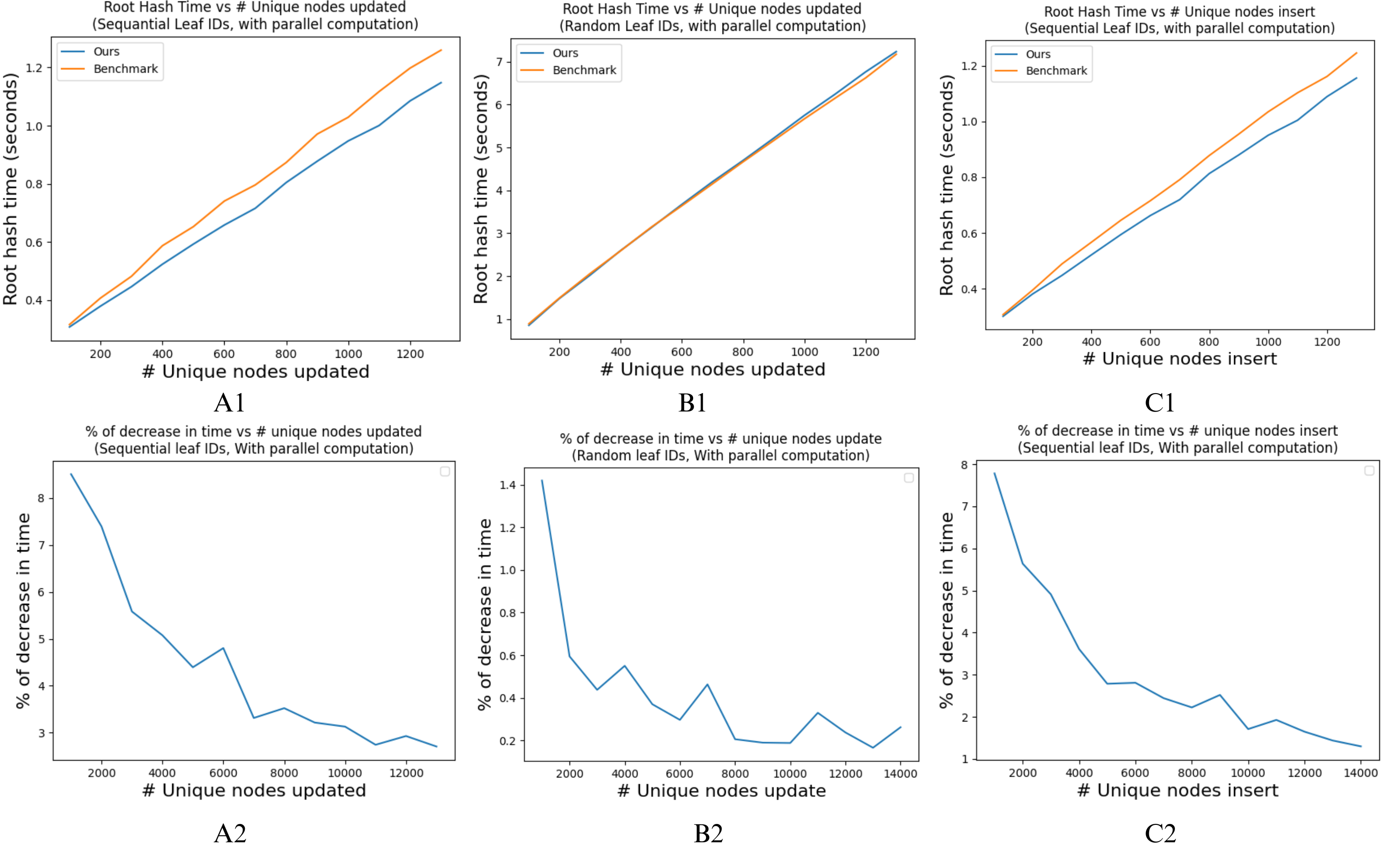
Micro-benchmark analysis shows significant performance improvement in multi-threaded environments, where sequential updates on leaves with common parent nodes benefit from reduced computation time. Figure 3

Figure 3: Root hash time comparison with multi-threading.

Macro-Benchmark on Real-World Data

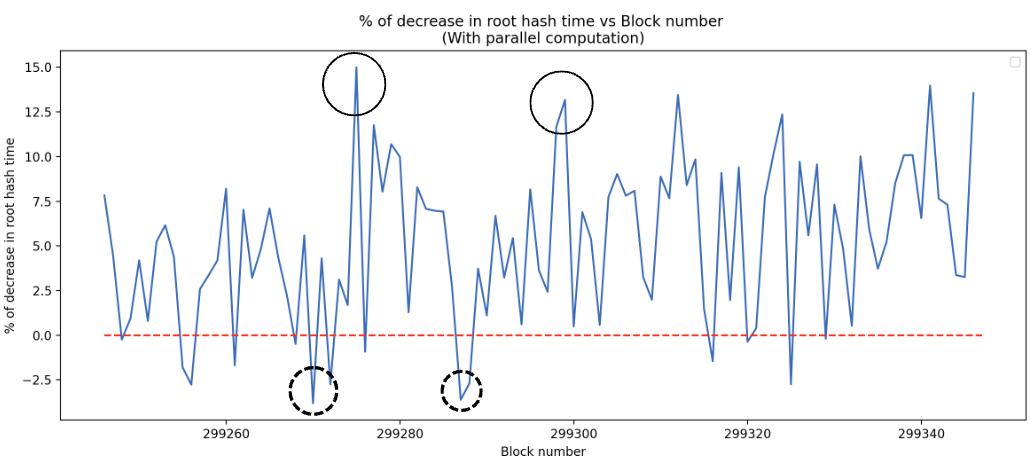
Empirical analysis on zkSync Lite block data demonstrates up to 14% better performance compared to the baseline approach, particularly in blocks dominated by transactions affecting fewer accounts. Figure 4

Figure 4: Percentage decrease in running time for zkSync Lite block data.

Implications and Future Work

The successful implementation of the One-Phase Batch Update algorithm enhances scalability and efficiency for applications leveraging SMTs in high-frequency transaction environments. Future work may extend this approach to other authenticated data structures, fostering improvements in zkEVM and Vector Commitment schemes. Further integration tests with zkSync Lite are planned to validate benefits under diverse transaction loads.

Conclusion

The proposed one-phase batch update algorithm offers substantial reductions in update processing time by minimizing tree traversal operations, making SMTs more efficient for blockchain scalability solutions. It presents a promising direction for optimizing blockchain state management and enhancing Layer-2 solutions for Ethereum and beyond. Figure 5

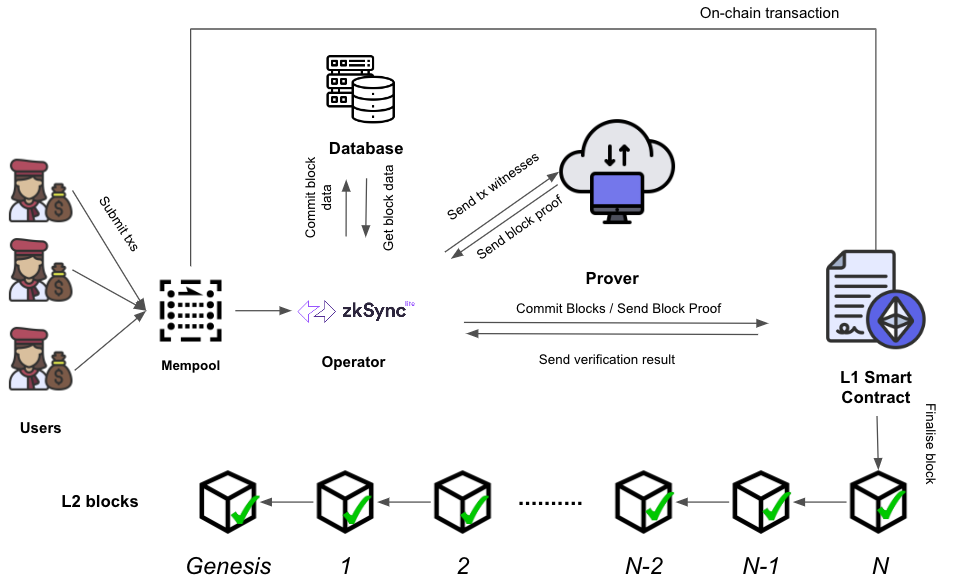
Figure 5: Transaction flow within the zkSync Lite server, demonstrating integration with Layer-1.

Whiteboard

No one has generated a whiteboard explanation for this paper yet.

Open Problems

We haven't generated a list of open problems mentioned in this paper yet.

Collections

Sign up for free to add this paper to one or more collections.

Tweets

Sign up for free to view the 1 tweet with 0 likes about this paper.