Papers
Topics
Authors
Recent
Search
2000 character limit reached

A First Look with JWST Aperture Masking Interferometry (AMI): Resolving Circumstellar Dust around the Wolf-Rayet Binary WR 137 beyond the Rayleigh Limit

Published 27 Nov 2023 in astro-ph.SR and astro-ph.EP | (2311.15948v2)

Abstract: We present infrared aperture masking interferometry (AMI) observations of newly formed dust from the colliding winds of the massive binary system Wolf-Rayet (WR) 137 with JWST using the Near Infrared Imager and Slitless Spectrograph (NIRISS). NIRISS AMI observations of WR 137 and a point-spread-function calibrator star, HD~228337, were taken using the F380M and F480M filters in 2022 July and August as part of the Director's Discretionary Early Release Science (DD-ERS) program 1349. Interferometric observables (squared visibilities and closure phases) from the WR 137 "interferogram" were extracted and calibrated using three independent software tools: ImPlaneIA, AMICAL, and SAMpip. The analysis of the calibrated observables yielded consistent values except for slightly discrepant closure phases measured by ImPlaneIA. Based on all three sets of calibrated observables, images were reconstructed using three independent software tools: BSMEM, IRBis, and SQUEEZE. All reconstructed image combinations generated consistent images in both F380M and F480M filters. The reconstructed images of WR 137 reveal a bright central core with a $\sim300$ mas linear filament extending to the northwest. A geometric colliding-wind model with dust production constrained to the orbital plane of the binary system and enhanced as the system approaches periapsis provided a general agreement with the interferometric observables and reconstructed images. Based on a colliding-wind dust condensation analysis, we suggest that dust formation within the orbital plane of WR 137 is induced by enhanced equatorial mass-loss from the rapidly rotating O9 companion star, whose axis of rotation is aligned with that of the orbit.
Summary

  • The paper demonstrates that JWST’s AMI mode resolves circumstellar dust around WR 137 with 60 mas resolution.
  • The methodology employs precise PSF calibration and multiple image reconstruction tools to ensure consistent interferometric observables.
  • Hydrodynamic analysis reveals deviations in shock cone geometry linked to asymmetric stellar wind dynamics in the WR 137 system.

Resolving Circumstellar Dust with JWST AMI: Insights into WR 137

Introduction to JWST AMI Observations

The utilization of JWST's Aperture Masking Interferometry (AMI) mode provides a strategic avenue for examining complex astrophysical systems featuring bright cores and subtle, extended features. The paper "Resolving Circumstellar Dust around the Wolf-Rayet Binary WR 137 beyond the Rayleigh Limit" investigates WR 137 using this novel approach with the Near Infrared Imager and Slitless Spectrograph (NIRISS), focusing on the circumstellar dust produced by the colliding winds of this massive binary system.

Observations and Data Reduction

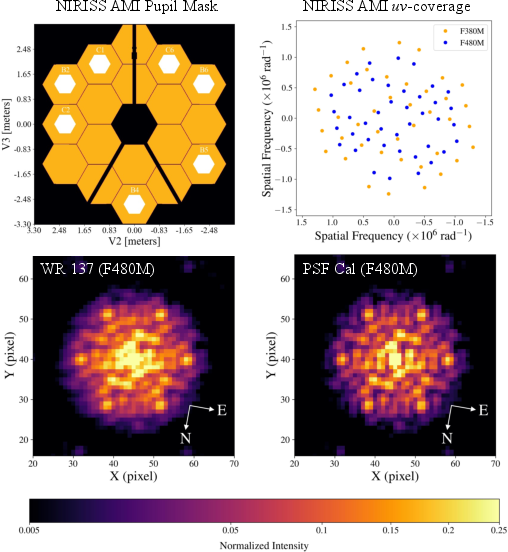
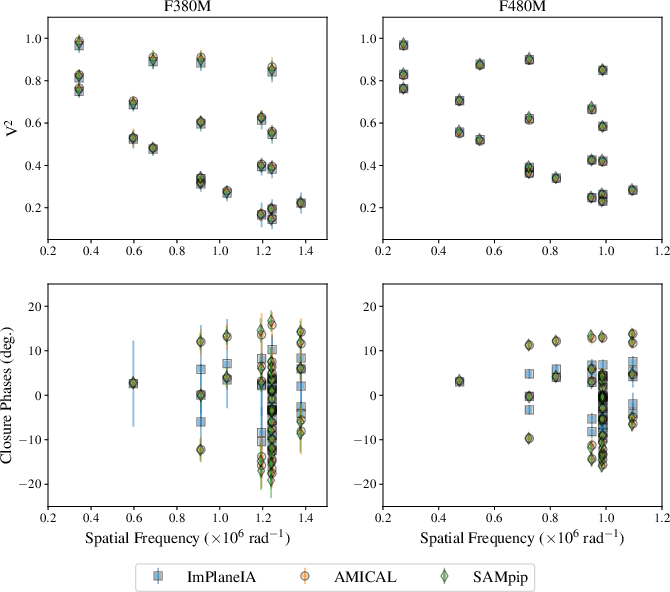
The JWST observations of WR 137 were conducted using NIRISS's AMI mode, employing F380M and F480M filters. The careful calibration against a PSF reference, HD 228337, was pivotal to ensure the accuracy of interferometric observables extracted from the interferogram patterns. The stringent calibration pipeline (Figure 1), along with the application of specialized software packages—ImPlaneIA, SAMpip, and AMICAL—yielded highly consistent squared visibilities, although some discrepancies in closure phases measured by different tools were noted (Figure 2). Figure 1

Figure 1: The NIRISS AMI pupil mask configuration and uv-plane coverage for WR 137 observations.

Image Reconstruction and Analysis

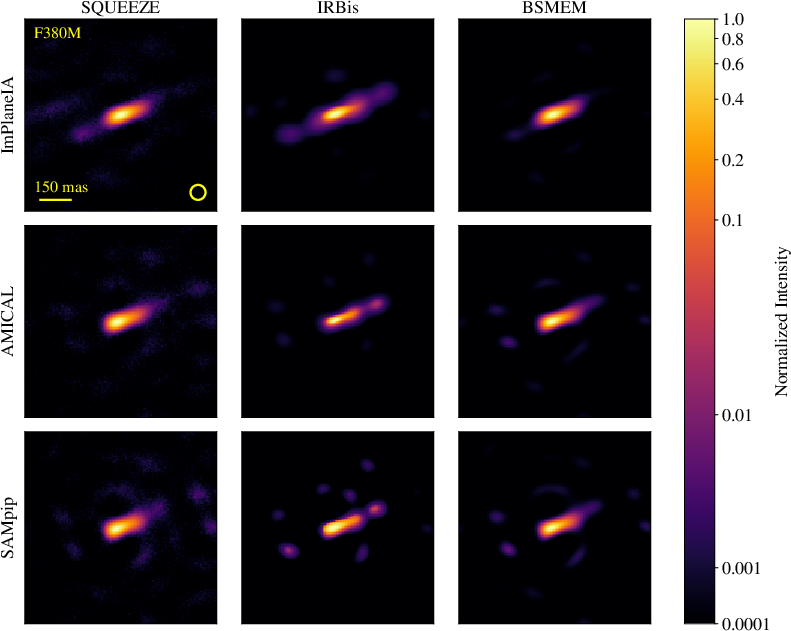
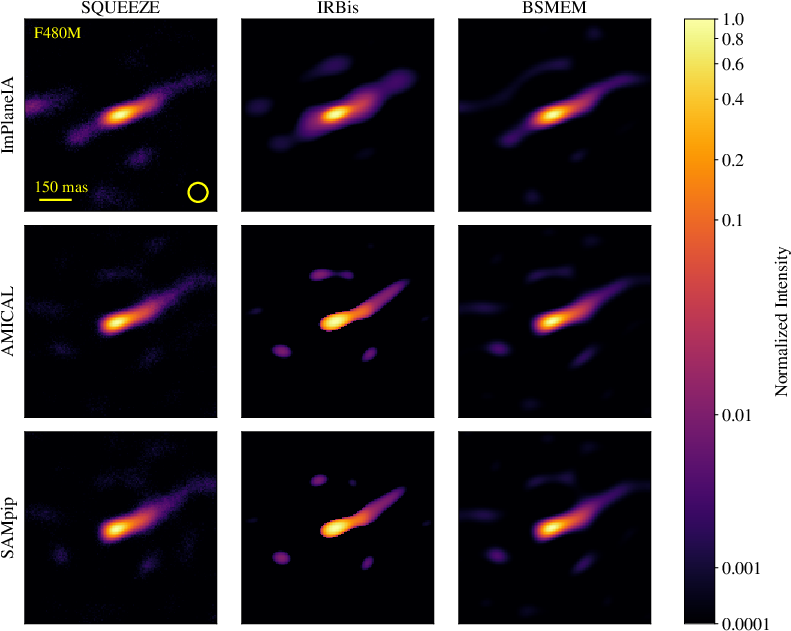
Reconstructed images from the interferometric data depict WR 137's dust emission extending northwest, forming a linear filament up to 300 mas from the central binary. This structural revelation emerged consistently across multiple reconstruction tools—BSMEM, SQUEEZE, and IRBis—reinforcing the reliability of these methods in capturing astrophysical phenomena (Figure 3, Figure 4). Figure 2

Figure 2: Verified interferometric observables calibrated from WR 137 across multiple processing software.

Figure 3

Figure 3: Reconstructed images of WR 137's circumstellar dust using F380M observations, showing superior angular resolution of 60 mas.

Colliding-Wind Dust Formation Dynamics

The linear morphology raises intriguing questions about the colliding-wind scenario typically characterized by a conical shock interface. The analysis of the shock cone half-opening angle calculated from hydrodynamic momentum ratios suggested deviations influenced by asymmetric wind properties, potentially explained by WR 137's rapidly rotating O9 companion (Figure 5). Figure 4

Figure 4: Reconstructed images of WR 137 using F480M observations displaying extended dust morphology.

Radiative Cooling and Dust Formation Threshold

The dimensionless radiative cooling parameter, Γ\Gamma, was employed to assess cooling efficiency within the wind interaction zone, crucial for dust viability at hot temperatures. Comparisons with the well-known dust-producing WR 140 highlighted the necessity of enhanced mass-loss for WR 137, possibly facilitated by equatorial mass-loss augmentations from its O9 companion (Figure 6).

Implications and Future Research Directions

The paper demonstrates the unparalleled capability of JWST AMI in resolving intricate stellar environments. It posits that rapid rotation-associated enhancements in stellar wind dynamics may significantly influence dust formation patterns. Continued observational campaigns utilizing varied dither strategies and more sophisticated calibration methods will further refine our understanding of complex stellar interactions and their circumstellar nebulae.

Conclusion

The findings underscore the transformative potential of JWST AMI in astrophysical research, reshaping our comprehension of WR binaries and colliding-wind phenomena. It opens pathways for exploring similar mechanisms in other evolving stellar systems, cementing its role as a vital instrument in illuminating cosmic dust production processes.

Whiteboard

No one has generated a whiteboard explanation for this paper yet.

Open Problems

We haven't generated a list of open problems mentioned in this paper yet.

Collections

Sign up for free to add this paper to one or more collections.

Tweets

Sign up for free to view the 2 tweets with 2 likes about this paper.