- The paper demonstrates that the 't Hooft equation can be reformulated as a TQ-Baxter system, allowing analytical continuation of meson masses.
- It reveals a square-root branch point at α = -1, indicating chiral symmetry restoration and the emergence of a massless meson.
- The study highlights the potential of integrable systems to uncover universal features in low-dimensional confining theories.
Analysis of "2d QCD and Integrability, Part I: 't Hooft model"
Introduction
The study of Quantum Chromodynamics (QCD) in lower dimensions, specifically in $1+1$ dimensions, provides a vital framework for understanding the dynamics of mesons and the intricate structures emerging from gauge theories at large Nc. This paper focuses on the 't Hooft model of mesons, exploring its analytical properties and revealing its connection to integrable systems through a reformulation of the eigenvalue problem as a TQ-Baxter system.
TQ-Baxter System and 't Hooft Equation
The reformulation of the 't Hooft equation into a TQ-Baxter system stands as a pivotal aspect of this study. The equation traditionally describes the mass spectrum of mesons and arises from the large Nc limit of $1+1$ dimensional QCD where mesons are bound states of quarks. By leveraging integrable systems methodologies, the authors demonstrate that the 't Hooft equation can be expressed in terms of a TQ-Baxter system, an approach that allows for the analytical continuation of meson masses and exposes a rich structure within the model.
Analysis in the Complex Mass Plane
An intriguing facet of the research lies in examining the meson spectrum as the quark masses are extended into the complex plane. The existence of a square-root branch point at α=−1, where chiral symmetry becomes exact, marks a significant finding. This critical point corresponds to the emergence of a massless meson, akin to a Goldstone boson associated with spontaneous symmetry breaking in higher dimensions, albeit limited by two-dimensional constraints.
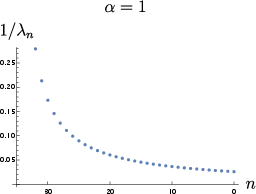
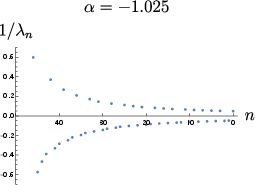
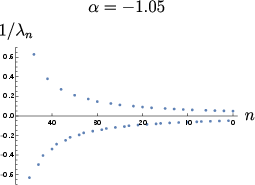
Figure 1: Inverse of the real eigenvalues of one positive and two negative values of alpha.
Future Directions and Implications
The study not only furthers the understanding of large Nc QCD in low dimensions but also opens pathways for the application of integrability concepts to other quantum field theories. The approach of using an inhomogeneous Fredholm equation to extend the eigenvalue problem to arbitrary values showcases potential in exploring spectral problems beyond conventional physical parameters.
The integrability structures unveiled might extend to broader classes of models, suggesting universality among low-dimensional confining theories. Furthermore, the implications for the broader context of gauge theories and potential connections to non-perturbative string theory highlight the depth and versatility of the techniques employed.
Conclusion
This examination solidifies the position of the 't Hooft model as a crucial theoretical framework within QCD and emphasizes the benefits of integrable systems in unraveling the complexities of such models. The discoveries concerning the analytic continuation of the mass spectrum and the integrable structure present new avenues for exploring QCD-like theories, both in their symmetric and broken phases, within the vast landscape of theoretical physics.

