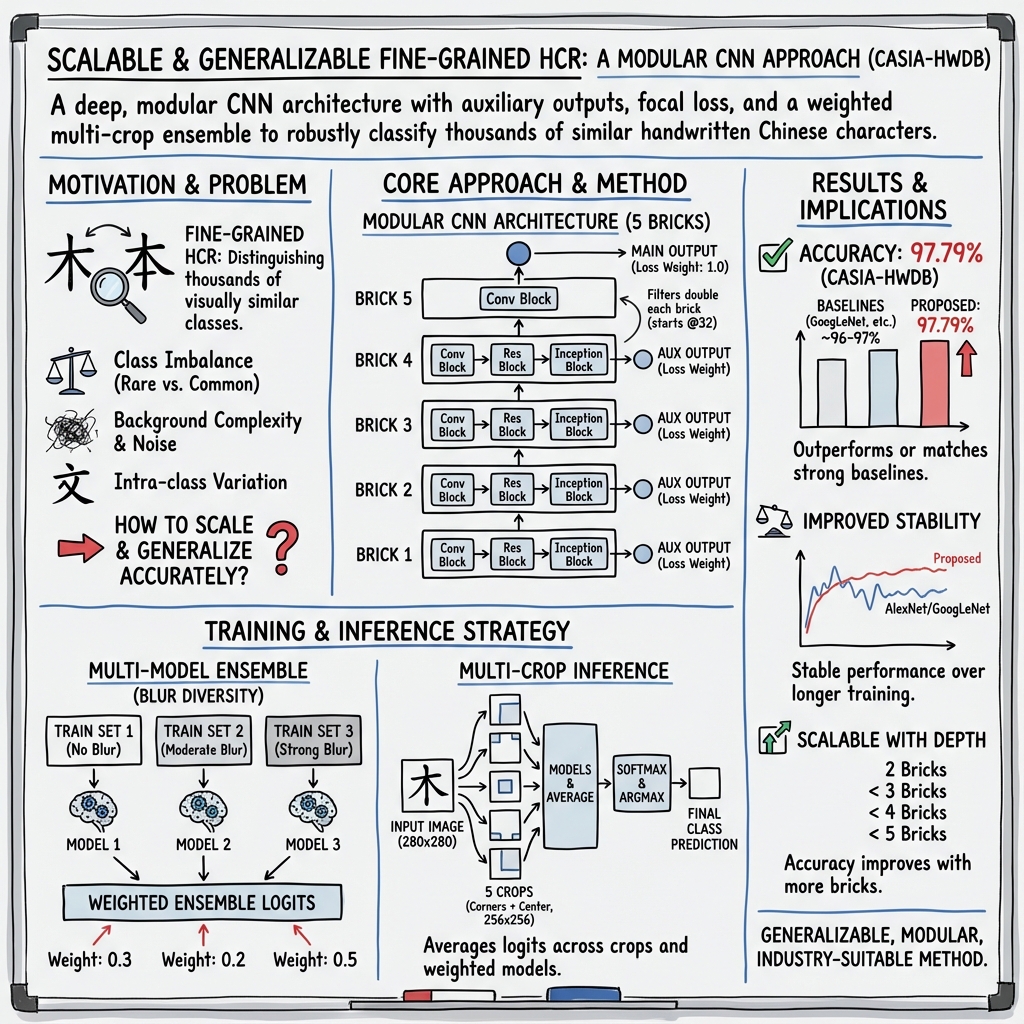
- The paper introduces a modular deep CNN architecture that progressively extracts discriminative features to improve recognition accuracy.
- The paper employs a balanced focal cross-entropy loss and multi-crop ensemble inference to address class imbalance and enhance predictive consistency.
- Experimental results on the CASIA-HWDB dataset demonstrate state-of-the-art performance, surpassing conventional models like HCCR-GoogLeNet.
Deep Learning-Driven Approach for Handwritten Chinese Character Classification
Introduction
The task of handwritten character recognition (HCR) remains a profound challenge in the field of machine learning due to intrinsic variability present in handwritten datasets. In particular, the classification of handwritten text, such as East Asian scripts, demands sophisticated methodologies capable of efficiently managing high dimensionality, imbalanced datasets, complex backgrounds, intra-class variation, and computational resource constraints. This paper presents a novel deep learning-driven approach that addresses these challenges and advances the field of HCR through innovative model architecture, data preprocessing, and predictive design strategies.
Methodology
Network Design
The proposed approach utilizes a deep CNN-based architecture structured into "learning bricks," comprising convolutional, residual, and inception blocks. Each block is engineered to progressively extract discriminative spatial features across different levels of abstraction, thus addressing the vanishing gradient problem common in deep networks. The network's architecture emphasizes modular scalability and generalization, facilitating high-level feature learning without diminishing operational efficiency. Notably, the inclusion of auxiliary outputs enhances model training by providing additional gradient signals, optimizing early layer representations, and encouraging robust abstraction learning.
Loss Function
To counteract class imbalance within the dataset, the approach employs a balanced focal cross-entropy loss function. This loss function assigns weighted significance to each class contribution, prioritizing the learning process for rare classes through heightened weight values. The method effectively recalibrates the learning dynamics, facilitating superior model performance even in datasets characterized by disproportionate class distribution.
Data Preprocessing and Predictive Design
The methodology incorporates advanced data preprocessing techniques that create multiple training dataset variants through Gaussian blurring methods, enabling the models to learn invariant features across small perturbations. The predictive design further employs a weighted ensemble of models, trained independently on specific data variants, combined with multi-crop inference strategies to amplify predictive accuracy. This design ensures comprehensive content consideration and enhances classification consistency.
Experimental Evaluation
Experiments conducted on the CASIA-HWDB dataset demonstrate the method’s capability to achieve state-of-the-art accuracy levels, surpassing many conventional approaches. The approach excels in scalability, modality, and generalization, as evidenced by its superior performance over renowned models like HCCR-GoogLeNet and SqueezeNet+CCBAM. The results underscore the approach's robustness in extracting complex features and its ability to maintain stability during extended training cycles, thus mitigating the risks of overfitting typically faced by deep CNNs.
Conclusion
This paper introduces a scalable, efficient, and comprehensive model for handwritten Chinese character classification that tackles the inherent complexities of HCR datasets. By adopting a carefully structured deep learning architecture complemented by innovative preprocessing and predictive strategies, the method achieves notable performance metrics. The findings validate the efficacy of balancing between depth and scalability, serving as a versatile foundation for future HCR research and industry application.
Overall, the work advances the understanding of HCR in a detailed manner, proposing a viable solution that practitioners can rely on for high-performance results without sacrificing replicability and generalization capabilities. The modularity of the approach promises seamless integration with future advancements in deep learning technology.