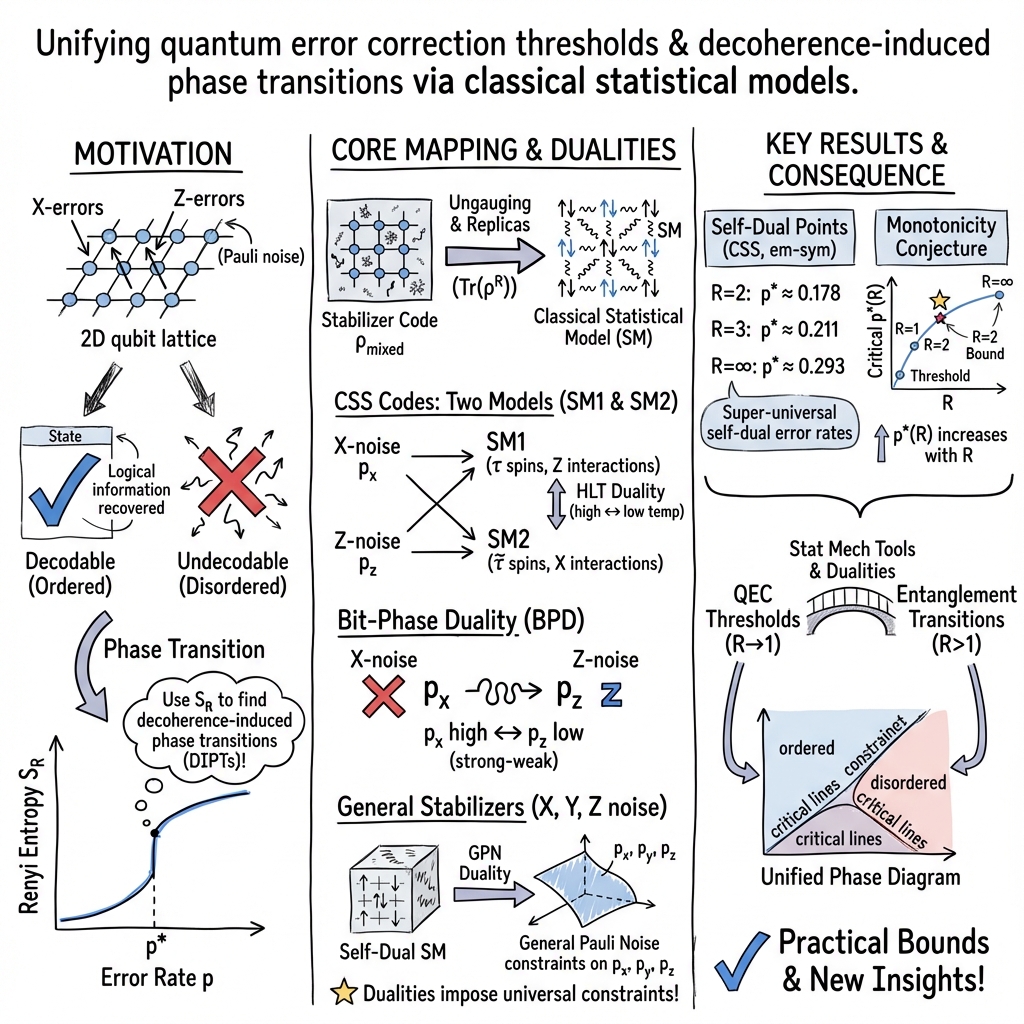
- The paper uncovers how decohered QEC codes exhibit R'enyi entropy dualities by mapping bit-flip and phase-flip errors onto distinct statistical models.
- It demonstrates that CSS codes with electric-magnetic symmetry achieve self-dual critical error rates, providing universal benchmarks for decoherence-induced phase transitions.
- It extends the framework to general stabilizer codes by introducing GPN dualities, offering practical insights into phase diagrams and error thresholds under Pauli noise.
Analysis of "Tapestry of Dualities in Decohered Quantum Error Correction Codes" (2401.17359)
Introduction
Quantum Error Correction (QEC) codes serve as a critical mechanism in quantum computing, designed to protect quantum information from the inevitable errors arising from decoherence. Beyond their primary role, QEC codes also offer a window into novel topological quantum phases due to their entanglement properties. This paper explores the behavior of decohered QEC codes, revealing connections to out-of-equilibrium quantum phases prompted by decoherence. It explores how the different decoherence-induced phase transitions (DIPTs) and error thresholds in these codes can be investigated via their R\'enyi entropies. These entropic measures uncover duality structures in statistical models associated with QEC codes, with profound implications for phase transitions driven by decoherence.
Decohered CSS Codes and Dualities
The study begins by focusing on Calderbank-Shor-Steane (CSS) codes experiencing bit-flip and phase-flip errors. Here, R\'enyi entropies of these codes are captured by dual statistical models endowed with randomness. These models are described by High-Low Temperature (HLT) dualities for varying R, a characteristic of R\'enyi indices R=2,3,∞.
- Decoupling of Errors: The authors demonstrate that bit-flip and phase-flip errors affect different stabilizers independently, allowing the error dynamics to be studied separately. This leads to distinct statistical models, SM1 and SM2, derived via an ungauging approach from the CSS codes.
- Statistical Models: SM1 and SM2, derived from the CSS codes, allow mapping the R\'enyi entropy to statistical models with real and imaginary random couplings, leveraging HLT duality to describe how these statistical models govern decoherence dynamics.
- Bit-Phase-Decoherence (BPD) Dualities: The analysis highlights additional dualities, termed BPD dualities, that relate bit-flip and phase-flip errors through equivalent statistical models for R\'enyi entropies, specifically for R=2,3,∞.
CSS Codes with Electric-Magnetic Symmetry
For CSS codes with electric-magnetic (em) symmetry, the duality extends to incorporate this symmetry, creating deeper interrelations.
- Self-Dualities in EM-Symmetric Codes: The em symmetry ensures the duality between SM1 and SM2 becomes a self-duality within a single statistical model SM. This self-duality implies super-universal error rates.
- Super-Universal Critical Error Rates: The paper precisely defines these error rates for R=2,3,∞, highlighting their invariance across different phases and dimensions, which governs the phase transitions within these codes.
General Stabilizer Codes
Moving beyond CSS codes, the authors utilize a broader framework to analyze general stabilizer codes affected by comprehensive Pauli noise.
- General-Pauli-Noise (GPN) Dualities: For general stabilizer codes, the study introduces GPN dualities, which extend the BPD concept to statistical models related to more diverse error channels.
- Self-Dual Surfaces: This work hypothesizes self-dual surfaces amidst the space of error rates, establishing theoretical bounds and physical implications for the phase diagrams of the decohered codes.
Concrete Examples and Implications
- 3D Toric Code: The study examines the 3D toric code, mapping its decohered state to Ising models and Z2 gauge theories, and providing numerical benchmarks for phase transitions.
- X-Cube Model: Examination extends to the X-cube model, revealing anisotropic Ashkin-Teller models linked to its decohered phases, supported by numerical findings.
- Impact of Self-Dual Critical Rates: Across all cases, the work elucidates that self-dual critical error rates offer universal benchmarks consistent across dimensions and error types.
Conclusion
This paper constructs a comprehensive framework to understand decoherence in QEC codes through statistical models characterized by dualities. The insights into decoherence-induced phase transitions and their relation to entropic measures offer profound opportunities for advancing quantum error correction strategies and understanding topological orders in noisy quantum systems. Speculation on future avenues includes exploring analogous constructs for qudit systems, subsystem codes, and integrating coherent errors, indicating a broad potential for future research.