- The paper presents a novel method that converts interatomic force constants into a force-displacement representation to enable effective graph neural network training.
- It employs an extensive phonon database and a DimeNet++ based model, achieving low mean absolute errors in predicting phonon frequencies and thermodynamic properties.
- The approach provides robust uncertainty quantification, paving the way for future ML-driven enhancements in modeling both harmonic and anharmonic material behaviors.
Machine Learning a Universal Harmonic Interatomic Potential for Predicting Phonons in Crystalline Solids
In "Machine Learning a Universal Harmonic Interatomic Potential for Predicting Phonons in Crystalline Solids," the authors present a novel method for predicting phonons in crystalline materials using machine learning universal interatomic potentials (MLUIPs). This work leverages graph neural networks (GNNs) and transforms existing phonon datasets to create a universal harmonic potential model, demonstrating remarkable accuracy in predicting phonon spectra and thermodynamic properties.
The core advancement in this paper is the conversion of interatomic force constants (IFCs) into a force-displacement (FD) representation more amenable to machine learning techniques. This transformation is pivotal for training the GNNs-based machine learning models. The authors utilize compressive sensing lattice dynamics (CSLD) to achieve back conversion, bridging between IFCs and GNNs effectively. These conversions are diagrammatically represented, spotlighting the transition from traditional IFCs to FD, and finally to GNNs representation.
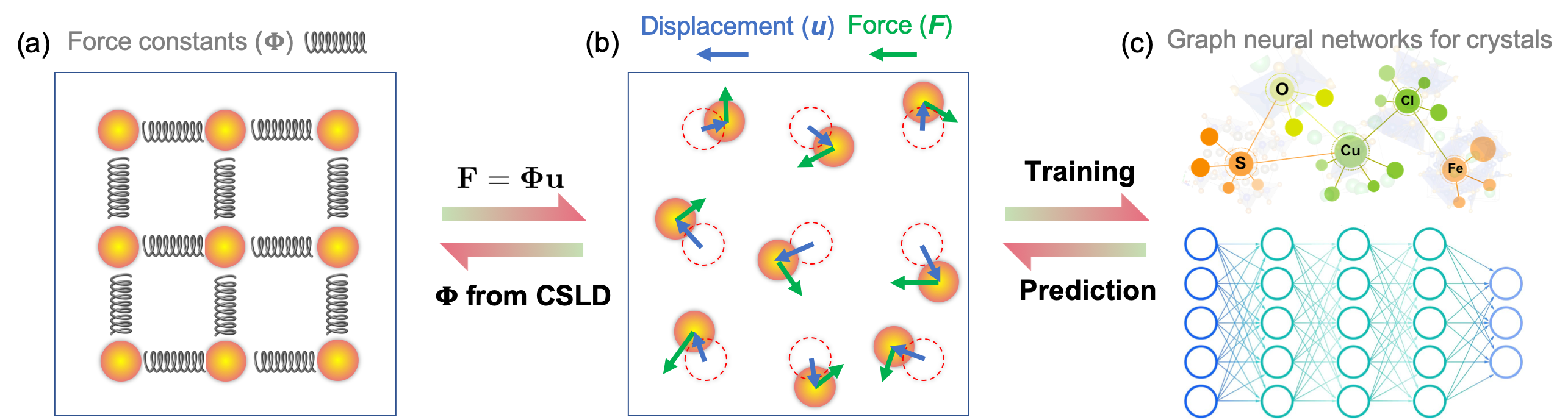
Figure 1: A schematic showing the conversions between different representations for describing interatomic interactions.
Data and Model Training
The study employs the extensive phonon database from Kyoto University, encompassing diverse chemical elements and crystalline symmetries. Screening for dynamical stability leads to a refined training set containing about 8,229 compounds. By generating force-displacement datasets through quantum covariance-driven displacements, the authors ensure a comprehensive and diversified training environment.
The GNNs model trained in this study is based on the Directional Message Passing Neural Network (DimeNet++), chosen for its efficiency and accuracy. The model is trained using optimized parameters, reaching a force prediction mean absolute error (MAE) comparable to existing MLUIPs like M3GNet. Training and evaluation employ a subset strategy ensuring no overlap between training and testing datasets, validating the model’s predictive capability across unseen compounds.
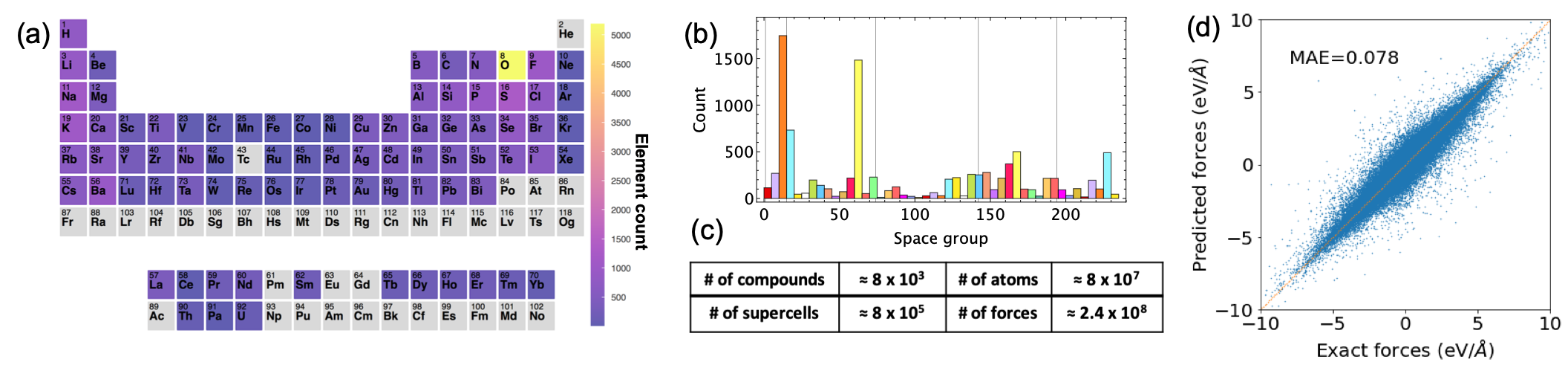
Figure 2: Distribution and training dataset characteristics for the GNNs-based MLUHIP model.
The model’s predictive performance is evaluated against Density Functional Theory (DFT) calculations. Significantly, it achieves a low MAE for both phonon frequencies and vibrational free energies, underscoring its potential for precise thermodynamic property predictions. The authors further elaborate on the correlation of force prediction errors with phonon prediction errors, suggesting a robust mechanism for uncertainty quantification inherent to the harmonic potential surface.
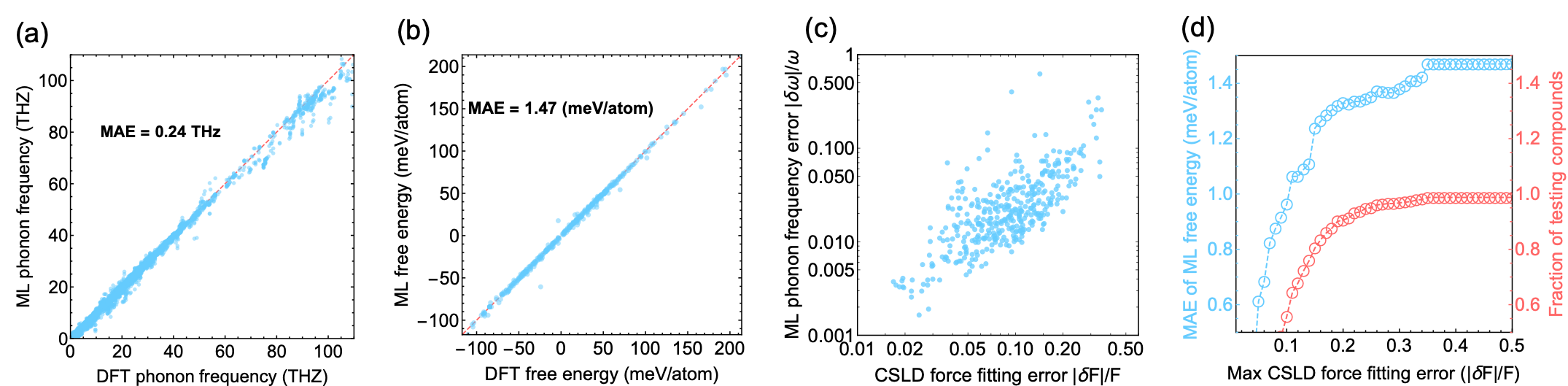
Figure 3: Performance of the ML model in predicting phonon frequencies and thermodynamic properties.
Discussion and Future Directions
The implications of this research extend to various domains within materials science, notably in predicting material behaviors critical at finite temperatures. The methodology paves the way for integrating advanced ML models like equivariant neural networks, capturing anharmonic properties, or employing active learning for model refinement.
Additionally, the approach holds promise for adapting to non-periodic or complex systems, potentially enhancing computational efficiency through improved CSLD methodologies. While traditional molecular dynamics may suffice for simple systems, this ML-driven model is particularly suited for computationally intensive scenarios involving complex crystalline architectures.
Conclusion
The study successfully introduces a protocol to transform IFCs into a machine learning-compatible form, training a GNNs-based model that predicts phonon properties with high fidelity across a wide range of compounds. This approach not only strengthens predictive accuracy but also ensures it can reliably estimate and quantify uncertainties, setting a precedent for future explorations in phonon modeling using machine learning techniques.