- The paper presents a QED model for calculating twisted photon radiation from axially channeled electrons, emphasizing the role of angular momentum.
- It utilizes Feynman diagrams and simulations to compare twisted channeling radiation with conventional radiation across various emission angles.
- The analysis outlines conditions for experimental detection and potential applications in quantum optics and high-energy physics.
Twisted Photons Distribution Emitted by Relativistic Electrons at Axial Channeling
Introduction
The paper "Twisted-photons Distribution Emitted by Relativistic Electrons at the Axial Channeling" focuses on a quantum electrodynamics framework for calculating the radiation of twisted photons. These photons are emitted by axially channeled electrons at arbitrary angles relative to the direction of motion. Twisted photons, characterized by angular momentum with both spin and orbital components, have significant implications in optics and high-energy physics. The ability to generate photons with angular momentum expands the toolkit available for probing photonuclear reactions and contributes to condensed matter optics and high-energy applications.
Twisted-Photon Phenomenon
The phenomenon under study involves channeling radiation (CR) during the motion of electrons through oriented crystals. Various quantum mechanical phenomena accompany this process, which occurs as electrons interact with the periodic potential of the crystal lattice. The theoretical framework advances earlier studies by Serbo et al., which describe twisted photons, combining them with methods to incorporate axial channeling scenarios.
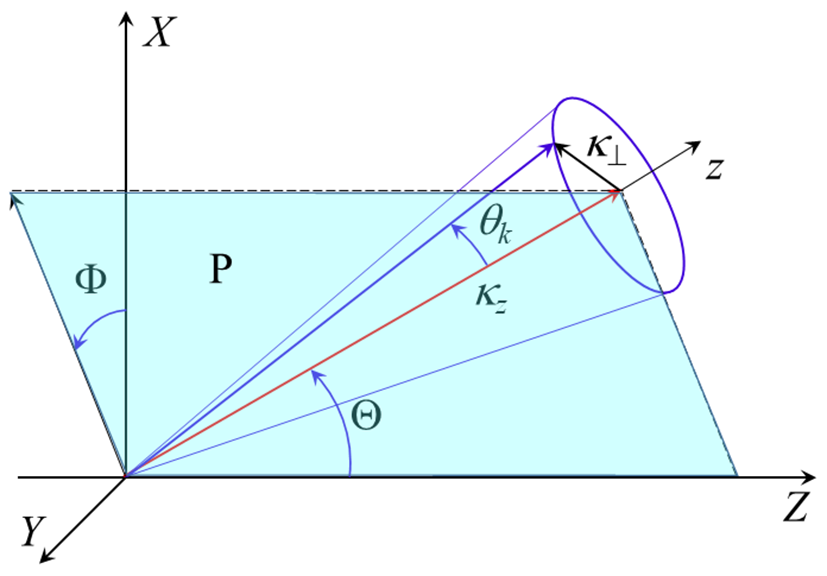
Figure 1: The geometry of TWcr emission: where Z is the channeling axis and z is the TWcr-photon axis.
Twisted-Photon Wavefunction
The twisted-photon wave function, critical to understanding emission dynamics, is designed to suit arbitrary directional emission as molded by the channeling effect. The wave function includes parameters that relate both to photon polarization and to the projection of photon angular momentum onto predefined spatial axes.
Radiation Probability & Feynman Diagrams
The calculation of radiation probability for twisted photons emitted from channeled electrons is essential to understanding the underlying physics. Feynman diagrams representing CR and twisted channeling radiation (TWcr) are instrumental in this analysis, allowing predictions about the interaction between twisted photon emission characteristics and electron momentum states.
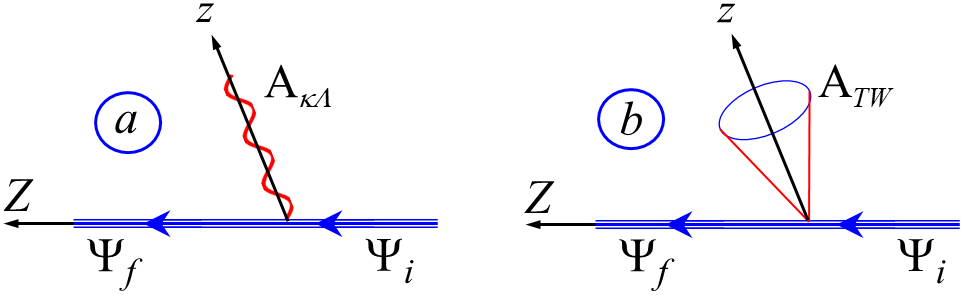
Figure 2: a) Feynman diagram CR. b) Feynman diagram TWcr with corresponding axes.
Twisted-Photon Angular Distributions
The probability of photon emission demonstrates significant dependence on the angular distributions dictated by quantum mechanics. Angular distributions provide insights into the symmetry properties of these emissions, which contrast sharply with those observed in conventional CR. Cylindrical symmetry emerges prominent in the angular distributions of TWcr-photons, highlighting the unique nature of twisted radiation patterns.
(Figure 3 & 4)
Figure 3: Angular distribution of TWcr-photons with TAM z-projection m=±3 for ``internal'' angles θκ=10∘.
Figure 4: Angular distribution of TWcr-photons with very small angles θκ=1∘.
Simulation and Comparative Analysis
The study presents simulated angular distributions of TWcr-photons, analyzing configurations across various projection scenarios. A central focus includes comparing positive and negative total angular momentum (TAM) values, finding nearly identical results in the broader angle context. However, deviations occur at smaller angles, demonstrating closer alignment with CR photon distributions as θκ approaches zero—conclusively turning TWcr into ordinary photon distributions.
(Figure 5 & 6)
Figure 5: Angular distribution at larger internal angles θκ=60∘ and θκ=85∘.
Figure 6: Comparison of TWcr-photons' angular distribution for TAM z-projections m=6 and m=9 at θκ=30∘.
Conclusion
This paper makes significant advances in understanding the radiation of twisted photons by axially channeled electrons. It provides critical insights into the angular distribution behaviors defining TWcr compared to traditional CR emissions. The modeling framework presents avenues for experimental validation and shortlists conditions under which twisted photons can be experimentally discerned from CR backgrounds. Despite complex detection challenges, the understanding of these distributions paves the way for future developments in manipulating photon states within crystal environments. Overall, the framework holds promise for developing twisted photon sources with applications across quantum optics and high-energy particle physics.