Transparent AI Disclosure Obligations: Who, What, When, Where, Why, How
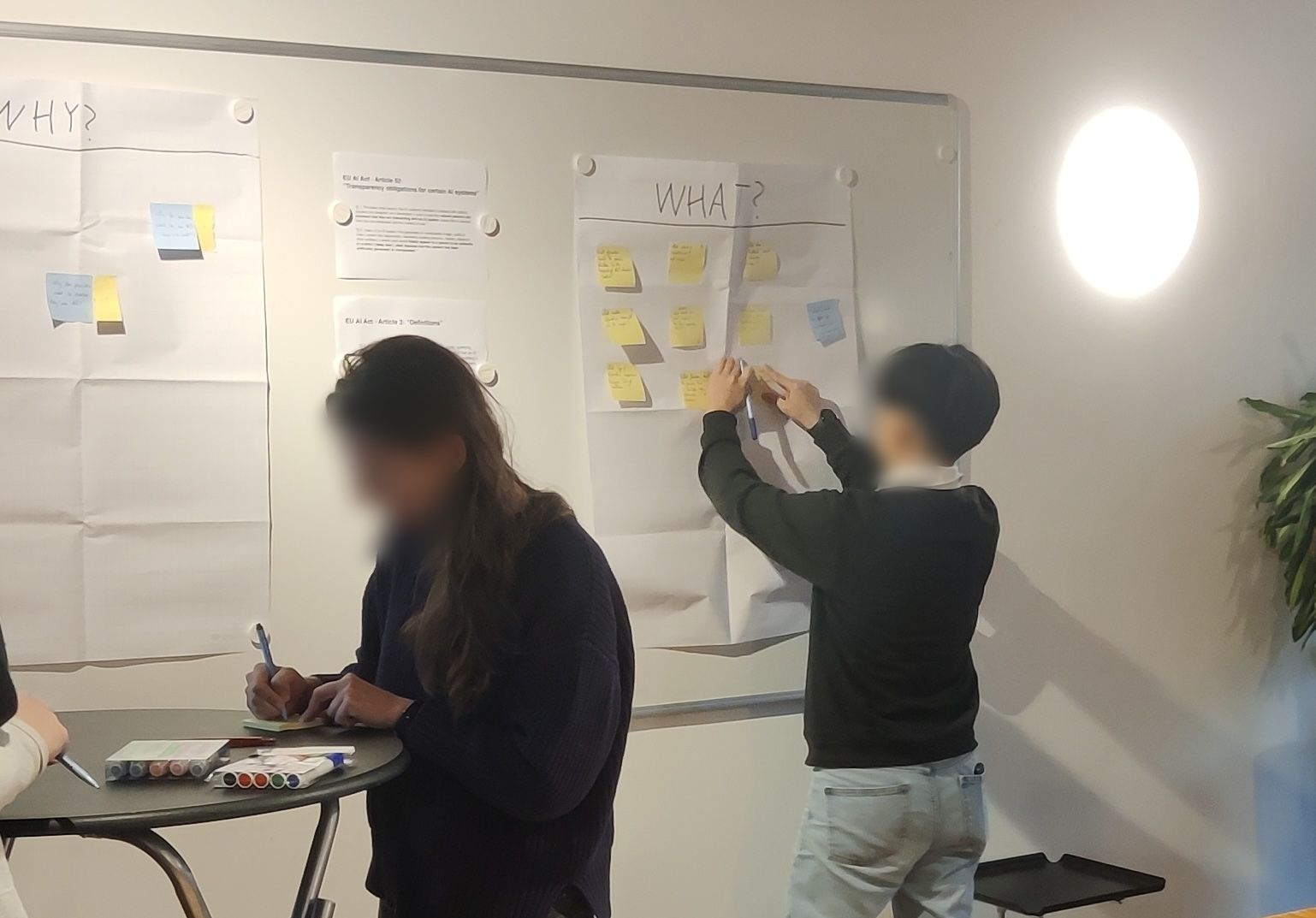
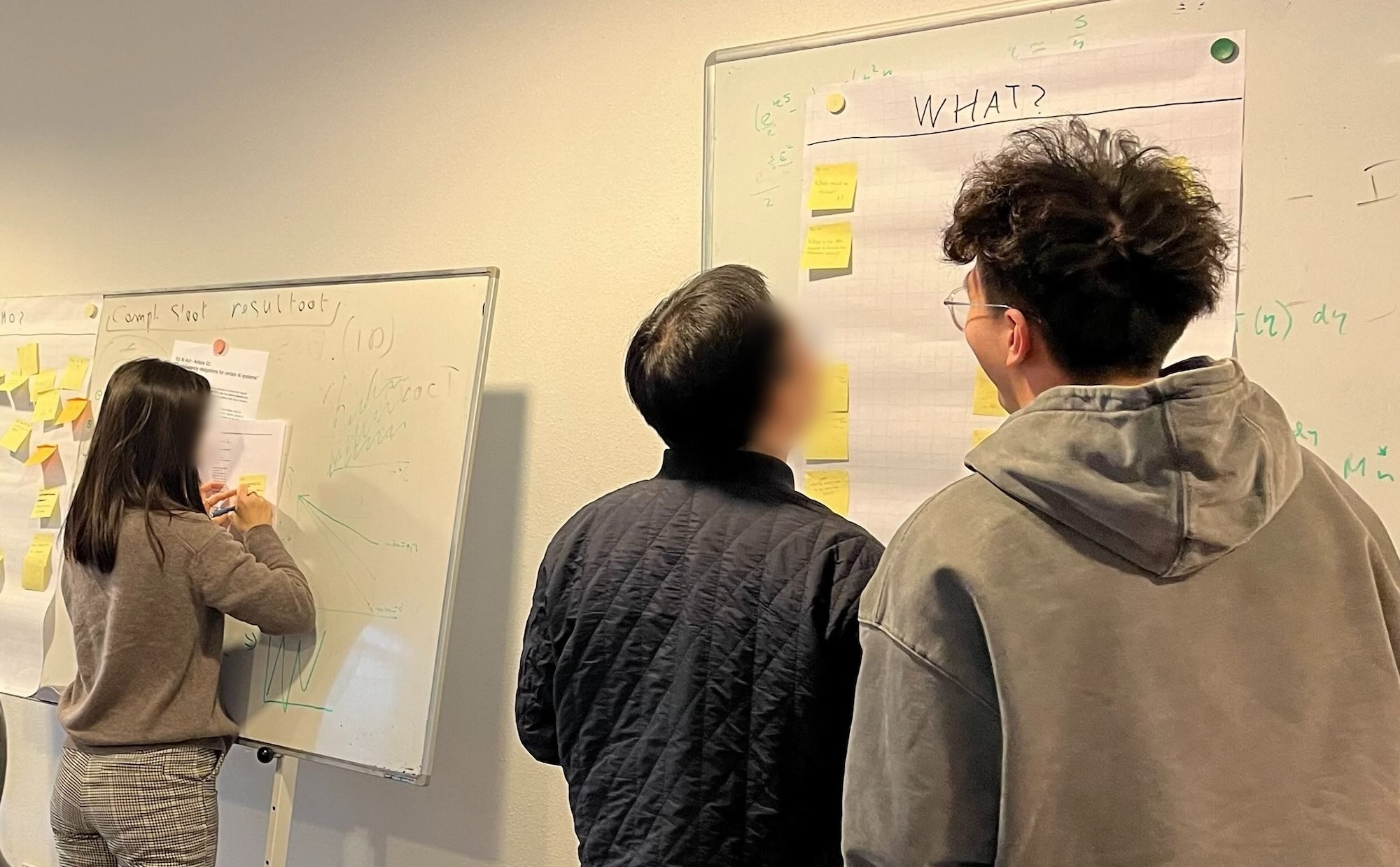
Abstract: Advances in Generative AI are resulting in AI-generated media output that is (nearly) indistinguishable from human-created content. This can drastically impact users and the media sector, especially given global risks of misinformation. While the currently discussed European AI Act aims at addressing these risks through Article 52's AI transparency obligations, its interpretation and implications remain unclear. In this early work, we adopt a participatory AI approach to derive key questions based on Article 52's disclosure obligations. We ran two workshops with researchers, designers, and engineers across disciplines (N=16), where participants deconstructed Article 52's relevant clauses using the 5W1H framework. We contribute a set of 149 questions clustered into five themes and 18 sub-themes. We believe these can not only help inform future legal developments and interpretations of Article 52, but also provide a starting point for Human-Computer Interaction research to (re-)examine disclosure transparency from a human-centered AI lens.
- World Economic Forum 2024. 2024. The Global Risks Report 2024. https://www.weforum.org/publications/global-risks-report-2024. [2024-1-19].
- ACM. 2024. ACM Policy on Authorship. https://www.acm.org/publications/policies/new-acm-policy-on-authorship. [Accessed 22-01-2024].
- European AI Act. 2022. Proposal for a Regulation of the European Parliament and of the Council laying down harmonised rules on artificial intelligence (Artificial Intelligence Act) and amending certain Union legislative acts) and amending certain Union legislative acts. https://eur-lex.europa.eu/legal-content/EN/TXT/?uri=CELEX%3A52021PC0206. https://data.consilium.europa.eu/doc/document/ST-14954-2022-INIT/en/pdf [Accessed 12-01-2024].
- Power to the People? Opportunities and Challenges for Participatory AI. In Equity and Access in Algorithms, Mechanisms, and Optimization (Arlington, VA, USA) (EAAMO ’22). Association for Computing Machinery, New York, NY, USA, Article 6, 8 pages. https://doi.org/10.1145/3551624.3555290
- On the Opportunities and Risks of Foundation Models. arXiv preprint arXiv:2108.07258 (2021). https://crfm.stanford.edu/assets/report.pdf
- AudioLM: a Language Modeling Approach to Audio Generation. arXiv:2209.03143 [cs.SD]
- Matthew Burtell and Thomas Woodside. 2023. Artificial Influence: An Analysis Of AI-Driven Persuasion. http://arxiv.org/abs/2303.08721 arXiv:2303.08721 [cs].
- C2PA. 2024. Introducing Official Content Credentials Icon - C2PA — c2pa.org. https://c2pa.org/post/contentcredentials/. [Accessed 17-01-2024].
- Thematic analysis. Qualitative psychology: A practical guide to research methods 222, 2015 (2015), 248.
- The Str(AI)ght Scoop: Artificial Intelligence Cues Reduce Perceptions of Hostile Media Bias. Digital Journalism 11, 9 (Oct. 2023), 1577–1596. https://doi.org/10.1080/21670811.2021.1969974
- Google DeepMind. 2024. SynthID. https://deepmind.google/technologies/synthid/. Accessed: 2024-1-19.
- Upol Ehsan and Mark O. Riedl. 2020. Human-Centered Explainable AI: Towards a Reflective Sociotechnical Approach. In HCI International 2020 - Late Breaking Papers: Multimodality and Intelligence, Constantine Stephanidis, Masaaki Kurosu, Helmut Degen, and Lauren Reinerman-Jones (Eds.). Springer International Publishing, Cham, 449–466.
- Transforming HCI Research Cycles using Generative AI and “Large Whatever Models” (LWMs). In Extended Abstracts of the 2024 CHI Conference on Human Factors in Computing Systems (Honolulu, HI, USA) (CHI ’24 EA). Association for Computing Machinery, New York, NY, USA, 5 pages. https://doi.org/10.1145/3613905.3643977
- What label should be applied to content produced by generative AI? https://doi.org/10.31234/osf.io/v4mfz
- Batya Friedman. 1996. Value-Sensitive Design. Interactions 3, 6 (dec 1996), 16–23. https://doi.org/10.1145/242485.242493
- Six Human-Centered Artificial Intelligence Grand Challenges. International Journal of Human Computer Interaction 39, 3 (2023), 391–437. https://doi.org/10.1080/10447318.2022.2153320 arXiv:https://doi.org/10.1080/10447318.2022.2153320
- Dark Patterns and the Legal Requirements of Consent Banners: An Interaction Criticism Perspective. In Proc. CHI ’21. ACM, Yokohama Japan, 1–18. https://doi.org/10.1145/3411764.3445779
- Human Detection of Political Speech Deepfakes across Transcripts, Audio, and Video. arXiv:2202.12883 [cs.HC]
- Regulating ChatGPT and Other Large Generative AI Models. In Proceedings of the 2023 ACM Conference on Fairness, Accountability, and Transparency (Chicago, IL, USA) (FAccT ’23). Association for Computing Machinery, New York, NY, USA, 1112?1123. https://doi.org/10.1145/3593013.3594067
- Geoff Hart. 1996. The Five W’s: An Old Tool for the New Task of Audience Analysis. Technical Communication 43, 2 (1996), 139–145. http://www.jstor.org/stable/43088033
- Natali Helberger and Nicholas Diakopoulos. 2023. ChatGPT and the AI act. Internet Pol. Rev. 12, 1 (Feb. 2023).
- Imagen video: High definition video generation with diffusion models. arXiv:2210.02303 [cs.CV]
- The ethics of disclosing the use of artificial intelligence tools in writing scholarly manuscripts. Research Ethics 19, 4 (2023), 449–465. https://doi.org/10.1177/17470161231180449 arXiv:https://doi.org/10.1177/17470161231180449
- Designing Participatory AI: Creative Professionals’ Worries and Expectations about Generative AI. In Extended Abstracts of the 2023 CHI Conference on Human Factors in Computing Systems. 1–8.
- Understanding Effects of Algorithmic vs. Community Label on Perceived Accuracy of Hyper-Partisan Misinformation. Proc. ACM Hum.-Comput. Interact. 6, CSCW2, Article 371 (nov 2022), 27 pages. https://doi.org/10.1145/3555096
- 5W+1H pattern: A perspective of systematic mapping studies and a case study on cloud software testing. Journal of Systems and Software 116 (2016), 206–219. https://doi.org/10.1016/j.jss.2015.01.058
- Michael H. Kernis and Brian M. Goldman. 2006. A Multicomponent Conceptualization of Authenticity: Theory and Research. In Advances in Experimental Social Psychology. Vol. 38. Elsevier, 283–357. https://doi.org/10.1016/S0065-2601(06)38006-9
- “Look! It’s a Computer Program! It’s an Algorithm! It’s AI!”: Does Terminology Affect Human Perceptions and Evaluations of Algorithmic Decision-Making Systems?. In Proceedings of the 2022 CHI Conference on Human Factors in Computing Systems (New Orleans, LA, USA) (CHI ’22). Association for Computing Machinery, New York, NY, USA, Article 581, 28 pages. https://doi.org/10.1145/3491102.3517527
- User Experience Design Professionals’ Perceptions of Generative Artificial Intelligence. In Proceedings of the 2024 CHI Conference on Human Factors in Computing Systems (Honolulu, HI, USA) (CHI ’24). Association for Computing Machinery, New York, NY, USA, 15 pages. https://doi.org/10.1145/3613904.3642114
- GPT detectors are biased against non-native English writers. Patterns 4, 7 (2023), 100779. https://doi.org/10.1016/j.patter.2023.100779
- News from Generative Artificial Intelligence Is Believed Less. In Proceedings of the 2022 ACM Conference on Fairness, Accountability, and Transparency (Seoul, Republic of Korea) (FAccT ’22). Association for Computing Machinery, New York, NY, USA, 97?106. https://doi.org/10.1145/3531146.3533077
- Nikita Lukianets. [n.d.]. Taxonomy — openethics.ai. https://openethics.ai/taxonomy/. [Accessed 22-01-2024].
- Frontiers: Machines vs. Humans: The Impact of Artificial Intelligence Chatbot Disclosure on Customer Purchases. Marketing Science 38, 6 (2019), 937–947. https://doi.org/10.1287/mksc.2019.1192 arXiv:https://doi.org/10.1287/mksc.2019.1192
- Reliability and Inter-rater Reliability in Qualitative Research: Norms and Guidelines for CSCW and HCI Practice. Proceedings of the ACM on Human-Computer Interaction 3 (11 2019), 1–23. https://doi.org/10.1145/3359174
- Tech Monitor. [n.d.]. Text of EU AI Act leaked amid debate over the timeline for final approval — techmonitor.ai. https://techmonitor.ai/technology/ai-and-automation/eu-ai-act-leaked-short-timeline. [Accessed 24-01-2024].
- Elements that Influence Transparency in Artificial Intelligent Systems - A Survey. In Human-Computer Interaction – INTERACT 2023, José Abdelnour Nocera, Marta Kristín Lárusdóttir, Helen Petrie, Antonio Piccinno, and Marco Winckler (Eds.). Springer Nature Switzerland, Cham, 349–358.
- Generative AI in EU Law: Liability, Privacy, Intellectual Property, and Cybersecurity. arXiv:2401.07348 [cs.CY]
- Council of the EU. [n.d.]. Artificial intelligence act: Council and Parliament strike a deal on the first rules for AI in the world. https://www.consilium.europa.eu/en/press/press-releases/2023/12/09/artificial-intelligence-act-council-and-parliament-strike-a-deal-on-the-first-worldwide-rules-for-ai/. [Accessed 22-01-2024].
- OpenAI. 2023. GPT-4 Technical Report. arXiv:2303.08774 [cs.DL]
- OpenAI. 2024. How OpenAI is approaching 2024 worldwide elections — openai.com. https://openai.com/blog/how-openai-is-approaching-2024-worldwide-elections. [Accessed 17-01-2024].
- The Role of Explainable AI in the Context of the AI Act. In Proceedings of the 2023 ACM Conference on Fairness, Accountability, and Transparency (Chicago, IL, USA) (FAccT ’23). Association for Computing Machinery, New York, NY, USA, 1139–1150. https://doi.org/10.1145/3593013.3594069
- The Implied Truth Effect: Attaching Warnings to a Subset of Fake News Headlines Increases Perceived Accuracy of Headlines Without Warnings. Management Science 66, 11 (2020), 4944–4957. https://doi.org/10.1287/mnsc.2019.3478 arXiv:https://doi.org/10.1287/mnsc.2019.3478
- Where Responsible AI Meets Reality: Practitioner Perspectives on Enablers for Shifting Organizational Practices. 5, CSCW1 (2021).
- Can AI-Generated Text be Reliably Detected? arXiv:2303.11156 [cs.CL]
- Photorealistic text-to-image diffusion models with deep language understanding. Advances in Neural Information Processing Systems 35 (2022), 36479–36494.
- Certification Labels for Trustworthy AI: Insights From an Empirical Mixed-Method Study. In 2023 ACM Conference on Fairness, Accountability, and Transparency. ACM, Chicago IL USA, 248–260. https://doi.org/10.1145/3593013.3593994
- Simulating the Human in HCD with ChatGPT: Redesigning Interaction Design with AI. Interactions 31, 1 (jan 2024), 24–31. https://doi.org/10.1145/3637436
- Aaron Springer and Steve Whittaker. 2020. Progressive Disclosure: When, Why, and How Do Users Want Algorithmic Transparency Information? ACM Transactions on Interactive Intelligent Systems 10, 4 (Dec. 2020), 1–32. https://doi.org/10.1145/3374218
- S Shyam Sundar. 2020. Rise of machine agency: A framework for studying the psychology of human–AI interaction (HAII). Journal of Computer-Mediated Communication 25, 1 (2020), 74–88.
- S. Shyam Sundar and Jinyoung Kim. 2019. Machine Heuristic: When We Trust Computers More than Humans with Our Personal Information. In Proceedings of the 2019 CHI Conference on Human Factors in Computing Systems (Glasgow, Scotland Uk) (CHI ’19). Association for Computing Machinery, New York, NY, USA, 1–9. https://doi.org/10.1145/3290605.3300768
- Benjamin Toff and Felix M Simon. 2023. “Or they could just not use it?”: The Paradox of AI Disclosure for Audience Trust in News. (Dec. 2023).
- Joel E Tohline et al. 2008. Computational provenance. Computing in Science & Engineering 10, 03 (2008), 9–10.
- Richie Torres. 2023. H.R.3831 - AI Disclosure Act of 2023. https://www.congress.gov/bill/118th-congress/house-bill/3831?s=1&r=1 Accessed: 2024-1-15.
- Steven Umbrello and Ibo Poel. 2021. Mapping value sensitive design onto AI for social good principles. AI and Ethics 1 (08 2021), 3.
- Michael Veale and Frederik Zuiderveen Borgesius. 2021. Demystifying the Draft EU Artificial Intelligence Act: Analysing the good, the bad, and the unclear elements of the proposed approach. Computer Law Review International 22, 4 (2021), 97–112. https://doi.org/10.9785/cri-2021-220402
- Merriam Webster. 2024. Definition of DISCLOSE. https://www.merriam-webster.com/dictionary/disclose. Accessed: 2024-1-22.
- Effects of Credibility Indicators on Social Media News Sharing Intent. In Proceedings of the 2020 CHI Conference on Human Factors in Computing Systems (Honolulu, HI, USA) (CHI ’20). Association for Computing Machinery, New York, NY, USA, 1–14. https://doi.org/10.1145/3313831.3376213
- Copyright Protection and Accountability of Generative AI: Attack, Watermarking and Attribution. In Companion Proceedings of the ACM Web Conference 2023 (Austin, TX, USA) (WWW ’23 Companion). Association for Computing Machinery, New York, NY, USA, 94–98. https://doi.org/10.1145/3543873.3587321
Paper Prompts
Sign up for free to create and run prompts on this paper using GPT-5.
Top Community Prompts
Collections
Sign up for free to add this paper to one or more collections.