Papers
Topics
Authors
Recent
Search
2000 character limit reached

Good rates from bad coordinates: the exponential average time-dependent rate approach

Published 15 Mar 2024 in physics.chem-ph, cond-mat.stat-mech, and physics.bio-ph | (2403.10668v1)

Abstract: Our ability to calculate rates of biochemical processes using molecular dynamics simulations is severely limited by the fact that the time scales for reactions, or changes in conformational state, scale exponentially with the relevant free-energy barriers. In this work, we improve upon a recently proposed rate estimator that allows us to predict transition times with molecular dynamics simulations biased to rapidly explore one or several collective variables. This approach relies on the idea that not all bias goes into promoting transitions, and along with the rate, it estimates a concomitant scale factor for the bias termed the collective variable biasing efficiency $\gamma$. First, we demonstrate mathematically that our new formulation allows us to derive the commonly used Infrequent Metadynamics (iMetaD) estimator when using a perfect collective variable, $\gamma=1$. After testing it on a model potential, we then study the unfolding behavior of a previously well characterized coarse-grained protein, which is sufficiently complex that we can choose many different collective variables to bias, but which is sufficiently simple that we are able to compute the unbiased rate dire ctly. For this system, we demonstrate that our new Exponential Average Time-Dependent Rate (EATR) estimator converges to the true rate more rapidly as a function of bias deposition time than does the previous iMetaD approach, even for bias deposition times that are short. We also show that the $\gamma$ parameter can serve as a good metric for assessing the quality of the biasing coordinate. Finally, we demonstrate that the approach works when combining multiple less-than-optimal bias coordinates.

Definition Search Book Streamline Icon: https://streamlinehq.com
References (11)
  1. Chandler, D. Barrier crossings: classical theory of rare but important events. Classical and quantum dynamics in condensed phase simulations 1998, 523
  2. Tuckerman, M. E. Statistical mechanics: theory and molecular simulation; Oxford university press, 2023
  3. Thiede, E. H.; Giannakis, D.; Dinner, A. R.; Weare, J. Galerkin approximation of dynamical quantities using trajectory data. J. Chem. Phys. 2019, 150
  4. Guttenberg, N.; Dinner, A. R.; Weare, J. Steered transition path sampling. J. Chem. Phys. 2012, 136
  5. Wieczór, M.; Tang, P. K.; Orozco, M.; Cossio, P. Omicron mutations increase interdomain interactions and reduce epitope exposure in the SARS-CoV-2 spike. Iscience 2023, 26
  6. Peña Ccoa, W. J.; Hocky, G. M. Assessing models of force-dependent unbinding rates via infrequent metadynamics. J. Chem. Phys. 2022, 156
  7. Mukadum, F.; Peña Ccoa, W. J.; Hocky, G. M. Molecular simulation approaches to probing the effects of mechanical forces in the actin cytoskeleton. Cytoskeleton 2024, 1–10
  8. McGovern, M.; De Pablo, J. A boundary correction algorithm for metadynamics in multiple dimensions. J. Chem. Phys. 2013, 139
  9. Blumer, O.; Reuveni, S.; Hirshberg, B. Short-Time Infrequent Metadynamics for Improved Kinetics Inference. arXiv:2401.14237 2024,
  10. Kuznets-Speck, B.; Limmer, D. T. Inferring equilibrium transition rates from nonequilibrium protocols. Biophys. J. 2023,
  11. Cossio, P.; Hummer, G.; Szabo, A. Transition paths in single-molecule force spectroscopy. The Journal of chemical physics 2018, 148
Citations (3)

Summary

  • The paper presents the EATR method, which improves transition rate estimation by incorporating a collective variable biasing efficiency parameter.
  • It validates the approach on a one-dimensional potential and a protein unfolding model, demonstrating close alignment with unbiased simulation results.
  • EATR’s ability to quantify CV performance through the γ parameter offers practical benefits for optimizing molecular dynamics simulations in biophysics.

Exponential Average Time-Dependent Rate Approach

Introduction

This paper introduces the Exponential Average Time-Dependent Rate (EATR) method, which aims to estimate transition rates of biochemical processes more effectively within molecular dynamics simulations. The EATR approach refines a previously suggested rate estimator that utilizes molecular dynamics simulations biased to explore several collective variables (CVs). By introducing the concept of collective variable biasing efficiency, denoted as γ\gamma, EATR enhances the calculation of transition times, providing more accurate rates for conformational transitions in complex systems.

Theoretical Framework

At the core of the study is the challenge of accurately predicting transition rates for rare events. Such events are characterized by extended residence times in metastable states. The EATR method is formulated within a generalized framework for time-dependent rate calculations. This framework considers rate enhancement techniques like Metadynamics (MetaD) and its variants, such as Infrequent Metadynamics (iMetaD), which add biasing potentials along chosen CVs.

Derivation of EATR

The EATR method constructs upon the formalism where a time-dependent rate k(t)k(t) is expressed as k(t)=k0f(t)k(t) = k_0 f(t), where k0k_0 is the unbiased rate and f(t)f(t) encapsulates the time-dependent scaling due to bias. The critical innovation of EATR is its capacity to treat both iMetaD and Kramers time-dependent rate (KTR) estimators uniformly. Specifically, EATR introduces γ\gamma, providing a quantitative measure of how effectively the chosen CVs facilitate the transition, offering insights into CV quality.

Methodological Validation

1D Potential Benchmark

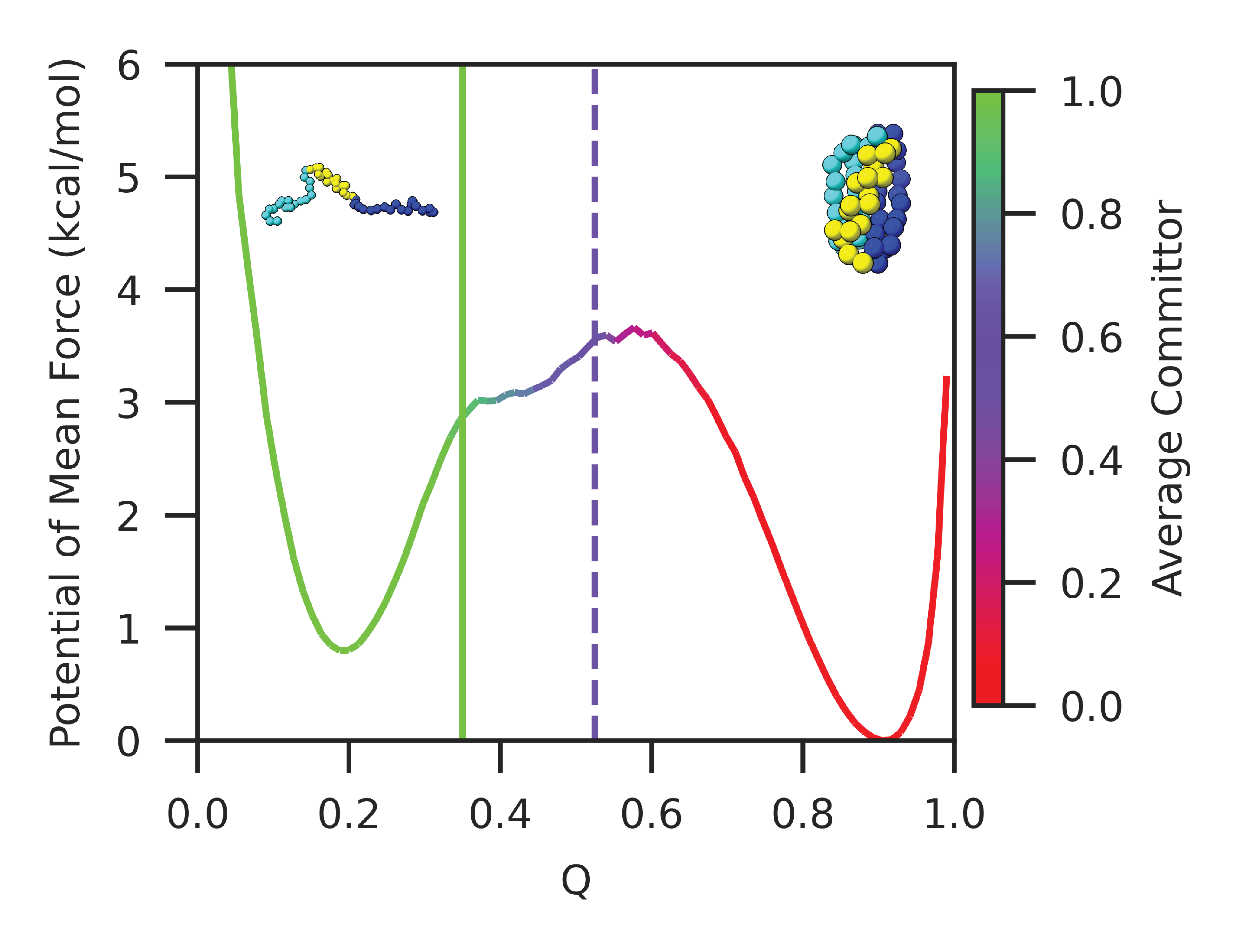
EATR's performance was initially validated on a one-dimensional matched-harmonic potential. This test case revealed that EATR predicts unbiased rates that agree closely with those derived from Kramers' theory, particularly excelling over previous methods in the context of imperfect CVs. Figure 1, depicting the relationship between the potential and the committor function, illustrates the alignment of predicted and empirical rates, demonstrating EATR's robustness. Figure 1

Figure 1: The potential of mean force along the fraction of native contacts Q for the G=o-like model of the B1 domain of protein G colored according to the average committor function.

Protein Unfolding Case Study

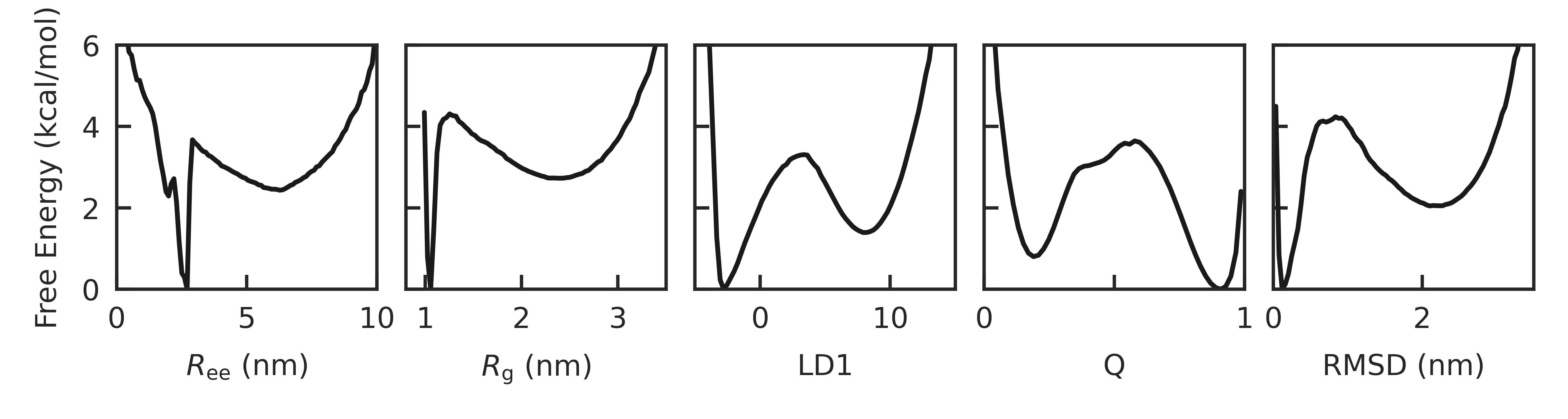
For a practical biophysical application, the unfolding of a coarse-grained G=o-like protein model was analyzed (Figure 2). Various CVs were assessed for their efficiency, showing that QQ and RMSD are superior for this system. The results showed that EATR calculated rates consistent with those obtained from unbiased simulations, even when CV quality varied significantly. Figure 2

Figure 2: PMF along various CVs calculated from an unbiased trajectory.

Practical Implications and Future Work

EATR proves to be an efficient tool for calculating transition rates in complex simulations with external biases. Its capability to report CV efficiency through γ\gamma offers significant practical advantages in evaluating the suitability of CVs in complex biomolecular systems.

The study suggests that further refinement of the method could involve optimizing how bias influences pre-exponential factors, which could enhance the accuracy of k0k_0 estimates in over-biasing scenarios. Future work is suggested towards implementing EATR in higher dimensional biasing scenarios and integrating it with additional non-equilibrium work estimators.

Conclusion

The EATR approach offers a robust framework for deriving more accurate transition rates within the context of time-dependent biased molecular dynamics. By establishing a direct relationship between existing methods and introducing a measure of CV biasing efficiency, EATR provides significant advancements towards understanding and improving the rate estimation of rare event transitions in complex systems.

Paper to Video (Beta)

Whiteboard

No one has generated a whiteboard explanation for this paper yet.

Collections

Sign up for free to add this paper to one or more collections.

Tweets

Sign up for free to view the 1 tweet with 96 likes about this paper.