Papers
Topics
Authors
Recent
Search
2000 character limit reached

Generalizing Instant Runoff Voting to Allow Indifferences

Published 17 Apr 2024 in cs.GT and econ.TH | (2404.11407v1)

Abstract: Instant Runoff Voting (IRV) is used in elections for many political offices around the world. It allows voters to specify their preferences among candidates as a ranking. We identify a generalization of the rule, called Approval-IRV, that allows voters more freedom by allowing them to give equal preference to several candidates. Such weak orders are a more expressive input format than linear orders, and they help reduce the cognitive effort of voting. Just like standard IRV, Approval-IRV proceeds in rounds by successively eliminating candidates. It interprets each vote as an approval vote for its most-preferred candidates among those that have not been eliminated. At each step, it eliminates the candidate who is approved by the fewest voters. Among the large class of scoring elimination rules, we prove that Approval-IRV is the unique way of extending IRV to weak orders that preserves its characteristic axiomatic properties, in particular independence of clones and respecting a majority's top choices. We also show that Approval-IRV is the unique extension of IRV among rules in this class that satisfies a natural monotonicity property defined for weak orders. Prior work has proposed a different generalization of IRV, which we call Split-IRV, where instead of approving, each vote is interpreted as splitting 1 point equally among its top choices (for example, 0.25 points each if a vote has 4 top choices), and then eliminating the candidate with the lowest score. Split-IRV fails independence of clones, may not respect majority wishes, and fails our monotonicity condition. The multi-winner version of IRV is known as Single Transferable Vote (STV). We prove that Approval-STV continues to satisfy the strong proportional representation properties of STV, underlining that the approval way is the right way of extending the IRV/STV idea to weak orders.

Summary

  • The paper presents Approval-IRV, which adapts traditional IRV by allowing voters to express indifferences among candidates.
  • It employs an approval system where each non-eliminated candidate in a voter’s top set receives an approval, ensuring clone independence and respect for majority preference.
  • Empirical results reveal that Approval-IRV often selects candidates with higher Borda scores, improving overall electoral representativeness.

Generalizing Instant Runoff Voting to Allow Indifferences

Introduction

The paper explores an extension of Instant Runoff Voting (IRV) called Approval-IRV, which allows voters to express indifferences among candidates by ranking multiple candidates equally. This extension addresses cognitive challenges and restrictions associated with the traditional IRV that mandates strict ordering of candidates.

Methodology

Approval-IRV generalizes IRV by interpreting votes as approval votes: each non-eliminated candidate in a voter's top preference set receives an approval. The candidate with the fewest approvals is eliminated each round until a winner remains. This process retains desirable properties of IRV, such as clone independence and respect for majority preference. Figure 1

Figure 1: Map of San Francisco election precincts, colored by the fraction of votes that could be interpreted as a weak order with indifferences.

Approval-IRV is shown to be unique among other generalizations, particularly against Split-IRV, which divides points among top candidates, leading to failures in clone independence and majority preference respect.

Results

Extensive analysis with both synthetic and real-world voting data was performed to evaluate the performance of Approval-IRV. The results highlight that in datasets where voters express indifferences, Approval-IRV often selects candidates with higher Borda scores than either Split-IRV or the original IRV, showing better candidate quality. Figure 2

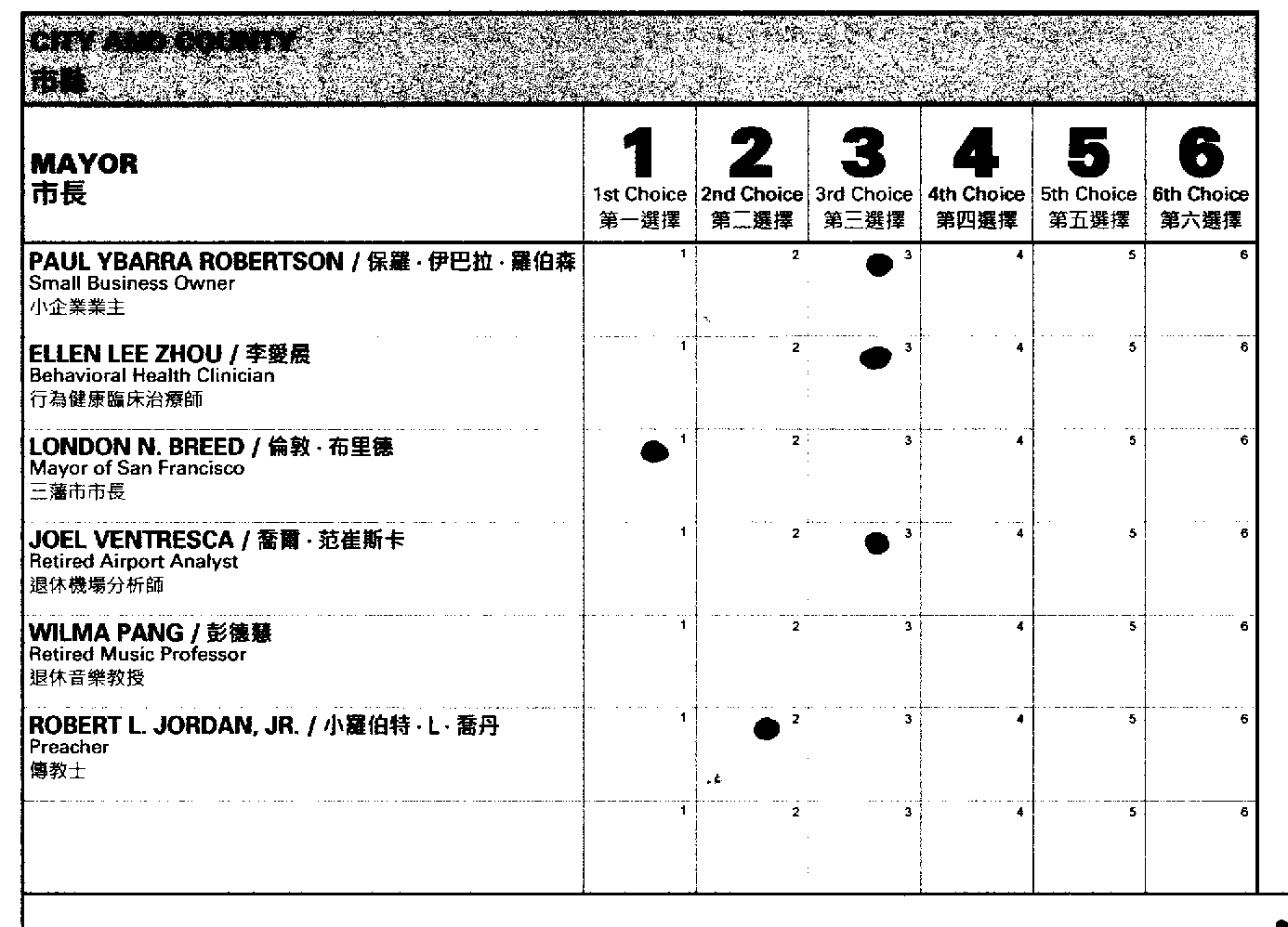
Figure 2

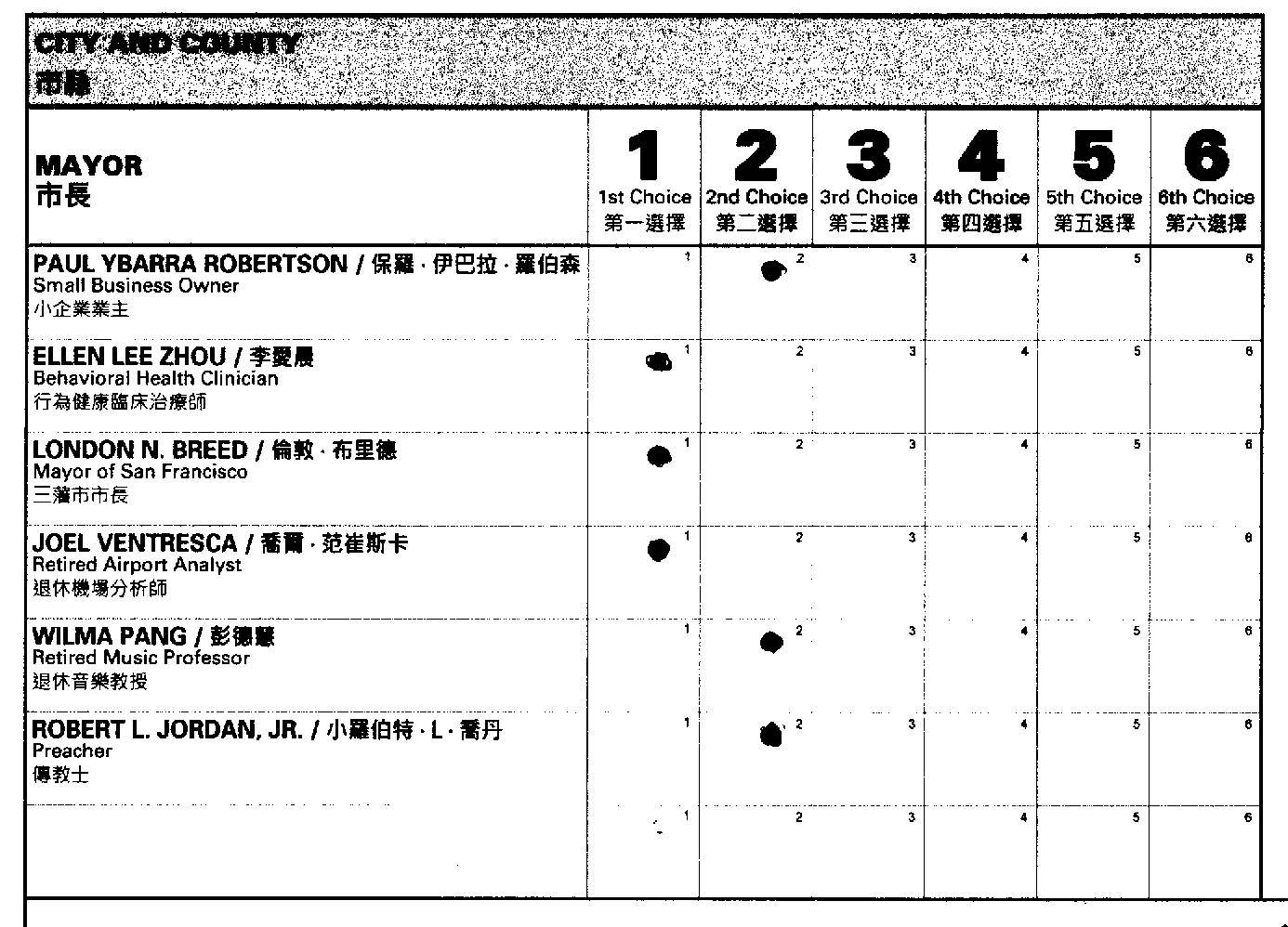
Figure 2

Figure 2: Two top choices.

These results are consistent across multiple datasets, indicating that Approval-IRV not only maintains desirable properties but also improves the representativeness of elected candidates in voting scenarios with indifferences.

Theoretical Implications

The paper proves that Approval-IRV satisfies key voting axioms, namely independence of clones and respect for cohesive majorities, characterizing it as the sole extension of IRV to weak orders that retains these properties. This theoretical backing suggests a strong foundation for its application across diverse electoral systems.

Practical Applications

The practical benefits of Approval-IRV are notable in electoral systems that involve a large number of candidates, such as those in Australia and parts of the US. Allowing voters to express indifferences can reduce ballot errors and disenfranchisement caused by voting complexity, potentially increasing turnout and improving voter satisfaction. Figure 3

Figure 3: Average Borda score of the winner (normalized by dividing by nn) for various datasets.

Moreover, Approval-IRV's compatibility with current electoral infrastructures makes it an appealing choice for electoral reforms aimed at maximizing voter expression while preserving robustness against strategic manipulation.

Conclusion

Approval-IRV represents a significant step in adapting the IRV framework to accommodate voter indifference, addressing key limitations while enhancing selection outcomes in terms of candidate quality. The theoretical rigor and empirical robustness of this method present a compelling case for its adoption in systems seeking to improve voter agency and decision quality.

Paper to Video (Beta)

Whiteboard

No one has generated a whiteboard explanation for this paper yet.

Open Problems

We haven't generated a list of open problems mentioned in this paper yet.

Collections

Sign up for free to add this paper to one or more collections.

Tweets

Sign up for free to view the 5 tweets with 5 likes about this paper.