- The paper introduces a novel framework that integrates causal structure learning using Granger causality and graph variational autoencoder to predict GMV.
- It employs a Causal Relational Encoder and a Marketing Response Decoder to capture dynamic temporal and saturation effects in advertising data.
- Empirical validations show that CausalMMM outperforms traditional regression-based MMM models with significant improvements in AUROC and forecasting accuracy.
CausalMMM: Learning Causal Structure for Marketing Mix Modeling
CausalMMM represents an innovative approach within the domain of Marketing Mix Modeling (MMM) by integrating causal structure learning into gross merchandise volume (GMV) prediction across various advertising channels. Traditional MMM models, which predominantly rely on regression, are limited in handling the complexity and dynamics of modern marketing environments. This paper outlines a method to dynamically discover interpretable causal structures from data, thereby improving the predictive efficacy of GMV models.
Methodology
Motivation and Overview
The innate heterogeneity in causal structures across different shops poses significant challenges to conventional MMM models. Additionally, the carryover and saturation effects observed in marketing response patterns necessitate a robust method to capture these dynamics (Figure 1).
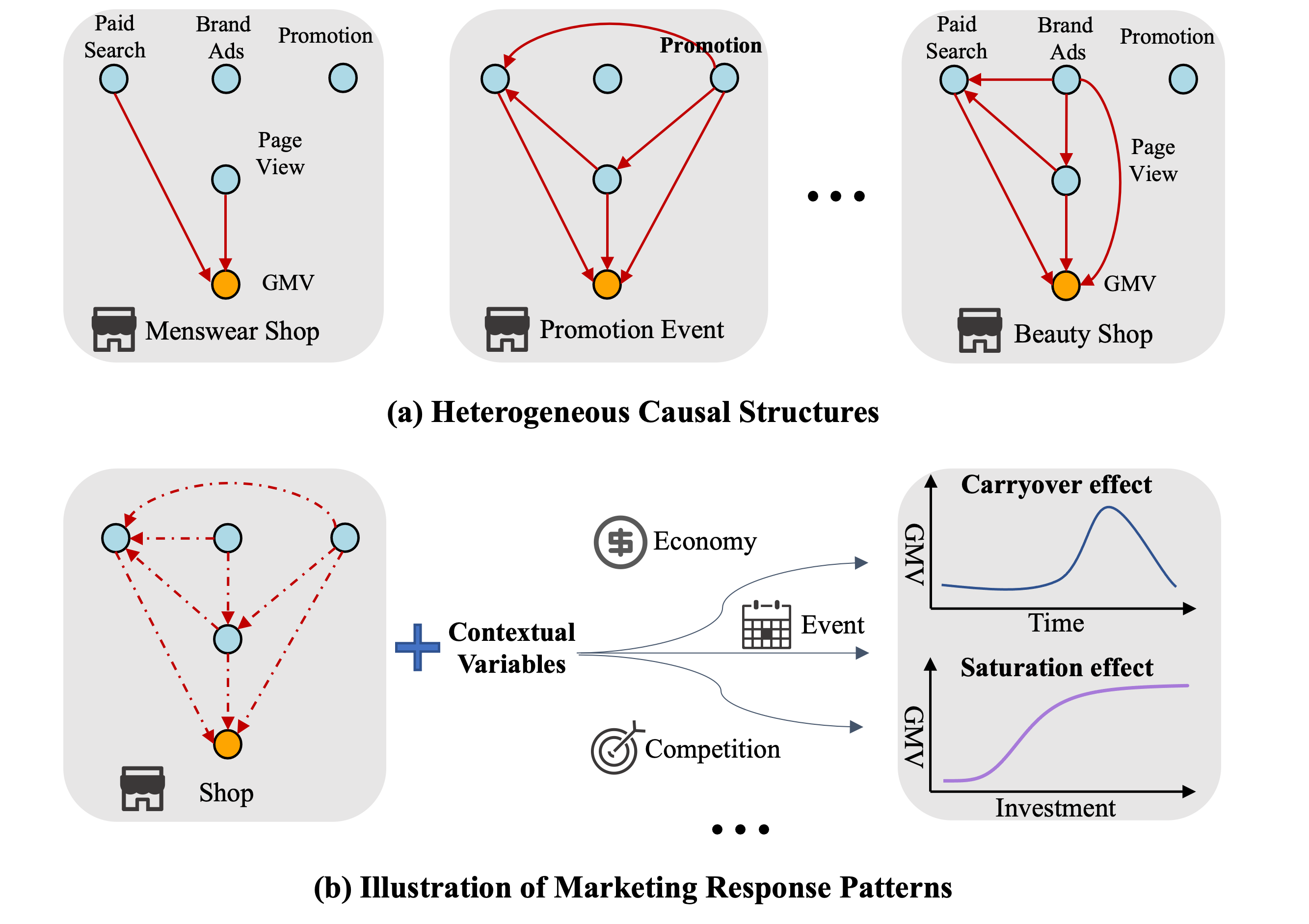
Figure 1: The motivation of CausalMMM. (a) shows heterogeneous causal structures in MMM where nodes in different colors denote channel and target variables, respectively. (b) illustrates the saturation curve of marketing response determined by contextual factors, such as economy, events, etc.
The CausalMMM framework utilizes a graph variational autoencoder composed of two core modules:
- Causal Relational Encoder: Predicts causal structures through Granger causality to measure relationships between advertising channels and GMV.
- Marketing Response Decoder: Models temporal and saturation patterns in marketing responses to predict GMV.
Implementation Details
Causal Relational Encoder employs Gumbel softmax sampling to infer causal relations from fully connected graphs. Pairwise embeddings represent node interactions, while relational interaction propagates global information. The encoder output is a latent distribution representing the causal structures.
Marketing Response Decoder addresses key marketing phenomena:
- Temporal Marketing Response Module: Utilizes RNNs to embed carryover effects, with hidden states capturing temporal lag in channel investments.
- Saturation Marketing Response Module: Applies S-curve transformations, crucial for modeling diminishing returns in marketing investments, manipulated through learnable parameters like inflection point and curve shape.
Optimization leverages variational inference to balance data fitting and structural regularization. The encoder-decoder architecture enables simultaneous causal discovery and marketing prediction.
Theoretical Analysis
CausalMMM provides a theoretical guarantee for inferring Granger causality in marketing contexts. The model complexity, offering scalability with temporal and structural variations, showcases its applicability to large datasets from diverse shops.
Experimental Validation
Causal Structure Learning
Extensive evaluations demonstrate CausalMMM's ability to recover causal structures accurately from synthetic and real datasets, outperforming baseline methods in AUROC metrics by margins of 5.7% to 7.1% (Figure 2).
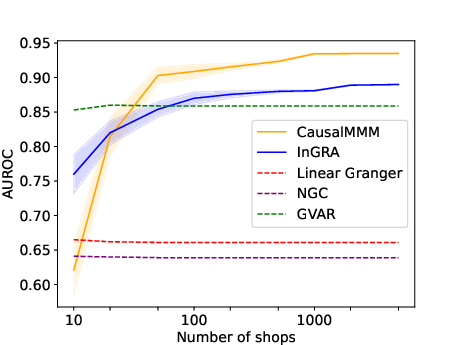
Figure 2: Causal structure learning performance (in AUROC) w.r.t. the number of shops N (d=10, T=120).
GMV Prediction
On real-world datasets (AirMMM), CausalMMM excels in predictive accuracy, adapting well to sudden variations in marketing data. Comparative analyses with state-of-the-art methods underscore its competency in multi-step GMV forecasting (Figure 3).
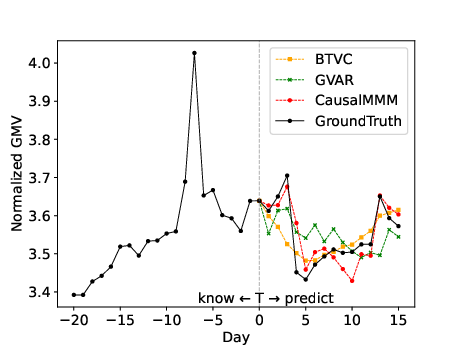
Figure 3: Visualization results for GMV prediction.
Real-World Application
CausalMMM's inferred causal structures (Figure 4) align with marketing domain knowledge, revealing insights into channel interactions unknown to regression-based models. Enhanced interpretability in causal relations informs decision-making.
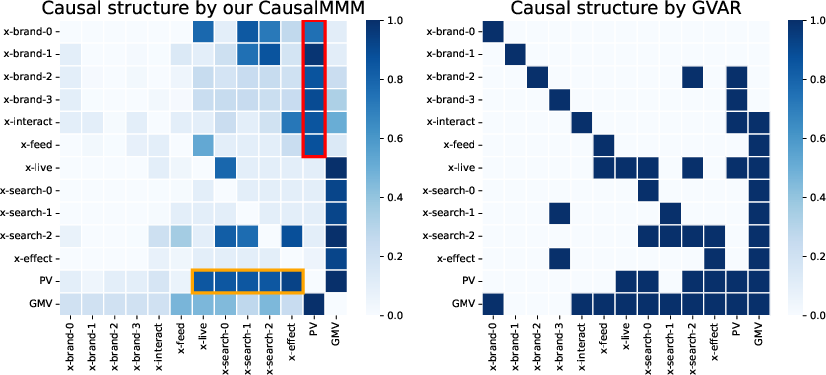
Figure 4: Learned causal structure of AirMMM. Causal relations from brand channels to PV are highlighted in {red{red}.
Conclusion
CausalMMM is pivotal in redefining MMM by integrating causal discovery within predictive frameworks, advancing both interpretability and precision in marketing strategies. The model's robust handling of heterogeneous datasets, coupled with theoretical and empirical validations, paves the way for future research in causal inference and temporal pattern modeling in marketing analytics.