- The paper demonstrates that applying the quantum SWITCH enhances classical and coherent capacities by superposing causal orders of channels.
- It details how indefinite causal order and the parameter Pₙ drive improvements in both Pauli and qudit depolarizing channels.
- The work further shows that enhanced private capacity in quantum cryptography can be achieved through novel quantum SWITCH protocols.
General Communication Enhancement via the Quantum Switch
Introduction
The paper "General Communication Enhancement via the Quantum Switch" (2407.02726) investigates the potential of the quantum SWITCH to enhance communication capabilities over quantum channels. Unlike conventional methods where channels are used in a fixed sequence or parallel, the quantum SWITCH allows channels to operate in a superposition of different orders. This structure exploits indefinite causal order, potentially achieving enhancements even with inherently noisy channels, such as depolarizing channels, which normally only transmit white noise when ordered conventionally.
Quantum SWITCH and Communication
The concept of the quantum SWITCH is pivotal in quantum information theory. It creates a new type of channel by taking a collection of quantum channels and operating them in a superposition of causal orders, controlled by an auxiliary quantum system. This can result in practical advantages in quantum communication tasks, such as improved data transmission and enhanced quantum cryptography.
The authors introduce a quantity denoted as Pn, conjectured to be a necessary and sufficient condition for achieving communication enhancement via the quantum SWITCH. This conjecture is explored in depth for specific classes of channels, notably the Pauli channels and qudit depolarizing channels.
Analysis of Pauli Channels
The paper rigorously analyzes the case of Pauli channels, which are described by a probability vector over the Pauli matrices. It is shown that for these channels, the Pn value characterizes potential enhancements effectively. The classical and coherent information capacities of the effective channel formed by the SWITCH are computed and shown to be superior to those of channels without the quantum SWITCH structure.
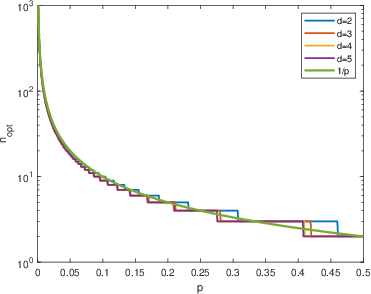
Figure 1: The optimal number of channels for communication enhancement via quantum SWITCH. The y-axis nopt is inversely related to the error probability for probabilities less than 0.5.
When applying the quantum SWITCH to these channels in both forward and backward orders, a significant capacity enhancement is observed almost surely, outside a measure-zero set where Pn=0, which signifies cases with no enhancement, such as completely dephasing channels combined with unitaries.
Depolarizing Channels and Higher Dimensions
Beyond qubit systems, the study extends to qudit depolarizing channels. These generalizations affirm that the benefits of a quantum SWITCH are not dimension-specific. The critical parameter Pn remains a decisive factor for capacity gains. The authors provide explicit formulas, revealing that with increasing dimensionality and proper parametric configurations, significant causal gains can be achieved even for depolarizing noise with increased entropy production.
The results suggest the possibility of exponential capacity enhancements relative to the classical use of such channels, given appropriate channel configurations and applications of the quantum SWITCH.
Implications for Quantum Cryptography
The paper also addresses practical applications, particularly enhancing the private capacity of cryptographic channels like the BB84 channel. By employing the quantum SWITCH, it is demonstrated that private capacity can exceed the standard limits imposed by definite causal order arrangements, thus providing novel protocols for more secure quantum communications.
Conclusion
The investigation by Wu et al. provides substantial evidence that the quantum SWITCH can indeed be utilized as a powerful tool to augment the communication capacities of quantum channels that otherwise impose severe limitations under classical arrangements. The results pave the way for the development of advanced protocols in quantum information processing, with potential applications spanning secure communications and beyond.
This work significantly contributes to the understanding of communication in quantum systems, challenging preconceptions about the limits of communication through noisy channels and opening new avenues for research in quantum information theory.