- The paper postulates that black holes experience a quantum bounce due to loop quantum gravity, preventing singular collapse and forming a Planck star.
- It reveals that this bounce results in stable Planck-mass remnants, which could potentially account for dark matter in the universe.
- The study outlines observational prospects and experimental approaches to detect quantum gravitational interactions during the black-to-white hole transition.
"Planck stars, White Holes, Remnants and Planck-mass quasi-particles" Overview
The paper "Planck stars, White Holes, Remnants and Planck-mass quasi-particles" explores the quantum gravitational phenomena associated with black hole evolution and posits a scenario involving Planck-mass stable remnants. The research ties together recent developments in loop quantum gravity (LQG), conjecturing that black holes undergo a quantum bounce, forming white holes, and possibly contribute to dark matter.
Quantum Gravity and Black Hole Dynamics
Planck Stars and Quantum Bounce
The paper postulates that black holes develop into regions dominated by quantum gravity effects. Utilizing LQG, the authors suggest that gravitational collapse is halted by quantum gravitational pressure upon reaching Planckian density, resulting in a "Planck star" and leading to a bounce instead of singular collapse.
The classical metric outside a collapsing matter distribution becomes modified at high curvatures due to quantum effects. The proposed metric involves non-negligible quantum corrections that redefine inner and outer horizon structures. This scenario suggests that black holes transform into white holes through a quantum transition facilitated by non-dissipative dynamics.
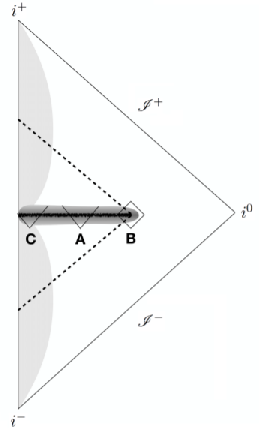
Figure 1: The Carter-Penrose diagram of the black-to-white transition. The dark grey region is the quantum gravity region. The black hole (trapped region) is below the quantum gravity region while the white hole is above. The trapping horizons are the dashed lines.
The bounce leads to quasi-stable remnants with Planckian mass, as suggested by the quantization of spacetime geometry in LQG. These remnants are stabilized by quantum superpositions of black and white geometries due to the LQG area gap. This contradicts the classical notion of event horizons and suggests that black hole evaporation might not completely dissipate, resulting in remnants that resemble dark matter.
Implications and Observational Prospects
Dark Matter Candidates
The remnants, comprising Planck-mass objects, serve as candidates for dark matter without necessitating new fields or particles. This aligns with theories suggesting primordial black holes contribute to the dark matter content of the universe.
Detectability
The remnants' detection is theoretically viable via quantum gravitational interactions in precision experiments using quantum superposition states. However, direct detection poses a significant challenge due to the inherently weak gravitational interactions.
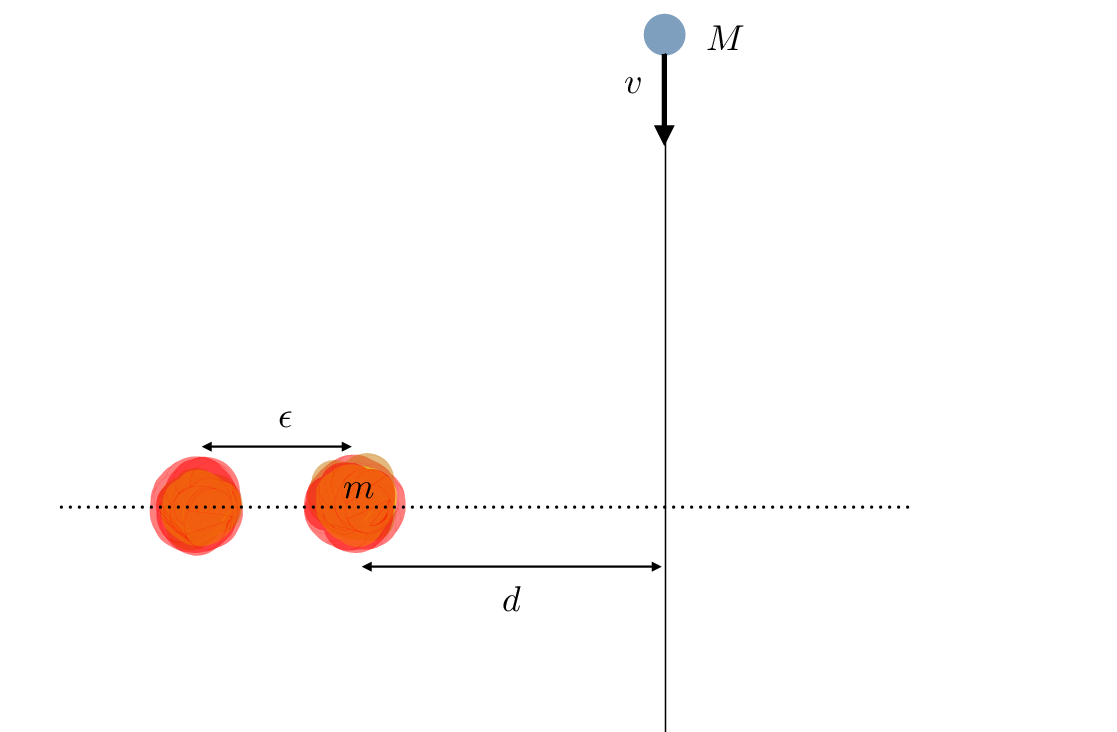
Figure 2: A particle of mass m in a superposition state with separation epsilon. The DM particle passes by with velocity v and a closest approach distance d.
Conclusion
The research outlines a coherent picture of black hole evolution under quantum gravity, highlighting the potential role of Planck-mass remnants in cosmology and dark matter research. The paper calls for further investigation into the observational aspects of remnants and encourages development of experimental techniques to probe these quantum gravitational systems. While theoretical, these ideas could significantly impact astrophysics and our understanding of fundamental forces. Future work in this domain aims to substantiate these predictions and explore their observational consequences.