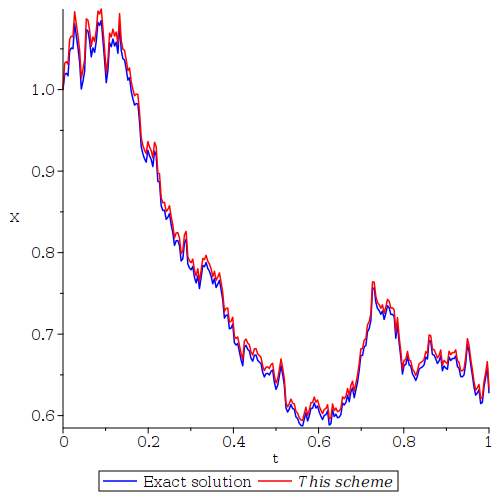
- The paper presents a novel quadratic polynomial approximation method for solving Itô stochastic differential equations with proven mean-square stability and conditional convergence.
- It employs iterative integration by subdividing the time interval and using quadratic interpolation to improve efficiency and accuracy in approximating geometric Brownian motion.
- Numerical experiments validate the method's superior error performance and robustness compared to standard implicit EM and Milstein methods under various drift and volatility conditions.
A New Approximation Method for Solving Stochastic Differential Equations
The paper presents a novel approximation method for solving Itô stochastic differential equations (SDEs) with quadratic polynomial approximations. The focus is on analyzing fundamental stochastic numerical method properties—convergence, consistency, and stability.
Introduction to Stochastic Differential Equations
Stochastic differential equations are critical in modeling diverse phenomena impacted by random noise across fields like mathematical finance, molecular biology, and theoretical physics. Unlike ordinary differential equations, SDEs incorporate stochastic processes, hence requiring computational numerical simulations for solutions. The paper introduces an approximation approach using quadratic polynomials over sub-intervals of the time domain to improve efficiency and accuracy.
Methodology
For approximating the solution of geometric Brownian motion modeled by SDEs, the proposed methodology subdivides the entire time interval into smaller sub-intervals. Within each interval, quadratic polynomials approximate the function X(t). In particular, the quadratic interpolation for SDEs progresses through multiple time steps, with the following main steps:
- Quadratic Approximation:
- The state variable X(t) within an interval [t_n, t_{n+2}] is approximated by quadratic functions.
- The coefficients are determined through function values at three successive time nodes.
- Iterative Integration:
- Integration within each sub-interval using the interpolated polynomials provides estimates at future time points, thereby iteratively propagating the solution over the entire domain.
This polynomial interpolation against the stochastic dynamics captures both deterministic drift and stochastic diffusion components, yielding a consistent and stable numerical scheme.
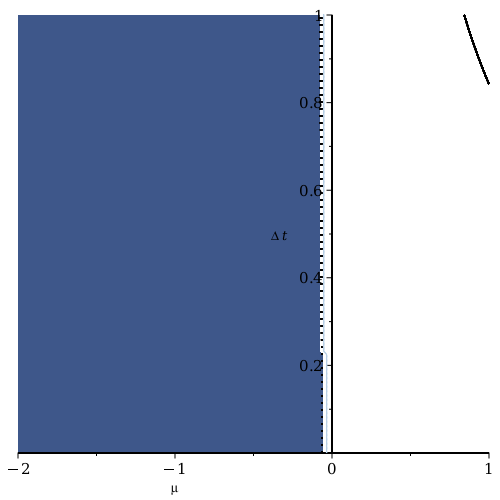
Figure 1: Plot of the stability region (shaded area) determined by \eqref{eq:stability_condition1} for σ=0.5.
Stability, Consistency, and Convergence
Critical analysis in the paper reveals the numerical scheme's stability, consistency, and convergence attributes, vital for ensuring solution reliability. Key takeaways include:
- Mean-square Stability: The method fulfills stability criteria under specific conditions on parameters, ensuring long-term viability in simulating sample paths.
- Consistency: Local error bound convergence (O(Δt)) indicates the method's correctness as the solution adheres to stochastic differential laws.
- Convergence: Derived from the Lax-Richtmyer equivalence theorem, convergence ensures the solution's fidelity as sub-interval step sizes diminish.
The paper's method displays conditional convergence provided the stability constraints—predominantly influenced by μ (drift) and σ (volatility)—are satisfied.
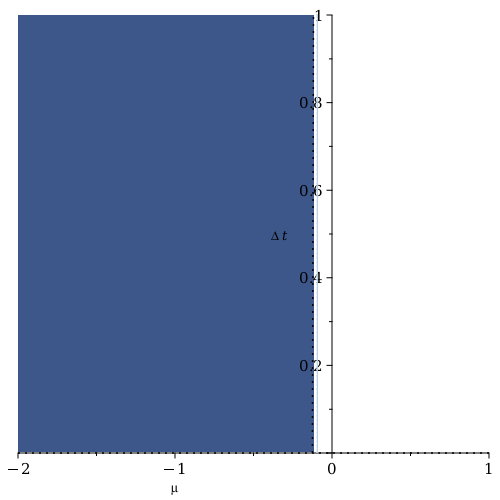
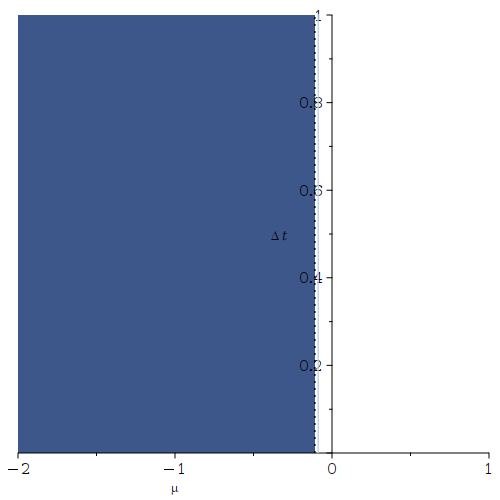
Figure 2: Plot of the stability region (shaded area) for $\sigma=0.5. Implicit EM on the left and Milstein on the right.
Numerical Experiments
Numerical validation showcases the method's performance on test problems involving stochastic differential equations with known analytic solutions. Comparisons against these solutions illustrate:
Conclusion
The presented quadratic approximation scheme for SDEs satisfies stability, consistency, and convergence requisites, making it performant and scalable for broad applications. Its advantages are most pronounced in scenarios involving complex stochastic dynamics, where conventional numerical methods struggle due to high variance and instability issues.
Future research directions aim at expanding this methodology to broader forms of SDEs, including systems characterized by variable coefficients and multi-dimensional dynamics. This could potentially improve performance for a wider array of stochastic models, especially in computational domains where reliability and precision are paramount.