- The paper presents Tabu Search-optimized RPL, significantly enhancing energy efficiency and link stability in IoT networks using a multi-metric cost function.
- The methodology integrates Tabu Search with NS-2 simulations to demonstrate lower energy consumption and reduced control overhead compared to standard RPL.
- The approach balances short path selection against robust, longer multi-hop routes, offering practical benefits for low-power and lossy IoT environments.
Tabu Search-Optimized RPL: Enhanced Link Stability and Energy Efficiency for IoT Networks
Introduction
The proliferation of Internet of Things (IoT) deployments imposes stringent requirements on low-power and lossy networks (LLNs), primarily concerning energy consumption, link robustness, and routing efficiency. The Routing Protocol for Low-power and Lossy Networks (RPL) has become the de facto standard for such environments, yet it exhibits limitations in sustaining link stability and energy preservation, especially under dynamic and dense network conditions. This work proposes an RPL optimization leveraging Tabu Search—a metaheuristic capable of traversing large combinatorial solution spaces and escaping local minima—in the parent/child selection of RPL, augmented via a multi-metric composite cost function. The methodology is rigorously validated in a set of comprehensive NS-2.34 simulations, establishing superior performance over prominent RPL variants in critical metrics, including energy consumption, link stability, and control overhead.
Tabu Search-Driven RPL Optimization Framework
The core of the proposed method is the integration of Tabu Search to optimize parent and child selection processes in RPL. A composite cost function guides Tabu Search, balancing six distinct parameters: residual energy, transmission energy, distance to the sink, hop count, ETX, and link stability. This framework allows adaptive and context-sensitive route selection, mitigating the classical trade-off between shortest-path routing and link/node robustness.
The cost functional is defined as:
C(P)=e∈P∑(λ1Er(e)1+λ2Et(e)+λ3d(e)1+λ4h(e)+λ5ETX(e)+λ6Ls(e)1)
where λi are normalization weights reflecting operator priorities, and P denotes a feasible routing path. The optimization process is characterized by the use of the Tabu List to avoid cycling, ensuring that the search explores new regions in the solution space until a global or near-global optimum is achieved.
Simulation Setup and Methodology
A static topology with 50 nodes and realistic IoT communication parameters (1000m × 1000m, IEEE 802.15.4 MAC, battery model for energy, random node deployment) forms the evaluation environment. Baseline RPL and competitive variants (BD-RPL, M-RPL, A-RPL) serve as the primary references. Evaluation metrics include packet delivery ratio (PDR), energy consumption, link stability, throughput, and control overhead across varied data rates and link reliability settings.
Results and Analysis
Energy Consumption
The energy consumption analysis (Figure 1) demonstrates that the proposed method, TABURPL (Tabu Search-optimized RPL), achieves the lowest mean energy expenditure across all simulated traffic rates (5, 10, 15 pkts/min). Unlike standard RPL implementations that frequently trigger unnecessary route changes or retransmissions due to link failures, TABURPL's robust path optimization minimizes both data and control-plane transmission costs, yielding an observable reduction in energy spent per data delivered.
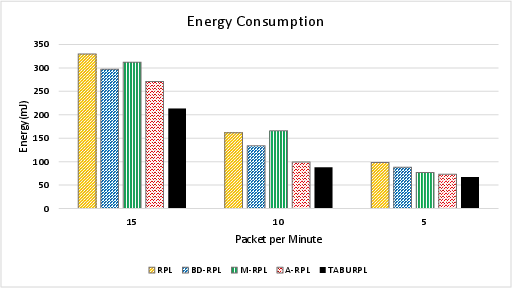
Figure 1: Average energy consumption per node for various RPL variants and traffic rates, showing minimum energy usage by TABURPL.
Path Length Characteristics
An analysis of average path length (Figure 2) reveals a significant behavioral deviation of TABURPL: as link reliability decreases, the protocol prefers longer but more stable and energy-efficient multi-hop paths. This outcome is a direct result of prioritizing joint link stability and node energy over strict hop-count minimization, critical in lossy environments. While this metric may superficially suggest inefficiency, the sustained data delivery success and reduced retransmissions negate any negative impact of path dilation.
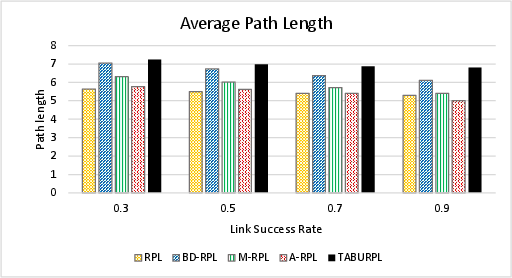
Figure 2: Average path length (hops) under different link success probabilities; TABURPL adopts longer routes to improve stability.
Control Overhead
TABURPL's design allows it to significantly suppress routing control overhead across data rates (Figure 3). The Tabu Search routinely selects paths that require fewer route maintenance and repair operations, reducing DIO/DAO/TARGET message floods that typically degrade network goodput and accelerate energy depletion. This reduction in control traffic enhances application-layer throughput by ensuring minimal interference with data bandwidth allocation.
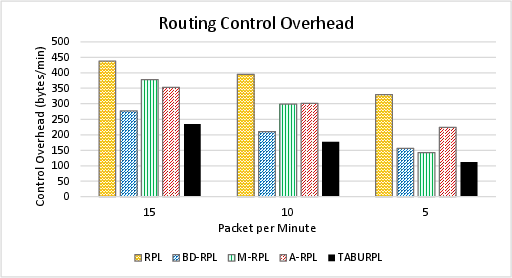
Figure 3: Average number of routing control packets; TABURPL demonstrates the lowest protocol-induced overhead in all traffic scenarios.
Theoretical Implications
The multi-objective cost function and Tabu Search synergy ensure Pareto efficiency in path selection. The mathematical proofs provided in the paper confirm the cost function's convexity and the global optimality of the iterative solution under certain regularity conditions. The framework generalizes beyond fixed-weighting, allowing for dynamic adaptation (e.g., via context-aware or self-learning weights) as a direction for future work.
Practical Implications and Future Developments
From an engineering standpoint, TABURPL directly addresses major pain points in IoT deployments: limited battery life and link volatility. The trade-off between minimal hop count and operational robustness is quantitatively balanced, resulting in practical gains for applications with strict uptime and sustainability constraints (e.g., environmental monitoring, industrial automation). This method is amenable to further improvements, such as integration with real-time digital twin simulations for predictive optimization, or embedding reinforcement learning to regulate λ coefficients for adaptive QoS targeting.
In large-scale, resource-diverse IoT networks, TABURPL's approach is expected to yield even more pronounced gains, given its inherent adaptability and avoidance of local minima (a limitation frequently observed in classical RPL metric combinations).
Conclusion
The paper presents an RPL optimization architecture using Tabu Search and a multi-factor cost function, resulting in strong and consistent improvements in energy consumption, route stability, control overhead, and—depending on the weighting—even path reliability. While resulting routes may utilize more hops, the gains in network longevity and delivery reliability substantiate this trade-off. This research substantiates the value of sophisticated, metaheuristic optimization for protocol adaptation in resource-constrained cyber-physical systems and lays a robust foundation for hybrid AI-driven RPL innovations (2408.06702).