- The paper introduces an approach where gravity emerges from the entropic action coupling matter-induced and spacetime metrics, redefining gravitational interactions.
- It employs quantum operators, the Dirac-Kähler formalism, and effective density matrices to derive modified Einstein equations with an intrinsic cosmological constant.
- The framework offers computational insights for simulating quantum gravity effects using tensor operations and adaptive techniques across multiple scales.
Gravity from Entropy
Introduction
The paper "Gravity from entropy" presents a theoretical framework where gravity emerges from an entropic action coupling matter fields with the geometry of spacetime. This novel approach interrelates Lorentzian spacetime metrics and quantum operators, interpreted as renormalizable effective density matrices. The interdisciplinary foundation leverages statistical mechanics, information theory, and quantum gravity concepts to derive a modified theory of gravity. The entropic action proposed is the quantum relative entropy between the spacetime metric and a matter-induced metric. This perspective maps the interplay between matter fields, depicted topologically, and geometric spacetime alterations.
Theoretical Framework
The framework postulates that the metric of spacetime can be represented as a quantum operator, relating the geometry to quantum field theory's mathematical underpinnings. The proposed action incorporates the Dirac-Kähler formalism, describing matter fields as the direct sum of a zero-form, a one-form, and a two-form. As a result, the metric induced by these matter fields provides an alternative to the traditional spacetime metric, encapsulating how matter influences geometrical structures.
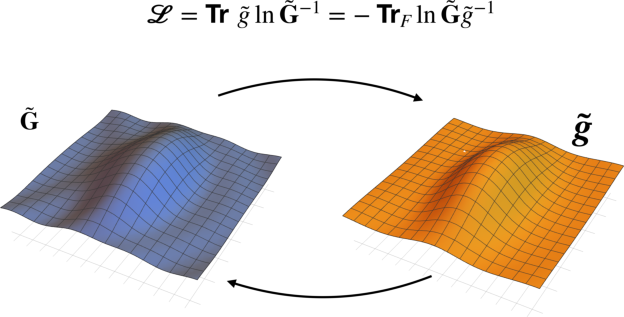
Figure 1: Schematic representation of this theoretical framework. The metric induced by the matter field G~ affects spacetime's metric g~, and vice versa.
Modified Gravity Equations
The modified Einstein equations derived from this entropic action reduce to the classical Einstein equations with zero cosmological constant in scenarios of low coupling. The introduction of an auxiliary field, the G-field, enables a transformation of the entropic action into a dressed Einstein-Hilbert action. This leads to an emergent cosmological constant intrinsically tied to the G-field. Importantly, the modified gravity equations remain second-order, preserving mathematical consistency without higher-order instabilities.
Implementation and Applications
Computational Requirements
Implementing this theory in a computational simulation requires tools capable of handling complex tensor algebra and differential geometry. Software like TensorFlow or PyTorch could be extended to support the differentiated operations between these metrics. Efficient computation requires handling large-scale matrix operations and eigenvalue computations as proposed in the paper's equations.
Scaling Considerations
Simulations should account for various scales from quantum to cosmological levels, necessitating adaptive resolution techniques and parallel computation for feasible execution times. The scalability hinges on optimizing tensor operations and parallel processing to address the increasing computational demand as scenarios grow in complexity.
Theoretical and Practical Implications
From a theoretical standpoint, this approach opens potential paths for unifying gravity with quantum mechanics through statistical mechanics and informational principles. Practically, insights could be garnered about dark matter and gravity's quantum aspects. While speculative, it sets a foundation for future exploration and validation against experimental data.
Conclusion
The "Gravity from entropy" paper proposes an innovative view of gravity as an emergent phenomenon from entropic interactions between matter fields and geometric constructs. By associating spacetime metrics with quantum operators, it introduces a compelling framework for modified gravity theories. The potential applications in understanding quantum gravity and cosmological constants hold promise, although they await further research and empirical substantiation.

