- The paper introduces the MODMD framework combining classical shadows with ODMD to reduce measurement overhead in eigenenergy estimation.
- It demonstrates rapid convergence and robust noise resilience in quantum simulations for both condensed matter and quantum chemistry applications.
- Results show efficient predictions of ground and excited state energies using minimized quantum resources and optimized measurement strategies.
Efficient Measurement-Driven Eigenenergy Estimation with Classical Shadows
This essay provides an in-depth examination of the paper "Efficient Measurement-Driven Eigenenergy Estimation with Classical Shadows" (2409.13691). The framework introduced in this paper aims to harness quantum algorithms for estimating eigenenergies in quantum systems, leveraging classical shadows to efficiently manage measurement overhead.
Introduction to the Framework
The research presents a hybrid quantum-classical framework named Multi-Observable Dynamic Mode Decomposition (MODMD). This approach amalgamates Observable Dynamic Mode Decomposition (ODMD)—a measurement-driven eigensolver optimized for near-term quantum devices—with classical shadow tomography. The MODMD framework innovatively reduces resource requirements by utilizing classical shadows, enabling the prediction of multiple low-rank observables while bypassing traditional Hadamard-test circuits. The spectral approximation provided by MODMD is backed by rigorous theoretical guarantees.
The framework shows its utility in estimating both ground and excited state energies of quantum systems, paving the way for efficient, measurement-driven algorithms favorable for near-term quantum hardware.
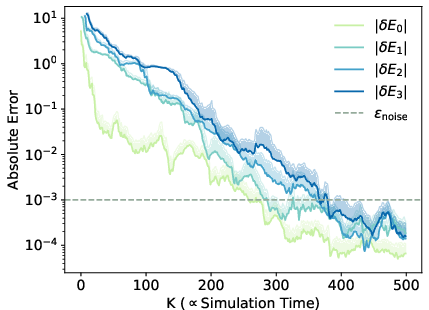
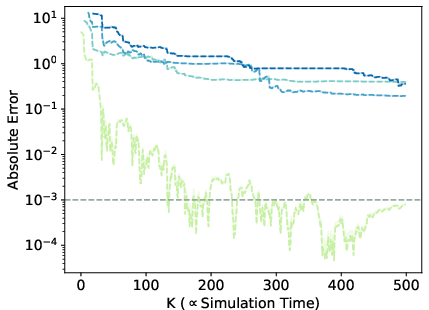
Figure 1: MODMD algorithm.
Preliminaries on Quantum Eigensolvers
Quantum algorithms exploiting real-time evolution play a pivotal role in calculating Hamiltonian eigenenergies. They rely on unitary evolution properties to generate expectation values that resonate with Hamiltonian eigenmodes. Key methods include the quantum subspace diagonalization which organizes extremal eigenenergies using a projected eigenvalue problem and signal processing-based methods that leverage time series to resolve frequencies and achieve noise resilience.
Traditional methodologies often encounter limitations such as solving ill-conditioned eigenvalue problems or requiring significant state preparation. MODMD circumvents these challenges by constructing a signal subspace from multi-observable measurements efficiently gathered via classical shadows.
Classical Shadows for Efficient Measurement
Classical shadow tomography revolutionizes efficient measurement by employing randomized measurement strategies to reconstruct the vector of observable expectations. Random quench evolution combined with computational basis measurement forms the core shadow dataset, allowing for the prediction of an exponential number of low-rank observables. Importantly, this technique introduces minimal additional quantum resource overhead—scaling logarithmically with the number of observables.
This shadow protocol fundamentally enables MODMD to extract comprehensive Hamiltonian information without the burden of collecting high volumes of individual measurements, markedly reducing system demands.
Convergence and Theoretical Guarantees
The convergence of MODMD builds upon ODMD but enhances efficiency through multi-dimensional signals. The MODMD framework uses a higher-dimensional data matrix, facilitating better energy estimation without additional quantum computational cost. The theoretical framework employs polynomial approximations for eigenfrequency identification, offering exponential convergence under particular conditions. Notably, MODMD achieves rapid convergence in spectral regions where single-observable approaches may stagnate, particularly in estimating excited states.
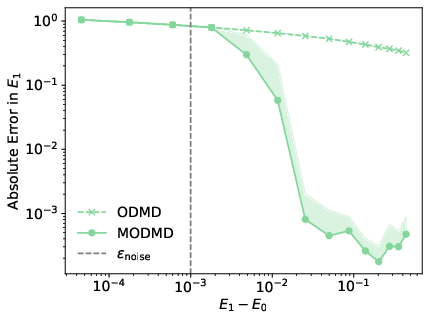
Figure 2: Convergence of the first excited state energy of the TFIM. Absolute error in the first excited state energy is shown as a function of the spectral gap between the ground and the first excited state for fixed K=500. The vertical dotted line marks the noise level εnoise.
Applications in Condensed Matter and Quantum Chemistry
Condensed Matter Physics
In simulations on the 1D TFIM, MODMD demonstrates superior convergence for the first few eigenenergies compared to ODMD. This model, characterized by its spectral complexity and phase transitions, offers an apt testbed for the algorithm's efficacy, especially across varying spectral gaps. MODMD not only outperforms ODMD in these settings but also provides a robust mechanism against perturbative noise, efficiently utilizing random Pauli observables and superposition states.
Quantum Chemistry
For electronic structure problems like LiH molecule simulations, MODMD efficiently estimates excited states using Hartree-Fock state superpositions as reference states. The MODMD algorithm shows precise eigenenergy convergence under moderate noise conditions, leveraging suitably chosen observables from the Hamiltonian's Pauli decomposition. Its ability to reconcile resource constraints with high accuracy positions MODMD as a formidable tool for early fault-tolerant quantum platforms.
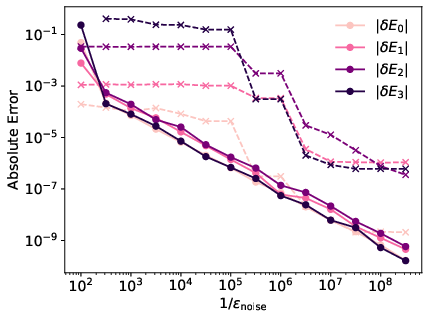
Figure 3: Convergence of eigenergies for LiH under varying noise level. The absolute errors in the first four eigenenergies of the LiH Hamiltonian are shown as a function of the noise level εnoise.
Conclusion
The introduced MODMD framework significantly advances the estimation of eigenenergies in quantum systems through efficient measurement use and robust classical post-processing. MODMD’s scalability, reduced quantum resource demands, and enhanced noise resilience underscore its potential for implementing complex quantum tasks on near-term hardware. Future research may further optimize spectral gap representations and extend MODMD's applicability to broader classes of quantum systems.