Papers
Topics
Authors
Recent
Search
2000 character limit reached

Causality for Large Language Models

Published 20 Oct 2024 in cs.CL, cs.AI, and stat.ML | (2410.15319v1)

Abstract: Recent breakthroughs in artificial intelligence have driven a paradigm shift, where LLMs with billions or trillions of parameters are trained on vast datasets, achieving unprecedented success across a series of language tasks. However, despite these successes, LLMs still rely on probabilistic modeling, which often captures spurious correlations rooted in linguistic patterns and social stereotypes, rather than the true causal relationships between entities and events. This limitation renders LLMs vulnerable to issues such as demographic biases, social stereotypes, and LLM hallucinations. These challenges highlight the urgent need to integrate causality into LLMs, moving beyond correlation-driven paradigms to build more reliable and ethically aligned AI systems. While many existing surveys and studies focus on utilizing prompt engineering to activate LLMs for causal knowledge or developing benchmarks to assess their causal reasoning abilities, most of these efforts rely on human intervention to activate pre-trained models. How to embed causality into the training process of LLMs and build more general and intelligent models remains unexplored. Recent research highlights that LLMs function as causal parrots, capable of reciting causal knowledge without truly understanding or applying it. These prompt-based methods are still limited to human interventional improvements. This survey aims to address this gap by exploring how causality can enhance LLMs at every stage of their lifecycle-from token embedding learning and foundation model training to fine-tuning, alignment, inference, and evaluation-paving the way for more interpretable, reliable, and causally-informed models. Additionally, we further outline six promising future directions to advance LLM development, enhance their causal reasoning capabilities, and address the current limitations these models face.
Summary

  • The paper introduces a comprehensive framework that incorporates causal reasoning into pre-training, fine-tuning, and inference stages of LLMs.
  • It employs debiased token embeddings, causal attention mechanisms, and counterfactual data augmentation to mitigate biases and improve interpretability.
  • The approach enhances ethical alignment and reliability, enabling LLMs to better handle complex, real-world decision-making scenarios.

Causality for LLMs

Abstract Description

The paper "Causality for LLMs" explores the challenges and potential of integrating causal reasoning into LLMs, addressing their current limitations in capturing genuine causal relationships as opposed to mere correlations. LLMs like ChatGPT, LLaMA, and others have demonstrated remarkable capabilities in language tasks but remain constrained by their reliance on statistical patterns rather than explicit causal understanding. This research proposes a framework to enhance LLMs with causality at every stage of their lifecycle, from pre-training to deployment, aiming to improve their reliability and ethical alignment.

Framework Overview

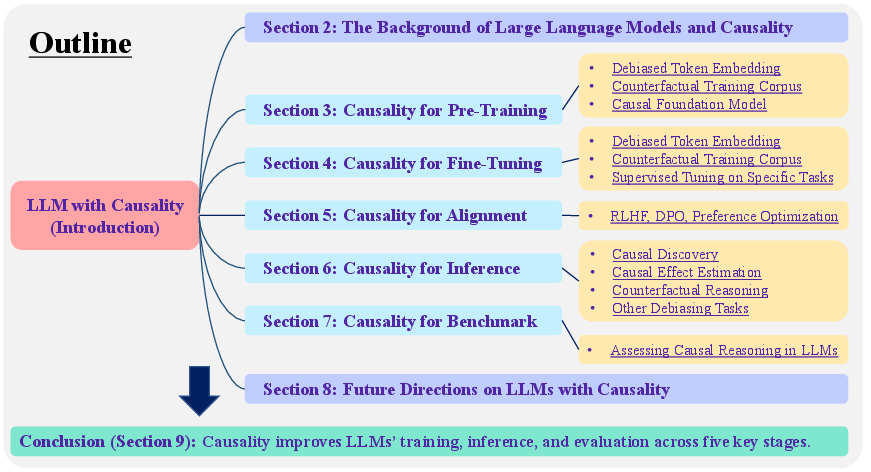
The proposed framework emphasizes the role of causality in mitigating biases and enhancing the interpretability of LLMs. The following stages are defined:

  • Token Embedding Learning: Implement debiased token embeddings and leverage counterfactual data augmentation to address demographic biases.
  • Foundation Model Training: Introduce causal attention mechanisms and causal discovery techniques to capture causal dependencies.
  • Fine-Tuning and Alignment: Employ causal preference optimization and reinforcement learning from human feedback (RLHF) to align model outputs with human values.
  • Inference and Evaluation: Utilize causal prompts and benchmarking to improve causal understanding. Figure 1

    Figure 1: The Role of Causality in Enhancing LLMs: A Comprehensive Framework Across Development Stages.

Pre-training and Token Embedding

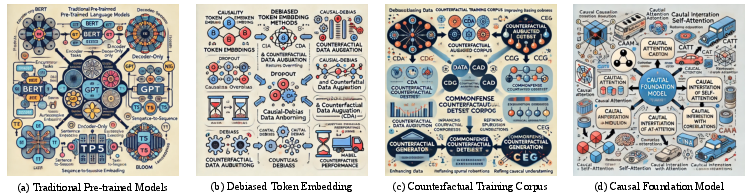
In pre-training, existing models like BERT, GPT, and LLaMA focus primarily on statistical correlations. This paper suggests advancing token embeddings through causal debiasing techniques, employing frameworks like Causal-Debias, which integrate causal interventions and invariant risk minimization to separate causal knowledge from bias-inducing attributes. Bolstering embeddings with counterfactual corpuses reinforces the model's capacity to infer causality beyond superficial patterns. Figure 2

Figure 2: An Interesting Attempt: Using ChatGPT to Generate an Illustration of Causality for LLM Pretraining.

Causal Foundation Models

The Causal Foundation Model utilizes causal attention modules which intervene in the Transformer architecture, enabling models to discern causal relationships. Techniques such as Causal Attention from earlier work in vision-LLMs are adapted to NLP, facilitating understanding of complex causal dynamics within language tasks.

Fine-Tuning and Alignment

Refinement through fine-tuning incorporates causal methods like Causal Effect Tuning (CET) to maintain core knowledge while adjusting to domain-specific nuances. In alignment processes, the model's outputs are finetuned using Causal Preference Optimization to ensure ethical and reliable responses, aesthetically addressing demographic biases without undermining the model’s performance.

Inference and Evaluation

For deployment, specifically crafted causal prompts and scenarios are used to invoke latent causal reasoning in LLMs. Benchmarks are developed to evaluate these capabilities rigorously, allowing models to apply learned causality to real-world situations effectively. Figure 3

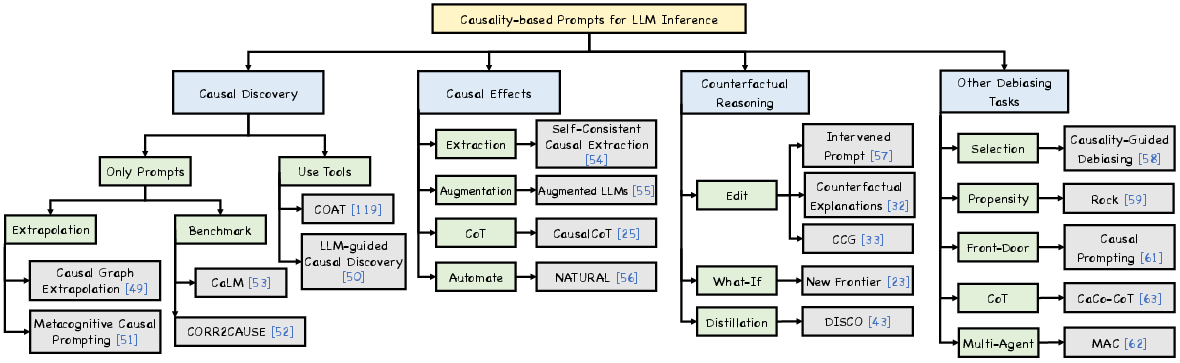
Figure 3: Categorization of Causality-based Promts for LLM Inference.

Conclusion

The research elucidates a comprehensive framework that outlines the introduction and integration of causal reasoning in LLMs, enhancing their robustness, fairness, and real-world applicability. This represents a pivotal step towards AI systems capable of more human-like reasoning and understanding, fostering advancements crucial for deploying LLMs in sensitive and complex domains such as healthcare and policy-making, where understanding causal relations is vital for ethical and accurate decision-making. Future research directions include refining causal graph integration, enhancing multiple task learning with causal information, and refining impacts on decision-making processes through advanced causal techniques.

Paper to Video (Beta)

Whiteboard

No one has generated a whiteboard explanation for this paper yet.

Open Problems

We haven't generated a list of open problems mentioned in this paper yet.

Collections

Sign up for free to add this paper to one or more collections.

Tweets

Sign up for free to view the 1 tweet with 6 likes about this paper.